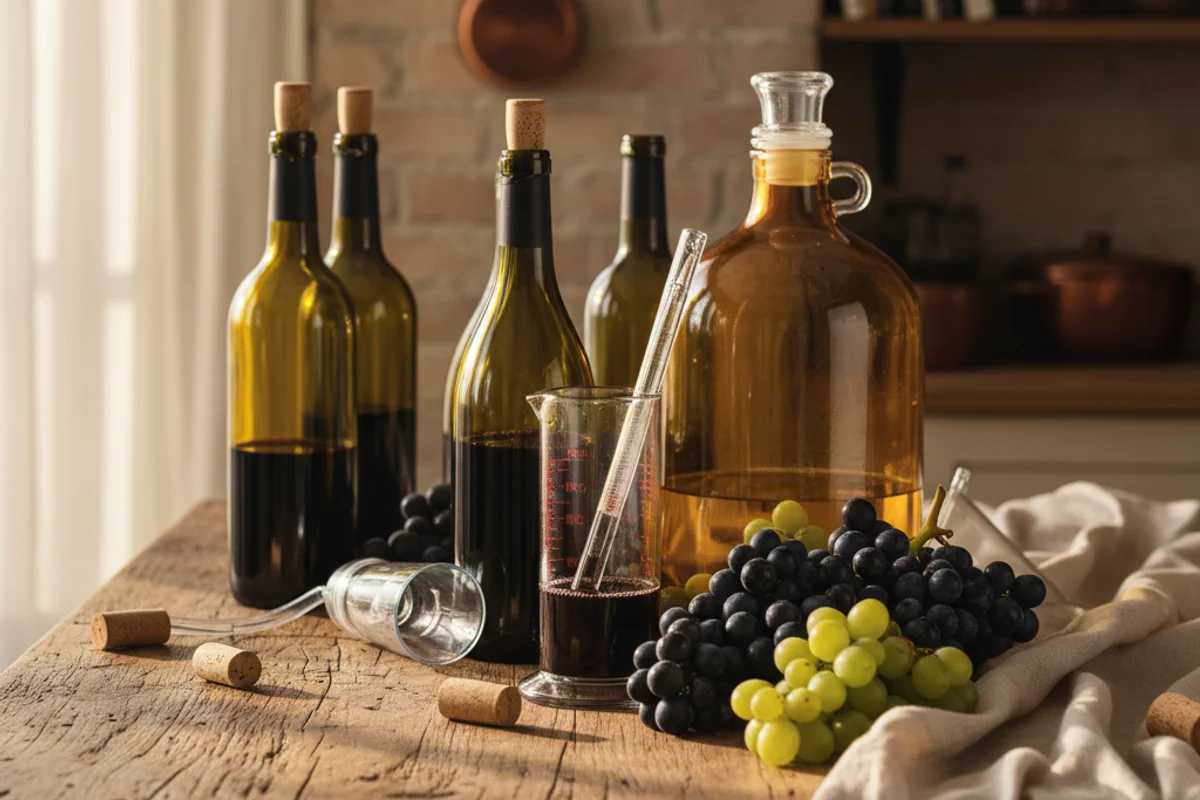
Advanced Winemaking Basics
Wine is not complicated — it’s just controlled microbiology with flavor goals. At its core, you’re feeding sugar to yeast, capturing the alcohol they produce, and coaxing a liquid into something that tastes good. The hard part isn’t the chemistry. It’s understanding why each step matters so you can make good decisions when things don’t go according to plan. This guide breaks down the foundational concepts that separate a winemaker who follows recipes blindly from one who actually understands the craft.
What Counts as Wine
Let’s settle this once and for all: wine is fermented juice. It does not have to come from grapes. Every major dictionary agrees — wine is the fermented juice of grapes or any other fruit or plant. That means strawberries, elderflowers, dandelions, apples, and even oak bark can serve as the starting point for a legitimate wine.
Grapes happen to be the gold standard because they bring everything to the party: natural sugar for yeast to eat, natural acid for balance, tannins for structure, and even wild yeast living right on the skin. No other fruit does all of that on its own. Every other base ingredient requires you to step in and fill the gaps — adjusting sugar, adding acid, supplementing tannin, or pitching a commercial yeast strain.
That’s not a limitation. It’s actually where the craft lives. Understanding what your base ingredient is missing tells you exactly what to add and why.
Know What You’re Working With — Safety First
Before you ferment anything growing in your backyard, your neighbor’s yard, or a field somewhere, stop and verify that it’s safe to consume. This is not optional.
Many flowers, leaves, and roots that look harmless are toxic. There are more toxic flowers in the world than edible ones. Some plants are safe to eat raw but produce harmful compounds when fermented. Others are fine in small amounts but dangerous in the concentrated quantities winemaking requires.
The rule is simple: if you’re not 100% certain something is non-toxic and safe to ferment, don’t use it. Check with your local agricultural extension office, a reputable botanical reference, or a food safety resource before you put anything in your fermentation vessel. One phone call can save you from a very bad outcome.
This applies especially to foraged ingredients — wild berries, roadside flowers, and decorative garden plants are common sources of nasty surprises.
The Core Winemaking Formula
Strip away all the complexity and winemaking comes down to this: combine a flavored liquid with the right balance of sugar, acid, and tannin, introduce yeast, and limit exposure to air while fermentation happens. That’s it.
Here’s what each component does:
- Sugar is yeast food. Yeast consume sugar and produce alcohol and carbon dioxide. More sugar means more potential alcohol — up to the point where the alcohol level kills the yeast.
- Acid (usually measured as titratable acidity or pH) keeps the wine tasting fresh and sharp, prevents microbial spoilage, and balances sweetness. Too little and wine tastes flat. Too much and it tastes like vinegar.
- Tannin is a polyphenol — a naturally occurring compound found in grape skins, seeds, oak, and some fruits — that gives wine its dry, slightly grippy texture. It also acts as a preservative and helps wine age well.
- Yeast is the engine. It converts sugar into alcohol through a process called fermentation. Commercial wine yeast strains are reliable, predictable, and available at most homebrew shops for a few dollars.
When any of these is off, the wine will tell you. Flat taste means low acid. Thin or flabby texture means low tannin. Stuck fermentation often means nutrient-deficient yeast. Knowing the formula helps you diagnose problems.
Extracting Flavor from Your Base Ingredient
Different ingredients give up their flavor in different ways, and choosing the right extraction method matters.
Juicy fruits like grapes, apples, and melons respond well to pressing — mechanical force that pushes juice out of the pulp. A simple potato masher and a straining bag work fine at home.
Stone fruits like peaches and plums need to be pitted first, then mashed or pressed. Citrus fruits should be juiced carefully to avoid the pith — the bitter white layer between the skin and the flesh — which will ruin the flavor if it gets into your must (the term for your pre-fermentation juice mixture).
Dense or low-juice fruits — think pears, most berries, and root vegetables — often need hot water to break down the pulp before flavor can be extracted. You pour boiling or near-boiling water over the prepared fruit, let it steep, and allow both the heat and the yeast to pull color, sugar, and flavor out of the solid material. The solids left after primary fermentation — called lees — are discarded before they can contribute off-flavors.
Herbs, flowers, and leaves are typically extracted through infusion — steeping in cold or hot water, similar to making tea. Cold infusion preserves delicate aromas and colors. Hot infusion pulls out more flavor but can mute subtle notes. Boiling is sometimes used for bark or woody material.
The method you choose affects color, aroma, and flavor intensity. Proven recipes will guide you, but understanding why a method is called for gives you the freedom to adapt.
Flavor Is a Balancing Act, Not a Volume Knob
Here’s where a lot of new winemakers go wrong: they assume more fruit equals more flavor, and more flavor equals better wine. That’s not how it works.
Wine flavor should be subtle — present and recognizable, but not a direct hit of concentrated fruit juice. A good raspberry wine doesn’t taste like biting into a raspberry. It tastes like a mellow, layered version of raspberry, with complexity that develops as you swallow. The finish — the flavor that lingers after you swallow — is where that nuance lives.
Too much base ingredient can actually destroy that balance. It can overwhelm the acid structure, push the flavor into a single harsh note, or create a wine that never fully clarifies. Most well-tested recipes are calibrated carefully. When you deviate, do it in small increments and take notes every single time.
Speaking of notes — keep a winemaking log. Write down your ingredients, amounts, dates, temperature, and observations at every stage. Wine often takes one to two years to fully develop, and your memory will not survive that timeline accurately. Your notes will.
Why This Works
Here’s the mental model that ties it all together: think of winemaking as tuning a guitar. Each string — sugar, acid, tannin, yeast health, flavor intensity — needs to be at the right tension for the instrument to sound right. Tightening one string affects how the others feel. You can play a song with a slightly out-of-tune guitar, but the more precisely each string is set, the better the music sounds.
Your job as a winemaker is not to follow a recipe perfectly. Your job is to understand what each “string” does, learn to hear when something is off, and know which adjustment to make. The recipe is just someone else’s tuning guide. Once you understand the instrument, you can write your own.