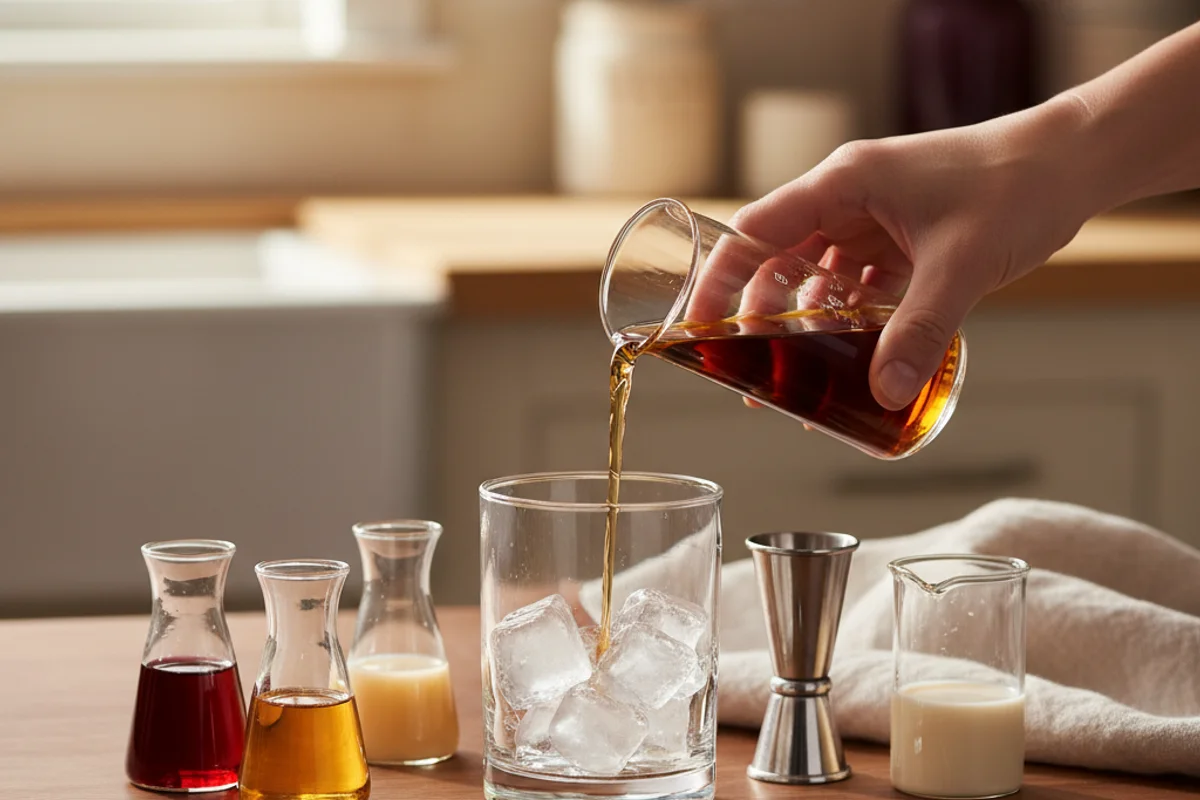
Blending to Adjust Alcohol
Alcohol level is one of the most important numbers in any wine or mead. Too low, and your wine tastes thin and doesn’t preserve well. Too high, and it tastes hot and unbalanced. The good news: if you have two wines (or a wine and a spirit) at different alcohol levels, you can blend them into a single batch that hits your target. No guesswork required — just a little math that’s been around for centuries.
What You’re Actually Trying to Do
The goal here is simple. You have a base wine — a wine with lower alcohol than you want — and a fortifier, which is anything with higher alcohol than your target. The fortifier could be a high-alcohol wine, a grape brandy, or even a neutral spirit.
You want to know: how much of each do I combine to land exactly at my target alcohol level?
For example, say your homemade fruit wine came out at 10% ABV (alcohol by volume — the standard measure of how much of a liquid is pure alcohol). You want to bottle a port-style wine at 18% ABV. You have brandy at 40% ABV. How many cups of wine do you mix with how many cups of brandy? That’s the question this whole article answers.
The Pearson Square: Old-School Tool, Timeless Logic
The Pearson Square is a visual calculation method that winemakers have used for well over a hundred years. It sounds fancy, but it’s basically a tic-tac-toe grid that uses subtraction to find ratios.
Here’s how it works:
- Draw a square. Put your target ABV in the center.
- Write the base wine ABV in the top-left corner.
- Write the fortifier ABV in the bottom-left corner.
- Subtract diagonally — always subtract the center from the corner (ignore negative signs, just use the absolute value).
- The result at the top-right is the number of parts of fortifier to use.
- The result at the bottom-right is the number of parts of base wine to use.
Let’s run the example:
- Base wine: 10% ABV (top-left)
- Target: 18% ABV (center)
- Fortifier: 40% ABV (bottom-left)
Top-right (parts of fortifier): |10 − 18| = 8 parts Bottom-right (parts of base wine): |40 − 18| = 22 parts
So for every 22 units of base wine, you add 8 units of fortifier. Those units can be anything — ounces, cups, liters — as long as you use the same unit for both.
Running the Numbers in Real Life
Let’s say you have a full gallon (128 ounces) of that 10% fruit wine and you want to turn it into an 18% port-style wine using 40% brandy.
From the Pearson Square, you need a 22:8 ratio of wine to brandy. That simplifies to about 2.75:1.
So for every 2.75 ounces of wine, you add 1 ounce of brandy.
For 128 ounces of wine: 128 ÷ 2.75 ≈ 46.5 ounces of brandy to add
Your final blend will be about 174.5 ounces total, sitting right at 18% ABV.
You can verify this roughly with a hydrometer (a simple glass instrument that measures liquid density to estimate alcohol) both before and after blending. It won’t be perfectly precise once sugar or other ingredients are involved, but it gets you close.
Important Limits to Know
The Pearson Square assumes a few things are true:
- You know the ABV of both components before you start.
- Your target ABV sits between the two components — never outside that range.
- You’re only blending two components at once.
If your base wine is 10% and your fortifier is 40%, your target must be somewhere between 10% and 40%. You can’t use this method to blend two 10% wines and get an 18% result — that’s just not how addition works.
Also worth noting: alcohol percentages are measured by volume, not by weight. Don’t mix up those two measurements or your ratios will be off.
When to Use This Technique
This method shines in a few specific situations:
Making port-style wines. Traditional port is a red wine fortified with grape brandy mid-fermentation, which stops the yeast and locks in residual sugar. Home winemakers often recreate this by fermenting a wine dry, then blending in brandy to hit 18–20% ABV.
Fixing a weak batch. If your fermentation stalled early and left you with a 9% wine when you wanted 12%, a small addition of a neutral spirit or high-proof wine can bring it up without wrecking the flavor.
Cutting an overpowering batch. If your wine came out hotter than expected — say 15% when you wanted 12% — you can blend it with a lower-alcohol wine to bring it down. The Pearson Square works in both directions.
Why This Works
Think of it like mixing paint. If you have a bucket of light gray (10% ABV) and a bucket of nearly black (40% ABV), you can blend them to hit any shade of gray in between (say, 18% ABV). The Pearson Square just tells you the exact ratio of each bucket to use.
The math underneath is a weighted average — the same kind of math used to calculate a grade point average. Each component “pulls” the final number toward itself based on how much of it you use. The Pearson Square skips the algebra and gives you the ratio directly through simple subtraction.
That’s it. No chemistry degree required. Just two numbers, a target, and a little subtraction.