Bottling Your Homemade Wine: The Final Steps That Actually Matter
You’ve watched your wine ferment, racked it a few times, and now it’s sitting there looking almost finished. Almost. Bottling feels like the finish line, but what happens in the weeks before and after you fill those bottles determines whether you end up with something you’re proud to pour — or a cork-popping mess in your storage closet. The good news: none of this requires a chemistry degree or a wine cave. It just requires understanding why each step exists.
Getting Your Wine Clear
Before a single drop goes into a bottle, your wine needs to be clear. Clarity isn’t just cosmetic — a hazy wine often signals that something is still floating around in there that shouldn’t be. Most wines will clear on their own after a few months and a couple of rackings (the process of siphoning wine off its sediment into a clean vessel). But if yours is stubborn, you have options.
The first move is pectic enzyme, which breaks down pectin — a natural substance in fruit that can cause a permanent, frustrating haze. If that doesn’t do it, you move to fining agents, which are substances that attract and clump together the particles causing the cloudiness so they sink to the bottom.
Here’s the key thing about fining agents: they work through electrical charge. Particles in your wine carry either a positive or negative charge. A good fining agent carries the opposite charge, so it attracts the problem particles and drags them down. Use the wrong one — one with the same charge — and it’ll push those particles away and make things worse.
For most home winemakers, a two-part clarifier product is the easiest solution. These products contain both a positively and negatively charged fining agent, so they cover your bases regardless of what’s causing the haze. One popular option available at homebrew shops is Super-Kleer KC, which uses kieselsol (negative charge) and chitosan (positive charge) together. Follow the package directions, wait about ten days, then rack the wine off the sediment.
Making Sure Fermentation Is Truly Done
A clear wine is not automatically a stable wine. Stability means fermentation has completely stopped and will not restart. This matters because a wine that starts fermenting again inside a sealed bottle will build up carbon dioxide gas — and that gas has to go somewhere. A popped cork is annoying. An exploded bottle is dangerous.
The simplest case: if your wine fermented completely dry (meaning all the sugar was consumed by yeast), it will stabilize on its own. You can confirm this with a hydrometer, a tool that measures sugar content by testing how dense the liquid is. A reading at or below a specific gravity of 0.990 means the wine is bone dry. Let it sit for 30 days, and you’re good.
If your wine still has residual sugar — meaning it tastes a little sweet — the yeast in there could wake back up, especially if you add more sugar later. To prevent that, you can use potassium sorbate, a common wine stabilizer sold at homebrew stores. It doesn’t kill yeast; instead, it disrupts their ability to reproduce. The yeast that are present gradually die off without replacements. Use about half a teaspoon per gallon, and always pair it with a Campden tablet (which contains potassium metabisulfite, an antioxidant and antimicrobial agent) — the two work better together than either does alone.
Dissolve both in a small cup of wine before adding them to the full batch. Stir well and look for any undissolved powder before moving on.
Sweetening Safely
Once your wine is stable, you can sweeten it if you want. Do this after stabilizing — never before. Adding sugar to an unstable wine is handing the yeast a snack and then wondering why they woke up.
The cleanest way to add sweetness is with a simple syrup: dissolve two parts sugar into one part hot water, stir until the liquid is completely clear, and let it cool. Then add it to your wine gradually — a quarter cup at a time — stirring and tasting as you go until you hit the flavor you’re after.
One important warning: don’t pour raw sugar crystals directly into finished wine. Wine absorbs carbon dioxide during fermentation, and that dissolved gas just needs a rough surface — like a sugar crystal — to come rushing out all at once. Think of it like dropping a mint into a soda bottle. Syrup avoids that problem entirely.
After sweetening, put the airlock back on and wait three to four weeks to confirm the wine isn’t trying to ferment again.
Removing Dissolved Gas
Even a wine that’s done fermenting often has carbon dioxide dissolved in it — especially if fermentation slowed down gradually rather than stopping all at once. This dissolved CO₂ can make a still wine taste fizzy or sharp when poured, which is not what you’re going for unless you’re making sparkling wine.
The fix is straightforward: stir the wine vigorously to release the gas. Use a sanitized plastic rod or a long spoon, stir hard for about a minute, then replace the airlock and let the wine rest for 30 to 45 minutes. Repeat this several times over a day or two until the wine stops releasing bubbles when you stir it. You’ll know it’s done when the wine looks calm and flat during stirring.
Aging, Bottling, and Patience
Before you bottle, give your wine time to develop in bulk. White wines benefit from at least six months in a sealed carboy (a large glass or plastic fermentation vessel). Light reds do well with nine to twelve months. Full-bodied, tannic reds may need longer. Aging rounds out harsh flavors and lets everything integrate.
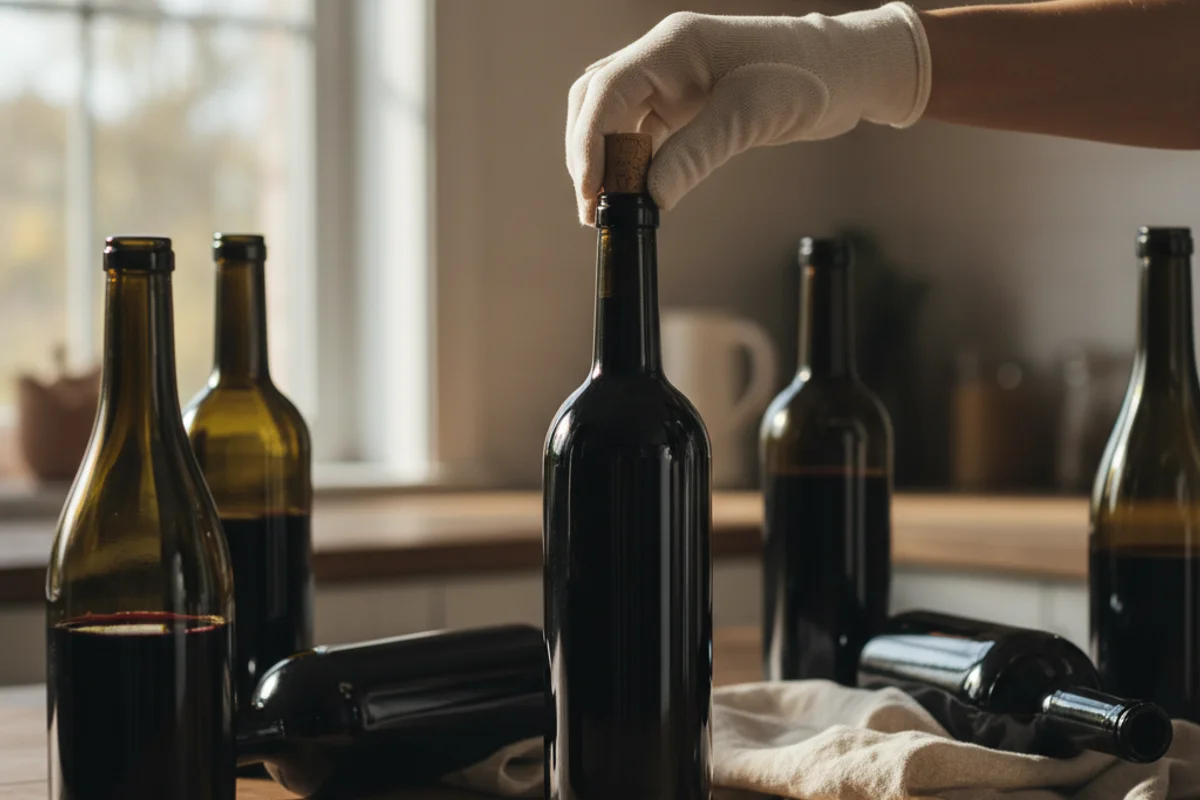
When you’re ready to bottle, siphon the wine into clean, sanitized wine bottles, leaving about an inch and three-quarters of space below the cork. Cork the bottles and stand them upright for three days — this gives the cork time to seal properly. After that, store them on their sides so the wine stays in contact with the cork, keeping it from drying out and letting air in.
Expect the wine to taste a little rough right after bottling. This is sometimes called bottle shock — the agitation of moving the wine stresses it temporarily. Give it at least two to three months in the bottle before judging it. After that rest period, you’ll be tasting what the wine actually became.
Why This Works
Think of finishing wine like resting a steak after cooking it. The heat did the main work, but that rest period lets everything redistribute and settle into something cohesive. Each step here — clearing, stabilizing, degassing, aging — is giving the wine time and conditions to become more than the sum of its parts. Skip a step, and you taste the gap. Follow the sequence, and the wine rewards your patience.