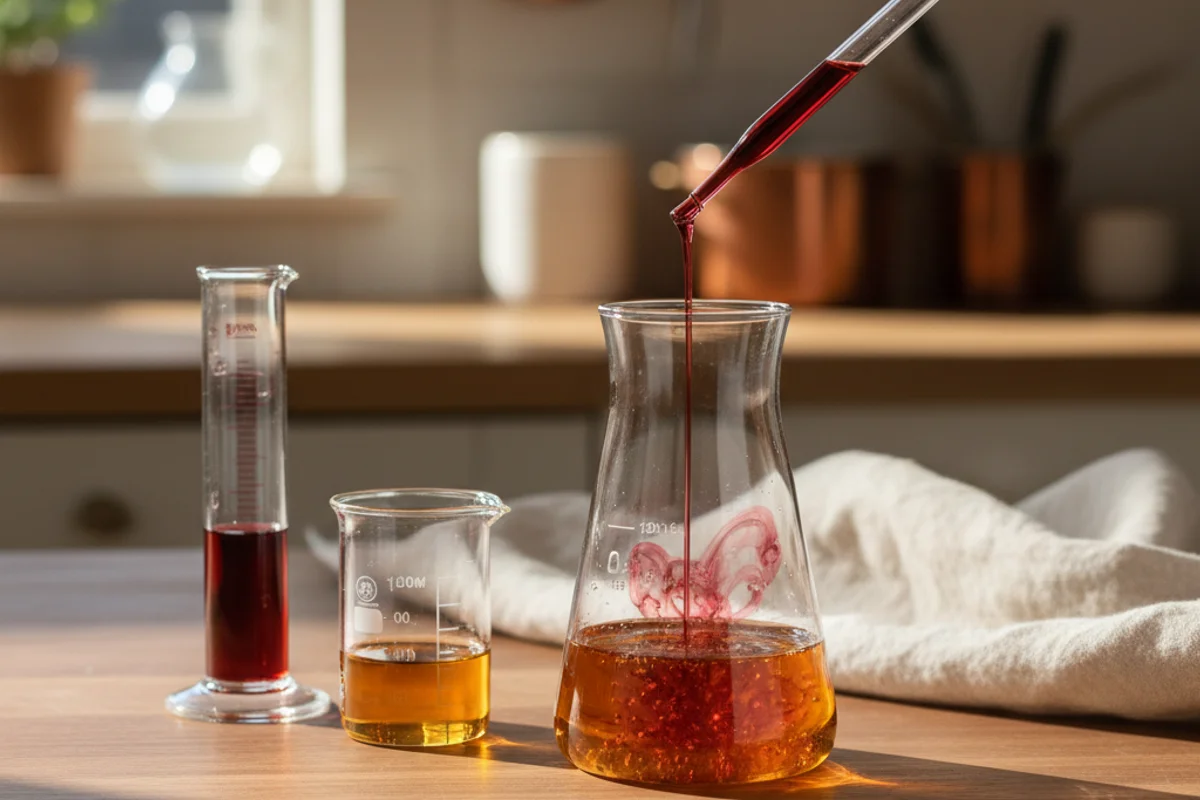
Solving Adjusted Alcohol of a Blend
Blending two wines sounds like something only a winemaker in a French château would do, but home winemakers do it all the time — combining a lighter batch with a stronger one to hit a target alcohol level. The math behind it is simpler than it looks. You don’t need a chemistry degree, just two numbers and a little arithmetic. Once you understand the logic, you’ll use it constantly.
What “Alcohol by Volume” Actually Means
Alcohol by volume, usually written as ABV, is the percentage of your wine that is pure ethanol (drinking alcohol). A wine at 12% ABV is 12% alcohol and 88% everything else — water, sugars, acids, and flavor compounds.
When you blend two wines, you’re mixing two different concentrations of alcohol into one container. The final ABV lands somewhere between the two starting percentages, pulled toward whichever wine you used more of. Think of it like mixing hot and cold water — the temperature of the result depends on how much of each you pour in.
The Two Ingredients You Need to Know
Before you calculate anything, you need four pieces of information:
- The ABV of your base wine — the lower-alcohol wine in the blend
- The ABV of your fortifier — the higher-alcohol wine or spirit you’re blending in
- The volume of your base wine (in gallons, liters, or bottles — your choice)
- The volume of your fortifier (in the same unit as above)
The one firm rule: both volumes must use the same unit of measurement. You can’t mix gallons and liters. Pick one and stick with it throughout the calculation.
The Formula
Here’s the formula that does the work:
Blended ABV = ((Volume A × ABV A) + (Volume B × ABV B)) ÷ Total Volume
Let’s walk through a real example.
Say you have 2 gallons of cherry wine at 11.6% ABV and 3 gallons of cherry wine at 15.3% ABV. You want to know what ABV you’ll get if you blend them together.
Step 1 — Multiply each wine’s volume by its ABV:
- 2 × 11.6 = 23.2
- 3 × 15.3 = 45.9
Step 2 — Add those two results together:
- 23.2 + 45.9 = 69.1
Step 3 — Divide by the total volume:
- 2 + 3 = 5 gallons total
- 69.1 ÷ 5 = 13.82% ABV
That’s your answer. The blended wine comes out at roughly 13.8% ABV.
Notice the result sits closer to 15.3% than to 11.6%. That makes sense — you used more of the stronger wine (3 gallons vs. 2), so it has more influence on the final number.
Working Backward: Hitting a Target ABV
Once you understand the formula, you can flip it around. Instead of asking “what ABV will I get?”, you can ask “how much of each wine do I need to hit a specific ABV?”
This is called a pearson square calculation (a classic blending tool used in winemaking and brewing). It’s a bit more involved, but the same basic logic applies — alcohol is conserved in a blend, so the math always balances out.
For now, the forward calculation above handles the most common situation: you already have set amounts of two wines, and you want to know what you’re working with before you bottle or serve.
Common Mistakes to Avoid
Using different units for the two volumes. Mixing gallons and liters will give you a wrong answer every time. Convert everything to one unit before you start.
Confusing ABV with specific gravity. Specific gravity (a measurement taken with a hydrometer — a glass tool that floats in liquid and reads density) tells you how much sugar is in solution. ABV tells you how much alcohol is present. They’re related, but they’re not the same number. Make sure you’re plugging in ABV values, not hydrometer readings.
Assuming the blend will taste exactly like the math predicts. The calculation gives you a precise ABV, but flavor doesn’t blend so neatly. A wine that works on paper might still need adjusting in the glass. Always taste after blending.
Why This Works
Here’s the mental model: think of each wine as a bucket of colored water. One bucket is light blue (low ABV), one is dark blue (high ABV). When you pour them together, you get a medium blue — and the exact shade depends on how much of each bucket you used.
Alcohol doesn’t disappear when you blend. It doesn’t react with anything or evaporate. It just gets diluted or concentrated based on the ratio of the two wines. That’s why simple multiplication and division are all you need. The total amount of alcohol in the final blend equals the sum of the alcohol in each starting wine — nothing more, nothing less.
That predictability is what makes blending such a powerful tool. You’re not guessing. You’re doing arithmetic.