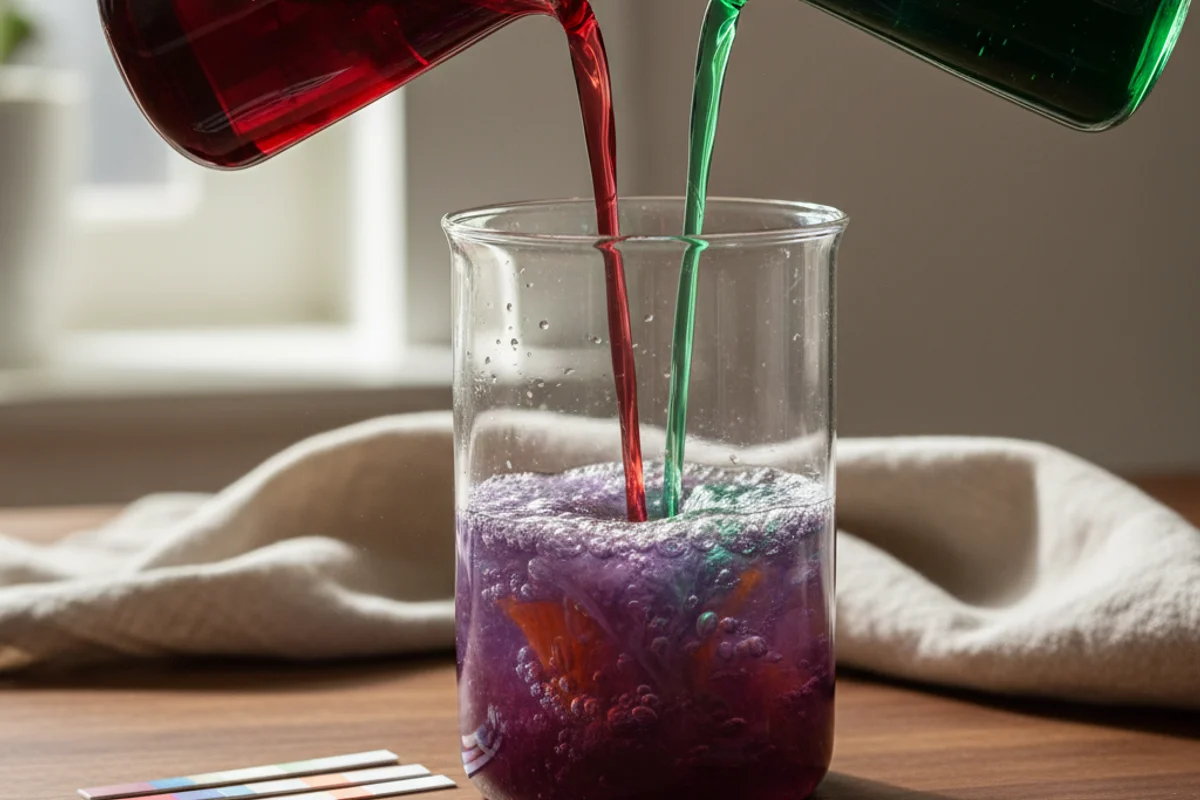
Solving pH of a Blend
pH is one of those numbers that looks intimidating until you realize it’s just a way of measuring how acidic something is. In winemaking, pH affects everything — how your wine tastes, how stable it is, and whether it’s protected against spoilage bacteria. When you blend two wines together, their pH values don’t simply average out the way temperatures do, and that surprises a lot of new winemakers. The good news is that predicting the pH of a blend is completely doable with a little math and an understanding of what’s actually happening in the bottle. Let’s break it down.
What pH Actually Measures
pH is a scale that runs from 0 to 14. Numbers below 7 are acidic, 7 is neutral (pure water), and numbers above 7 are alkaline. Most finished wines sit somewhere between 3.0 and 4.0 — firmly on the acidic side.
Here’s the part that trips people up: pH is a logarithmic scale, meaning each whole number represents a tenfold change in acidity, not a one-step jump. A wine at pH 3.0 is ten times more acidic than a wine at pH 4.0. This is exactly why you can’t just average two pH numbers together and get the right answer for a blend.
Think of it like decibels in audio. A sound at 30 dB isn’t twice as loud as 15 dB — the scale doesn’t work that way. pH works the same way.
The Math Behind the Blend
To predict the pH of a blend, you need to work in hydrogen ion concentration — the actual chemical quantity that pH is measuring. pH is defined as the negative log of that concentration. So to go backward from pH to concentration, you use this formula:
[H⁺] = 10^(−pH)
Once you have the hydrogen ion concentration for each wine, you can mix them proportionally by volume, then convert the result back to pH.
Here’s a concrete example. Say you have:
- 2 gallons of blackberry wine at pH 3.1
- 3 gallons of blackberry wine at pH 3.6
Step 1 — Convert each pH to hydrogen ion concentration:
- Wine 1: 10^(−3.1) = 0.000794 mol/L
- Wine 2: 10^(−3.6) = 0.000251 mol/L
Step 2 — Weight each concentration by its volume:
- Wine 1 contribution: 0.000794 × 2 = 0.001588
- Wine 2 contribution: 0.000251 × 3 = 0.000753
Step 3 — Add the contributions and divide by total volume:
- Total: (0.001588 + 0.000753) ÷ 5 = 0.000468 mol/L
Step 4 — Convert back to pH:
- pH = −log(0.000468) ≈ 3.33
A straight average of 3.1 and 3.6 would have given you 3.35 — close, but not exact, and the difference matters more as the pH gap between your wines grows.
What You Need Before You Start
You don’t need a lab to do this. Here’s what the process requires:
-
A pH meter — A basic digital pH meter from a homebrew shop or online costs $15–$30 and is far more reliable than pH strips for this purpose. Calibrate it with buffer solution (usually pH 4.0 and 7.0 packets) before each use.
-
Accurate volume measurements — Use the same unit for both wines. Gallons, liters, milliliters — it doesn’t matter which, as long as you’re consistent. Mixing gallons with liters will give you a wrong answer.
-
A calculator — Any smartphone calculator with a log function works. Look for the “log” button, not “ln” (that’s a different logarithm).
If your calculator doesn’t have a log button, you can use Google. Just type log(0.000468) directly into the search bar and it will return the answer.
Why This Matters for Your Wine
Getting the pH of your blend right isn’t just an academic exercise. Here’s why it’s worth doing properly:
Taste: Wines in the 3.0–3.4 range tend to taste crisper and more tart. Wines above 3.6 can taste flabby or flat. Knowing your blend’s pH before you commit lets you adjust — usually by adding a small amount of tartaric acid (the most common winemaking acid) to bring the pH down if needed.
Stability: Higher pH wines are more vulnerable to spoilage by bacteria like Lactobacillus. If your blend lands above 3.6, you may need to increase your sulfite (SO₂) additions to maintain the same level of protection.
Sulfite effectiveness: This is a big one. Sulfite works much better at lower pH values. At pH 3.0, a small dose of sulfite goes a long way. At pH 3.8, you need significantly more to achieve the same protective effect. Knowing your actual blended pH lets you dose accurately rather than guessing.
A Quick Reference: When the Simple Average Misleads You
The further apart your two wines are in pH, the more the simple average will lead you astray. Here’s a rough guide:
| pH difference between wines | Error from using simple average |
|---|---|
| Less than 0.2 | Negligible |
| 0.2 – 0.5 | Small but noticeable |
| Greater than 0.5 | Use the full calculation |
For small differences and rough planning, the average is fine. For any blend you’re actually making decisions about — acid additions, sulfite levels, cellaring timeline — run the real numbers.
Why This Works
Here’s the mental model: imagine you’re mixing two buckets of lemonade. One is really sour (lots of hydrogen ions, low pH), and one is barely tart (fewer hydrogen ions, higher pH). When you combine them, the sourness in the final bucket depends on how many sour molecules are in there total, spread across the new combined volume — not on the average of two arbitrary numbers from a scale. pH is just a compressed way of writing that ion count. To blend correctly, you uncompress it, do simple volume-weighted math, then compress it again. That’s the whole trick.