Winemaking Additives and Cleansers
Wine is essentially a chemistry experiment you drink. Every additive in your winemaking toolkit — whether it’s a nutrient, a clarifier, a sanitizer, or an acid — exists because someone figured out exactly what was going wrong and found the right molecule to fix it. That’s not scary; that’s useful knowledge. Understanding why you’re reaching for a particular product separates a winemaker who gets consistent results from one who just follows a recipe and hopes for the best. This guide breaks the major categories down so you know what each tool does and when to actually use it.
Sanitizers and Cleansers: Your First Line of Defense
Before anything touches your wine, it needs to be clean — and clean isn’t the same thing as sanitized. Cleaning removes physical debris; sanitizing kills microorganisms that could spoil your wine.
Potassium metabisulfite (often called “K-meta”) is the workhorse of the home winery. When dissolved in water, it releases sulfur dioxide (SO₂) — a gas that kills wild yeast and bacteria on contact surfaces. A solution of about one teaspoon per quart of water makes an effective rinse for carboys, airlocks, and tubing. The same compound, in tablet form, is sold as Campden tablets — one tablet per gallon of must releases around 75 ppm of SO₂. Most winemakers use half a tablet per gallon at each racking to protect wine from oxidation and microbial growth.
For equipment that’s hard to rinse — floor corkers, valve fittings, large fermenters — a no-rinse sanitizer like Star San (an acid-based blend) or iodophor (iodine-based) works well. Both need only one to two minutes of contact time and leave no flavor residue when used at the correct dilution. Star San foams, which is actually a feature — the foam clings to surfaces and keeps working.
For cleaning (not sanitizing) mineral deposits, tartrate crystals, and general grime, soda ash (sodium carbonate, sold as washing soda at most grocery stores) dissolved in warm water is inexpensive and effective. Rinse thoroughly after use.
Acids: Balancing the Backbone of Your Wine
Acidity in wine isn’t just about taste — it controls microbial stability, affects color, and influences how yeast perform. A must (the unfermented juice) that’s too low in acid will ferment sluggishly, age poorly, and taste flat. One that’s too high will taste sharp and harsh.
Tartaric acid is the primary acid in grapes and the best choice for acidifying wine. It buffers to a nice low pH, helps the wine clear more easily, and doesn’t break down during fermentation. About 3.7 grams per gallon raises titratable acidity (TA — the total measured acid content) by roughly 0.1%.
Malic acid is the dominant acid in apples and is found in most other fruits. It works fine for acidifying fruit wines but buffers to a higher pH than tartaric, which means it’s less effective at creating the acidic environment that protects wine from spoilage.
Citric acid is found in citrus fruits and small amounts in grapes. It’s metabolized by some bacteria, so most of it disappears during fermentation. It’s useful for preventing iron hazes and works as an acidulant in fruit wines, but tartaric is the better choice for pH control in grape wines.
Acid Blend — a pre-mixed combination of tartaric, malic, and citric — is convenient for fruit wine recipes that call for a generic acid addition. You can substitute equal weights of tartaric acid and get a slightly lower, more stable pH.
To reduce acidity, potassium bicarbonate is the fastest and most flexible option. About 3.4 grams per gallon drops TA by roughly 0.1%. Avoid using it if the pH is already above 3.5. Calcium carbonate (chalk) works similarly but takes months to fully precipitate out of solution and preferentially neutralizes tartaric acid first, which can affect tartrate stability.
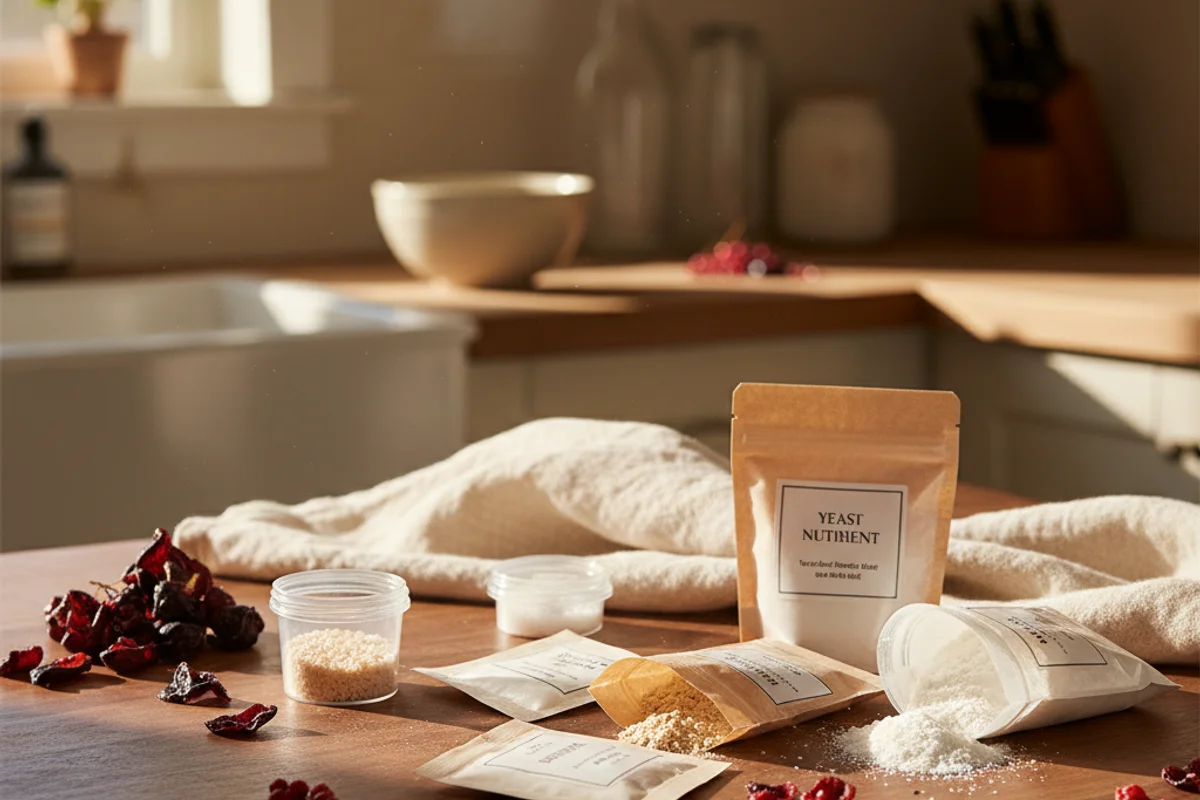
Yeast Nutrients: Feeding the Fermentation
Yeast don’t just eat sugar — they need nitrogen, vitamins, minerals, and fatty acids to stay healthy and finish fermentation without producing off-flavors. A nutrient-starved fermentation is one of the most common causes of stuck fermentation (when yeast stop before all the sugar is consumed) and hydrogen sulfide production (the rotten-egg smell).
Diammonium phosphate (DAP) is the simplest and most widely available yeast nutrient. It delivers inorganic nitrogen — the kind yeast can absorb immediately. Use about half a gram per gallon. It’s sold at homebrew shops and some winemaking supply sites. DAP alone isn’t enough for difficult fermentations; combine it with a complete nutrient.
Fermaid K is a compound formula that includes DAP, yeast hulls, vitamins (including thiamine and niacin), and trace minerals. It’s most effective when added at the one-third sugar depletion point — roughly when the Brix (a measure of sugar concentration) has dropped by 8 to 10 points. At that stage, yeast are under the most stress and need support.
Yeast hulls (also called yeast ghosts) are the empty cell walls of dead yeast. They supply lipids and sterols that live yeast need to maintain healthy cell membranes, and they adsorb fatty acids that build up and inhibit fermentation. They’re not a nutrient in the traditional sense, but they keep your active yeast in better shape.
Go-Ferm is a nutrient specifically designed for the yeast rehydration step — the point when you’re waking up dried yeast before adding it to the must. Use 1.25 grams per gram of yeast, mixed with warm water. Getting yeast off to a strong start here reduces stress and improves fermentation performance throughout.
Fining Agents: Clearing the Wine
Wine clarity isn’t just aesthetic — haze can signal protein instability or microbial activity. Fining agents (additives that cause suspended particles to clump together and settle out) work by electrical attraction: most particles in hazy wine carry a negative charge, so positively charged fining agents attract and bind them, forming clumps heavy enough to sink.
Bentonite is a type of clay (montmorillonite, if you want the technical name) with a strong negative surface charge that attracts positively charged proteins — the primary cause of heat instability in white wines. Mix 1 to 2 grams per gallon in warm water, let it hydrate for an hour or two, then stir into the wine. It settles in about a week and leaves a bulky sediment, so expect some wine loss at racking.
Gelatin (yes, the same unflavored gelatin you’d find at a grocery store) carries a positive charge and binds to negatively charged tannins — making it useful for softening overly astringent red wines. Use 1 to 2 grams per gallon for reds, dissolved in warm water. When using gelatin in white wines, add a small amount of kieselsol or tannin first to prevent a gelatin haze.
Kieselsol (colloidal silica — a silica gel suspension) carries a negative charge and pairs well with positively charged gelatin. Add kieselsol first, wait at least a day, then add gelatin. The opposite charges attract, forming large, fast-settling flocs. Many two-part commercial fining kits like Super Kleer and Claro KC are exactly this combination.
Isinglass is derived from fish swim bladders and is one of the gentlest fining agents available. It works especially well in whites and sparkling wines and doesn’t require a counter-fining agent. Pre-hydrolyzed forms (like Drifine) rehydrate in about 30 minutes instead of days.
Potassium caseinate (powdered skim milk is an acceptable substitute) is used in white wines to reduce oxidized aromas and remove brownish color. Add it while stirring vigorously — it coagulates quickly in acidic wine. Typical dose is 1 to 2 grams per gallon.
PVPP (polyvinylpolypyrrolidone — a synthetic polymer) targets the small phenolic compounds that cause browning and bitterness in whites. It settles slowly, so filtration is usually needed afterward.
Pectic Enzymes: Unlocking Juice and Clarity
Pectin (the same natural polysaccharide that thickens jam) is found in grape skins and, at much higher levels, in most other fruits. In wine, unbroken pectin forms haze and makes juice thick and difficult to press. Pectic enzymes break pectin chains apart, improving juice yield, clarity, and filterability.
Add pectic enzyme at crushing or at the start of fermentation. Most liquid forms work at a rate of 1.5 to 3 drops per gallon for grapes; fruit with high pectin content (peaches, plums) need higher doses — often triple the grape rate. Enzyme activity drops off below 50°F (10°C), so warming the must slightly speeds things up.
For red wines, specialized pectic enzymes like Crystalzyme Tinto also help extract color compounds from grape skins, improving color intensity and stability. For white wines, enzymes like Rapidase Vino Super or Crystalzyme Vinostar improve free-run juice yield and produce cleaner-tasting fermentations.
Sulfur Dioxide Management: Protecting What You’ve Built
SO₂ (sulfur dioxide) is the single most important protective additive in winemaking. It does two jobs: it kills or inhibits spoilage organisms, and it acts as an antioxidant — blocking the chemical reactions that cause wine to brown and lose freshness.
SO₂ exists in wine in two forms. Bound SO₂ has already reacted with compounds in the wine and is no longer active. Free SO₂ is what’s still doing the protective work. You manage free SO₂ levels, not total SO₂.
Potassium metabisulfite is the standard source. One gram per gallon of wine adds roughly 150 ppm total SO₂, but only about 57% of that becomes active SO₂. At racking, a half Campden tablet per gallon (about 37 ppm) is a common maintenance dose.
Potassium sorbate is sometimes confused with a sulfite, but it works differently — it prevents yeast from reproducing, not from surviving. It’s used to stabilize wines with residual sugar before bottling. Critical rule: always add potassium sorbate together with at least 40 ppm of free SO₂. Without the sulfite, malolactic bacteria can convert sorbate into a compound that smells exactly like geranium leaves — a flaw that cannot be fixed.
Why This Works
Think of your wine as a crime scene — and you’re the forensic investigator. Every problem has a cause, and every additive in your toolkit targets a specific type of evidence: proteins causing haze, acids throwing off pH balance, pectin blocking juice, or microbes threatening the fermentation. The key mental model is this: additives don’t fix bad winemaking — they support good winemaking. Start clean (sanitizers), feed your yeast properly (nutrients), protect the wine from oxygen and spoilage (SO₂), and clarify thoughtfully (fining agents). Each step builds on the last. Get that sequence right, and most of these additives become fine-tuning tools rather than emergency repairs.