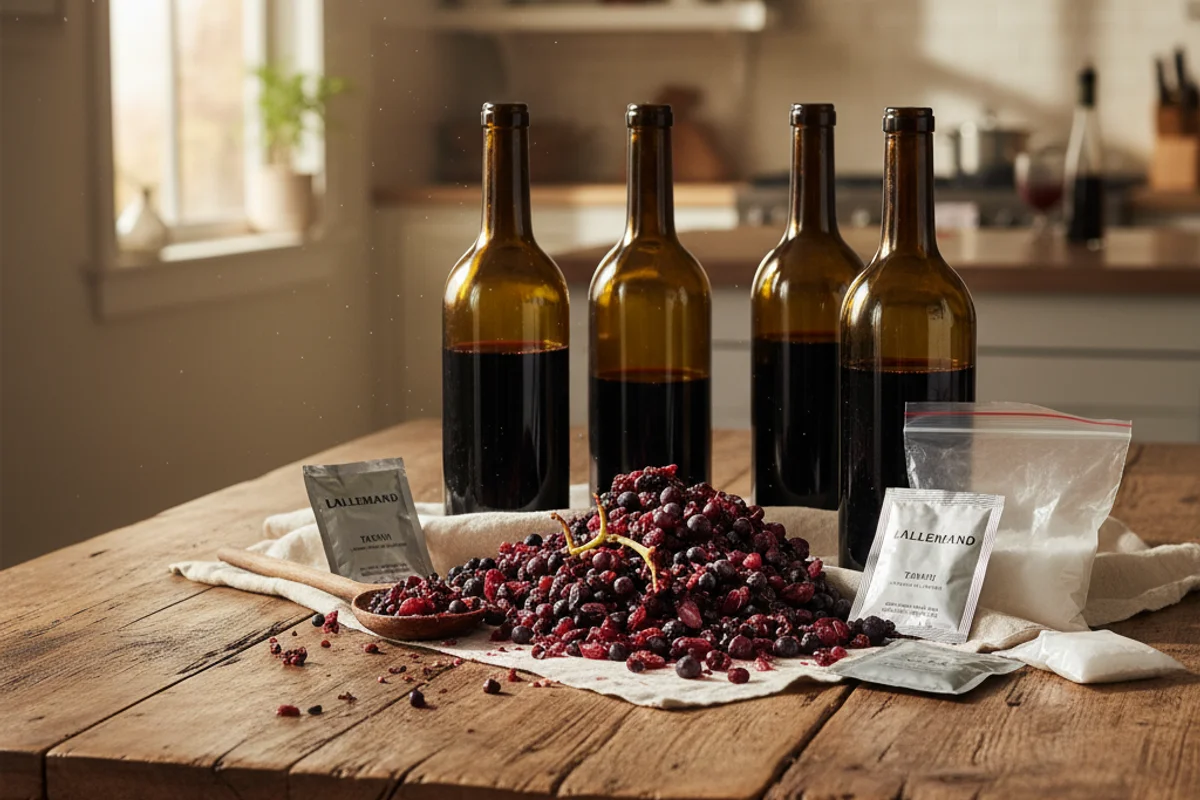
Winemaking: The Basic Steps — Additives and Ingredients
Making wine from scratch sounds intimidating until you realize it’s mostly chemistry you already understand — sweet things ferment, acid adds brightness, and oxygen is the enemy. The gap between grape juice and a decent bottle of wine comes down to a handful of ingredients working together in the right order. Get these fundamentals right, and the rest of winemaking clicks into place. This guide walks you through every major additive and ingredient you’ll encounter in a basic recipe, explains what each one does, and tells you why skipping any of them is a bad idea.
Sulfites: Your First Line of Defense
The moment you crush fruit or mix your must (the unfermented juice and pulp that becomes wine), a clock starts ticking. Bacteria, mold spores, and wild yeast are already present — on the fruit skins, in the air, on your equipment. Your first job is to slow them down.
You do that with sulfites, added as either crushed Campden tablets or powdered potassium metabisulfite. One Campden tablet per gallon, or ¼ teaspoon of potassium metabisulfite per 5 gallons, is the standard dose. This doesn’t sterilize your must — it brings it to an aseptic level, meaning low enough in microbial activity to give your cultured yeast a fair head start.
Sulfites also release sulfur dioxide gas, which fills the microscopic gaps in your liquid where oxygen atoms would otherwise sit. Oxygen reacts with wine compounds over time and eventually makes the wine undrinkable — that process is called oxidation. Sulfur dioxide pushes oxygen out and slows that degradation. It also keeps white wines from turning brown and red wines from going a muddy brick color prematurely.
Add sulfites as early as possible. You can add them to a warm must, just not a hot one. Don’t exceed the recommended dose — too much sulfite causes its own problems.
Pectic Enzyme, Acid, and Tannin: Balancing the Must
These three additives shape the flavor, texture, and structure of your finished wine.
Pectic enzyme breaks down pectin, the natural gelling agent in most fruit. Without it, pectin clouds your wine and traps flavor compounds inside the fruit pulp. Add it 8–10 hours after your sulfites — sulfur dioxide slows the enzyme’s action, so give the gas time to dissipate first. Powdered pectic enzyme is the practical choice for home winemakers: it’s shelf-stable, consistent between brands, and works well at temperatures below 75°F.
Acid blend — a mix of citric, malic, and tartaric acids in crystal form — adjusts the tartness of your must. Most fruits other than wine grapes are either too acidic or not acidic enough. Recipes will tell you how much to add, and you can add it any time before you pitch your yeast. Proper acidity isn’t just about taste; it also protects the wine during fermentation and aging.
Tannin provides structure and the slight drying sensation on your tongue. It occurs naturally in grape skins, seeds, and stems, but most fruit wines come up short. A small amount — ⅛ to ¼ teaspoon of powdered grape tannin — goes a long way. Dissolve it in a small amount of water before adding it to your must, since it doesn’t mix well if dropped directly into a large volume of liquid.
Yeast Nutrients and Sugar: Feeding the Fermentation
Yeast need more than sugar to survive — they need nitrogen and trace minerals to stay healthy through a full fermentation. That’s what yeast nutrient provides. For most fruit wines, about 1 teaspoon per gallon is enough. Don’t confuse it with yeast energizer, which is a different product used only when a fermentation stalls or slows to a crawl — and even then, only in tiny amounts (¼ teaspoon per gallon).
Sugar is the fuel that yeast convert into alcohol. Most recipes call for plain white granulated sugar (cane or beet sugar — either works). Avoid powdered sugar entirely. Use brown sugar or honey sparingly unless the recipe specifically calls for a larger quantity; honey requires about 1¼ pounds for every pound of sugar. The sugar level in your must determines your wine’s potential alcohol content, which you can measure before and after fermentation with a hydrometer.
Water and Yeast: The Foundation
Water makes up the bulk of almost every wine must. Tap water is fine if it tastes good — it contains trace minerals that actually support yeast health. Distilled water, despite sounding “pure,” is missing those minerals and can lead to a sluggish fermentation. Spring water is a solid middle ground. If your tap water smells like a swimming pool or has a strong off-flavor, use bottled spring water instead.
Wine yeast is what turns your sweetened, balanced must into wine. Wild yeast from fruit skins and kitchen air will ferment your must if given the chance — but they’re unpredictable, can produce off-flavors, and often can’t survive long enough to finish the job. Cultured wine yeast strains are bred for reliability and alcohol tolerance. Use active dry yeast (ADY) in a 5-gram packet — enough for 1 to 5 gallons. Rehydrate it in a small amount of warm water or juice before adding it to your must, and give it a couple of hours to wake up and start multiplying.
Primary Fermentation: Let It Breathe
Once you’ve added all your ingredients and pitched your yeast, you’re in primary fermentation — the wild, active phase that lasts 3 to 10 days. This happens in an open-top container called a primary fermenter, not a sealed carboy.
Here’s why: yeast need oxygen during the first 48–72 hours to reproduce rapidly. A sealed container would starve them of that oxygen and slow the whole process down. Cover the fermenter with a clean, tightly woven cloth — muslin works well — secured with a rubber band. This keeps debris and insects out while letting air in. If your fermenter has a rigid lid with an airlock hole, plug that hole with a cotton ball for the first few days, then swap in an airlock once fermentation is roaring.
Keep the fermenter in a spot that stays between 70–75°F. Too cold and the yeast go dormant. Too hot and you risk killing them or producing off-flavors.
Why This Works
Here’s the mental model: think of your must as a construction site and yeast as the crew. Sulfites clear the site of trespassers. Nutrients and water stock the break room. Sugar is the building material. Acid and tannin are the blueprints for structure. Pectic enzyme is the demolition crew prepping raw materials so the builders can actually use them.
Yeast don’t care about your end goal — they just eat sugar and make alcohol as a byproduct. Your job as the winemaker is to create conditions where that process runs clean, fast, and complete. Every ingredient in a recipe exists to support that single chain of events. Once you see it that way, the additives stop looking like a confusing shopping list and start looking like a logical system — because that’s exactly what they are.