MUSTANG GRAPE WINE (Sweet, Red) [4]
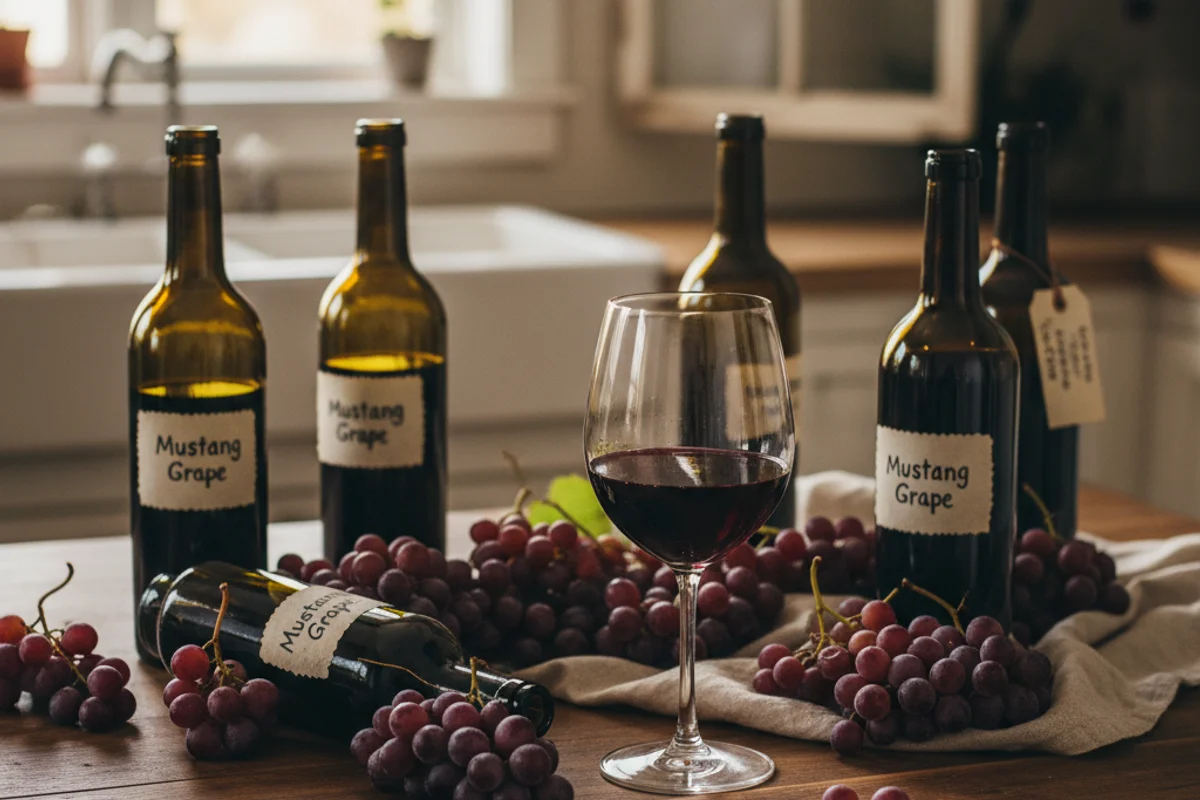
If you’ve ever bitten into a wild Mustang grape straight off the vine in a Texas summer, you know the experience: a deep, almost aggressive purple-red juice, sky-high acidity, and a feral, musky punch that commercial grapes simply don’t have. Tamed with sugar and time, that wildness becomes something genuinely special — a bold, sweet red with a personality all its own. This is not a subtle wine. It’s the kind that makes you stop mid-sip and ask, “What is that?” in the best possible way.
The beginner trap: Mustang grapes are notoriously high in acid, and skipping the step of measuring and adjusting acidity down to around 7 parts per thousand (ppt) tartaric will leave you with a wine so mouth-puckering it’s nearly undrinkable.
Ingredients
- 10 lbs. (roughly 1 gallon) black Mustang grapes, fresh or frozen
- 2¼ lbs. granulated white sugar, divided
- ½ gallon water, plus 1 cup for cooking
- 1 tsp. pectic enzyme (available at homebrew shops or online)
- 1 packet Champagne or Montrachet wine yeast (dry wine yeast works as an everyday substitute)
- 1 tsp. yeast nutrient (available at homebrew shops)
- Acid test kit (for measuring and adjusting tartaric acid levels)
Method
- Remove all stems and rinse the grapes thoroughly under cold water.
- Place the grapes in a large pot with 1 cup of water, cover, and heat over low to medium heat, stirring every 10 minutes with a wooden spoon until the grapes burst and release their juice.
- Remove from heat and allow the grape mash to cool to room temperature (tepid, not hot).
- Meanwhile, bring ½ gallon of water to a boil, pour it over the sugar in your primary fermentation vessel (a food-safe crock or bucket), and stir until the sugar fully dissolves. Set aside half of this sugar-water in a sealed quart jar for later use.
- Pour the cooled grape juice and pulp into a nylon straining bag (a mesh paint strainer bag from a hardware store works fine) over the crock; tie the bag closed and leave it sitting in the juice.
- Stir in the yeast nutrient and pectic enzyme, cover the crock loosely, and leave it undisturbed for 10–12 hours.
- Add the yeast, re-cover, and push the bag fully under the juice twice per day for 7 days using your wooden spoon.
- After 7 days, lift and press the bag firmly to squeeze out as much juice as possible, then remove and discard the pulp.
- Test the acidity of the juice with your acid test kit and adjust downward to approximately 7 ppt tartaric acid if needed (potassium bicarbonate, available at homebrew shops, will lower acid; add it gradually and retest).
- Transfer the wine to a secondary fermentation vessel (a glass carboy or food-safe jug), top up with the reserved sugar-water, fit an airlock, and let it sit for three weeks.
- Rack the wine (siphon it off the sediment into a clean vessel), top up with any remaining sugar-water, and rack again after another three weeks.
- Set the wine aside for two more months, then rack once more and allow it to clear.
- Wait one month; if sediment is still settling, wait another month before proceeding.
- Stabilize the wine to a final specific gravity between 1.000 and 1.008 (using potassium sorbate and potassium metabisulfite per package directions), then wait 10 days for remaining yeast to settle out.
- Rack one final time and bottle once the wine runs clear. It’s drinkable young but improves noticeably with 6–12 months of additional aging.
Why this works
Mustang grapes carry an exceptionally high natural acid load — mostly tartaric and malic acid — which is why acid adjustment isn’t optional here, it’s the whole game. The pectic enzyme is equally important: grape skins are rich in pectin, and without an enzyme to break it down, you’ll end up with a hazy wine that refuses to clear no matter how long you wait. Heating the grapes gently before fermentation breaks down cell walls and releases pigment and flavor compounds locked inside the skins, giving you that deep red color. The two-stage sugar addition keeps the yeast from being overwhelmed by too much sugar at once, encouraging a cleaner, more complete fermentation.
Notes
Frozen Mustang grapes work excellently here — freezing ruptures the cell walls, so you may get juice release even faster during the heating step. If you can’t source Mustang grapes locally, this method adapts well to other high-acid wild grapes like Concord or Fox grapes (adjust acid to taste). If the finished wine is still too bold on its own, blending it with a lighter, thin red can stretch a batch beautifully without losing the Mustang character.