RASPBERRY-CHIPOTLE WINE
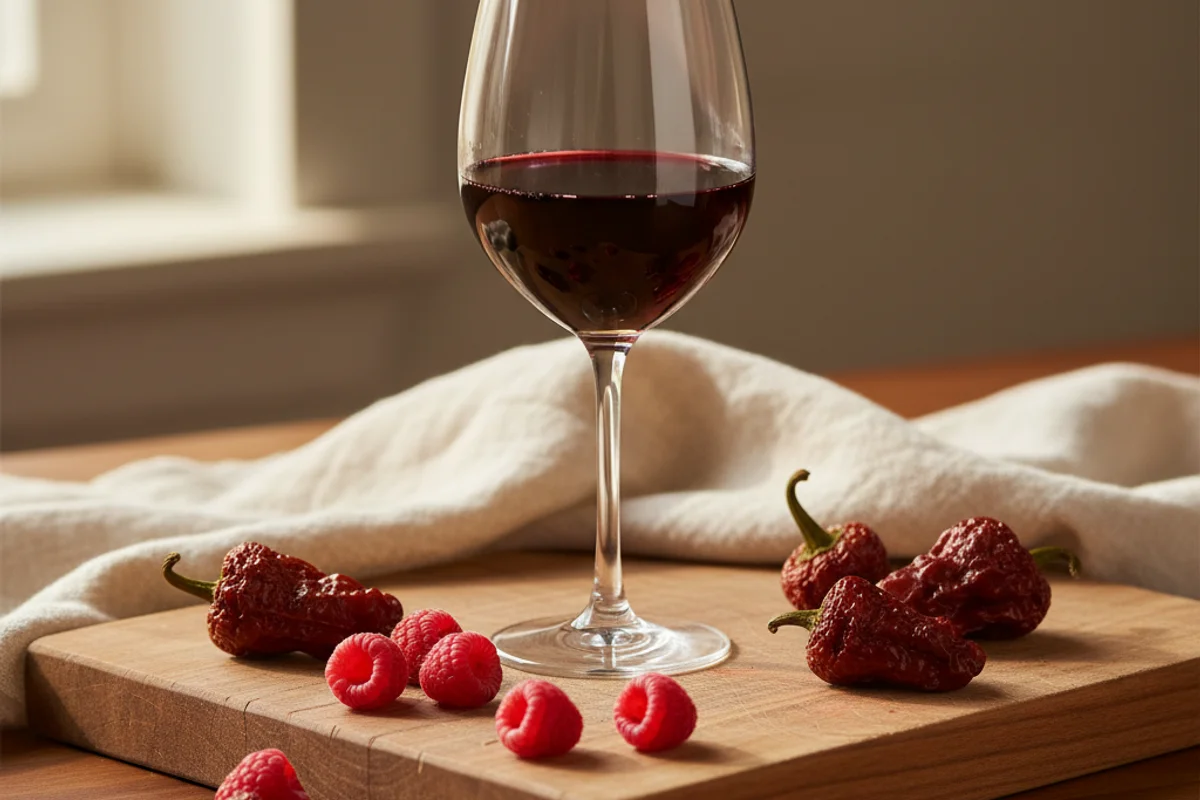
Think of this wine as a Texas Hill Country barbecue sauce in a bottle — without the bottle being a sauce bottle. Ripe red raspberries bring bright fruit and natural acidity. Dried chipotle peppers (smoke-dried jalapeños, for the uninitiated) bring a slow, woody heat and a campfire backbone. Together they create something that shouldn’t work but absolutely does: a wine that opens fruity and sweet, then finishes with a gentle smokiness that lingers just long enough to make you reach for another glass.
The beginner trap: Using canned chipotles in adobo sauce instead of dried chipotles — the oil and vinegar in the can will wreck your fermentation and throw off the flavor entirely.
Ingredients
- 2 lbs red raspberries, fresh or frozen
- 6–8 dried chipotle peppers, coarsely chopped (find these in the Latin foods aisle or dried spice section)
- 1¾ lbs granulated white sugar
- 1¼ tsp acid blend
- ½ tsp pectic enzyme
- 1 Campden tablet, crushed
- ¼ to ½ tsp wine tannin (or 1 cup strong unsweetened black tea as a substitute)
- 7 pints (3.5 quarts) water
- 1¼ tsp yeast nutrient
- 1 packet Champagne wine yeast (EC-1118 or equivalent)
Method
- If using fresh raspberries, wash and remove any stems. Place the chopped chipotles in a jelly bag (or a doubled layer of cheesecloth tied shut), and place it in your primary fermenter.
- Put the raspberries in a nylon straining bag, tie it closed, and crush the berries by hand over the primary fermenter. Drop the bag in.
- Add the sugar, acid blend, pectic enzyme, crushed Campden tablet, tannin, and yeast nutrient to the primary.
- Bring the water to a boil, pour it over all the ingredients, and stir until the sugar fully dissolves.
- Cover the primary loosely with plastic wrap and let it cool to 70–75°F before doing anything else.
- Once cooled, add the yeast, re-cover, and stir the must once daily until the specific gravity (SG) drops to 1.020 or lower — this typically takes 5–7 days.
- Lift out the raspberry bag and let it drip-drain over the fermenter for 30–45 minutes. Do not squeeze it — pressing forces bitter solids into your wine.
- Siphon the liquid off the sediment into your secondary fermenter (a glass carboy works well). Transfer the chipotle jelly bag into the secondary as well. Top up with water if needed, fit an airlock, and move to a cool, dark spot (60–65°F).
- After 3 weeks, pull out the chipotle bag, give it a gentle squeeze to extract the last of the flavor, and discard its contents. Rack the wine, top up, and refit the airlock.
- Rack again after 3 months, adding a second crushed and dissolved Campden tablet to protect the wine.
- Rack one final time 3 months later. When the wine is clear and stable, bottle it, store it away from light, and age for at least 6 months before opening.
Why this works
Capsaicin — the compound that makes jalapeños hot — is oil-soluble, not water-soluble. That means only a fraction of the pepper’s heat transfers into your water-based wine. What transfers more freely are the smoky phenolic compounds created during the drying process, along with mild pepper flavor. The result is warmth and smoke rather than a five-alarm burn. Keeping the chipotles in a bag (rather than loose in the must) also gives you control: pull the bag early for subtle heat, leave it the full three weeks for a more pronounced finish. Meanwhile, raspberry’s high natural pectin content is why pectic enzyme is non-negotiable here — skip it and you’ll end up with a hazy wine that refuses to clear.
Notes
Frozen raspberries work just as well as fresh and are often more consistent in flavor year-round — thaw them completely before use. If dried chipotles are hard to find locally, check a Latin grocery or order online; do not substitute chipotle powder, as controlling the quantity becomes very difficult. Start with 6 dried peppers if you prefer mild smokiness, and go up to 8 if you want more presence.