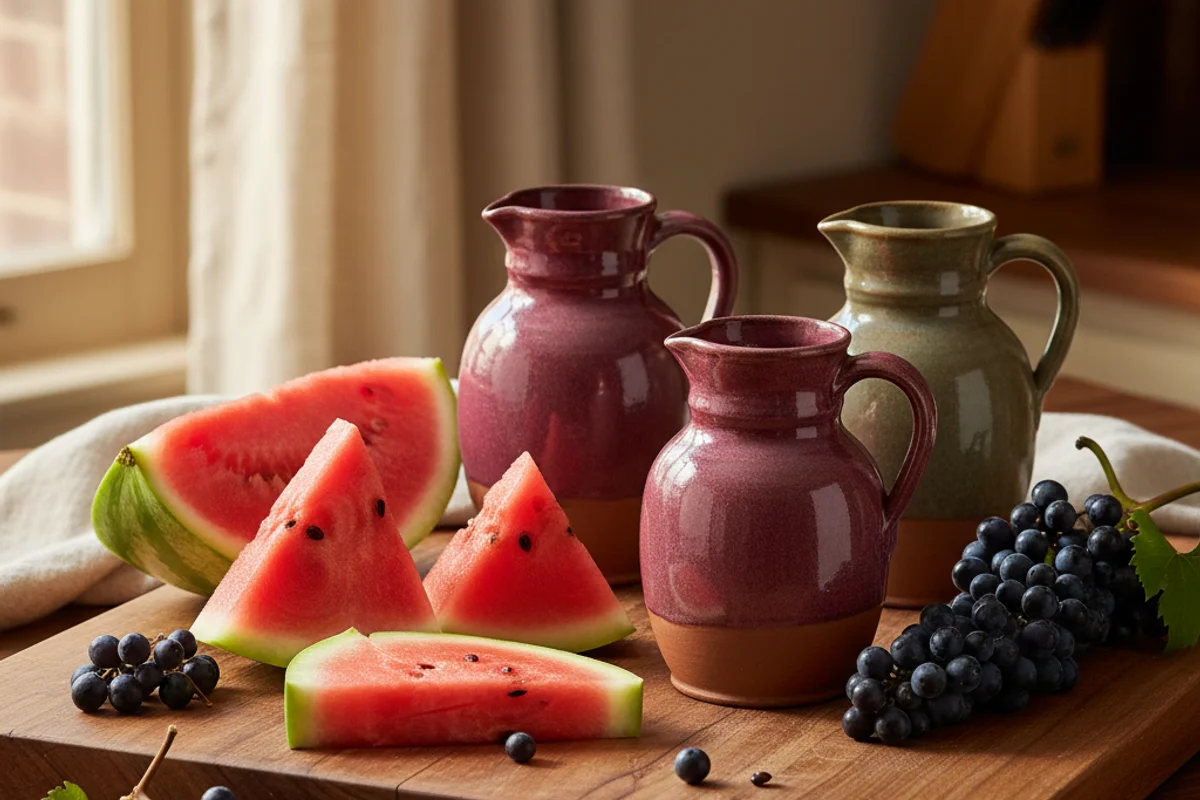
Watermelon-Mustang Grape Wine (makes 3 gallons)
Watermelon alone makes a thin, pale wine — pleasant, but forgettable. Mustang grapes fix that. These wild Texas natives bring fierce acidity, deep color, and enough tannin structure to give the whole thing a backbone. What you end up with is something genuinely surprising: the bright, summery sweetness of watermelon anchored by the grip of wild grape. It finishes dry-ish, it ages, and it earns a place on the table. This is a wine that started as a skeptic’s experiment and became a convert’s favorite.
The beginner trap: Mustang grape seeds are bitter and high in harsh tannins — crack even a few of them during crushing and the wine will be unpleasantly astringent, so crush or chop gently and by hand.
Ingredients
- 2–3 large watermelons (enough to yield roughly 2¾ gallons of juice)
- 10–12 lb Mustang grapes (wild or foraged; Concord grapes are the closest grocery-store substitute)
- Up to 6 lb granulated white sugar
- 2 tsp pectic enzyme (found at homebrew shops or online)
- 2 Campden tablets, crushed (potassium metabisulfite powder works too — use ¼ tsp)
- 3 tsp yeast nutrient
- 1 packet Montrachet or Pasteur Red wine yeast (Red Star and Lalvin both sell these widely)
Method
- Cut the watermelon flesh into chunks, remove the loose seeds, and load it into a nylon straining bag. Squeeze the bag firmly over a large pot or bucket until you’ve extracted as much juice as possible — discard the pulp.
- Measure your watermelon juice. You need 2 gallons plus 1 quart for the primary; refrigerate any extra in a sealed container for later topping up.
- Remove the stems from the grapes, rinse them well, then gently crush or coarsely chop them by hand. Work slowly and deliberately — do not break the seeds.
- Add the crushed grapes and any juice they release into your primary fermenter, then pour in the 2 gallons plus 1 quart of watermelon juice.
- Check the specific gravity with a hydrometer. Add sugar gradually, stirring well after each addition, until you hit a reading of at least 1.095.
- Stir in the crushed Campden tablets, cover the fermenter loosely with a clean cloth, and leave it alone for 12 hours.
- Add the pectic enzyme and yeast nutrient, stir, and wait another 12 hours.
- Sprinkle in the wine yeast, cover again, and ferment at room temperature for 7–8 days. Stir daily and push the floating grape cap back down into the liquid each time.
- Strain the fermenting wine through a clean nylon straining bag into your secondary fermenter (a 3-gallon carboy). Squeeze the bag firmly to pull out every drop of grape juice.
- Fit an airlock. Once active bubbling slows down — usually 5–7 days — top up the carboy with your reserved watermelon juice from the fridge. Let it ferment for 30 days.
- Rack the wine off its sediment into a clean carboy, top up again, refit the airlock, and wait another 30 days.
- After an additional 4–6 months, rack the cleared wine into bottles. Age in the bottle for at least 3–6 months before opening.
Why this works
Watermelon juice is mostly water and sugar with very little acid or tannin — on its own, it ferments into something thin and hard to stabilize. Mustang grapes solve all three problems at once. Their skin pigments (anthocyanins) contribute color and antioxidant stability. Their naturally high tartaric and malic acid content drops the pH into a range where spoilage organisms struggle. Their tannins give the wine enough structure to actually age. The two-stage sulfite-and-enzyme treatment handles the rest: the Campden tablets knock out wild yeast and bacteria on day one, and the pectic enzyme breaks down fruit pectins that would otherwise leave the finished wine hazy and dull.
Notes
If Mustang grapes aren’t available in your area, Concord grapes (widely sold fresh in fall, or frozen year-round) are a solid substitute — expect a slightly less tannic, more jammy result. Frozen seedless watermelon chunks can replace fresh; thaw them completely and squeeze out the juice as you would fresh flesh. If your finished wine tastes sharply acidic after aging, a small addition of potassium bicarbonate (¼ tsp at a time, tasted after each addition) can bring it into balance.