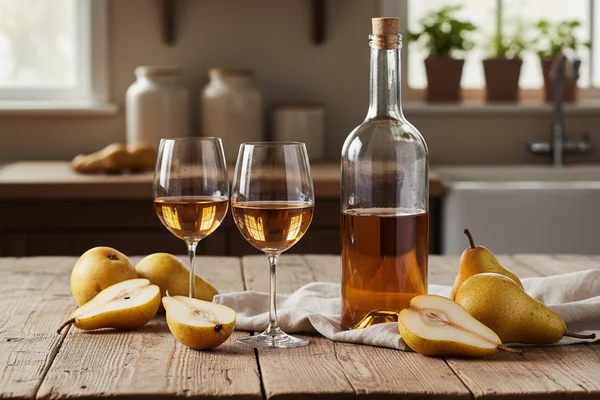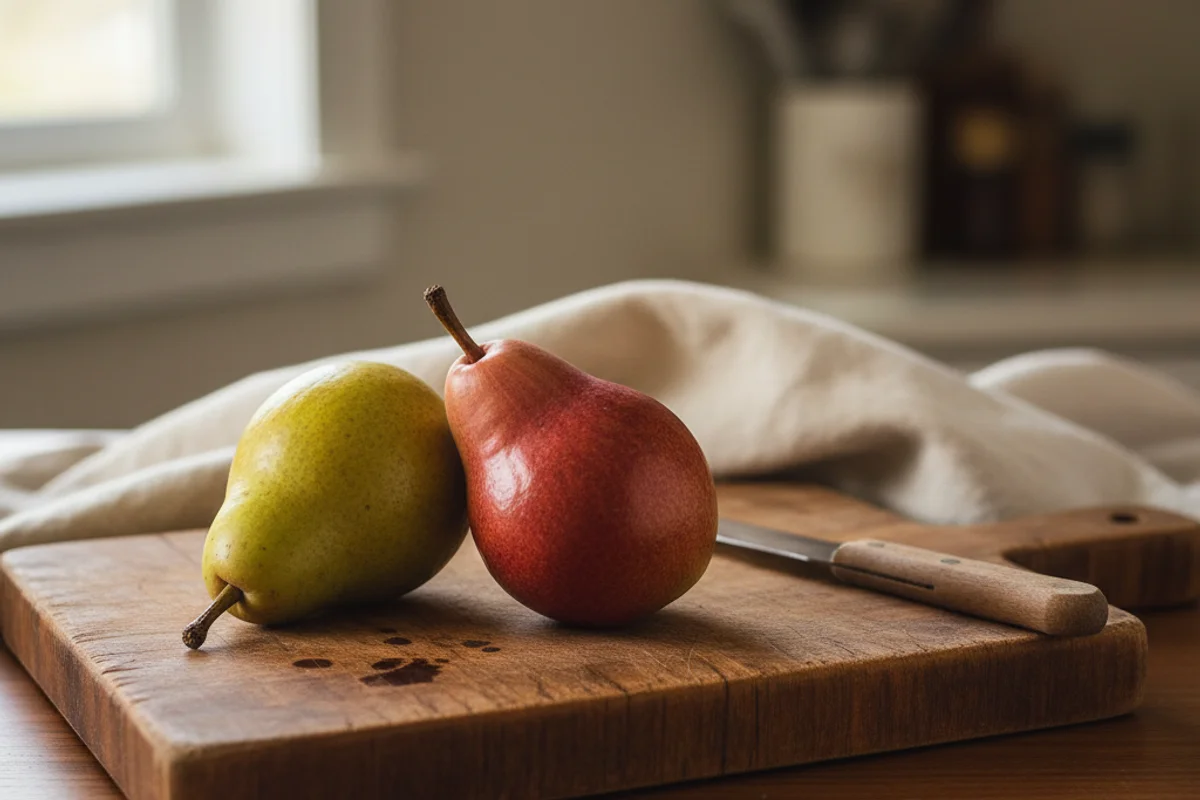
Anjou and Flemish Beauty Pears
Pears are the quiet overachievers of the fruit wine world. They bring a soft, honeyed sweetness with just enough floral lift to keep things interesting — but they’re also subtle enough that lazy winemaking will leave you with something that tastes like slightly fermented water. Anjou pears, in particular, need time to ripen off the tree before their flavor really opens up. Give them that time, and you get something genuinely worth bottling. These two recipes cover both ends of the spectrum: a lean, dry version built for the kitchen, and a richer, back-sweetened sipper with golden raisins adding body and depth.
The beginner trap: Skipping the full ripening window on the pears — freshly picked Anjous have almost no flavor, so buy store pears that are soft and fragrant, or let firm ones sit at room temperature until they yield slightly at the stem end.
Ingredients
Recipe 1 — Dry Pear Wine (cooking or light sipping)
- 4 lbs ripe Anjou pears (or Bartlett/d’Anjou from the grocery store), washed, cored, and roughly chopped
- 2 lbs granulated white sugar
- 3½ quarts water, or enough to reach 1 gallon total volume
- 2 tsp acid blend (find it at a homebrew shop, or use 1½ tsp lemon juice as a rough substitute)
- ½ tsp pectic enzyme
- ¼ tsp grape tannin (or 1 cooled cup of strong plain black tea)
- 1 Campden tablet, crushed
- 1 tsp yeast nutrient
- 1 packet Champagne yeast (Red Star or Lalvin EC-1118 both work)
Recipe 2 — Sweet Pear Wine (back-sweetened sipping wine)
- 4 lbs ripe Anjou pears, washed, cored, and roughly chopped
- ½ lb golden raisins, chopped (adds body and a hint of dried-fruit richness)
- 2 lbs granulated white sugar, plus 2–4 oz reserved for back-sweetening
- 3½ quarts water, or enough to reach 1 gallon total volume
- 2 tsp acid blend
- ½ tsp pectic enzyme
- ¼ tsp grape tannin (or 1 cup cooled strong black tea)
- 1 Campden tablet, crushed
- 1 tsp yeast nutrient
- 1 packet Champagne yeast
Method
- Bring the water to a boil and dissolve the sugar completely, then set aside briefly.
- Core the pears and remove all seeds — pear seeds contain trace amounts of cyanogenic compounds and should not go into the must.
- Roughly chop the pears and load them (plus raisins, if making Recipe 2) into a nylon straining bag; tie it closed and place it in your sanitized primary fermenter.
- Use a potato masher or the back of a large spoon to crush the fruit inside the bag, then pour the hot sugar water over the pulp.
- Stir in the crushed Campden tablet, acid blend, grape tannin, and yeast nutrient; cover the fermenter with a clean cloth and let it sit for 12 hours.
- Add the pectic enzyme and wait another 12 hours before pitching the yeast.
- Sprinkle the yeast over the must, re-cover with cloth, and stir once daily for 7 days, gently squeezing the bag each time to pull flavor from the fruit.
- After 7 days, lift out the bag and let it drip-drain over the fermenter for at least one hour — do not squeeze it dry, or you’ll invite harsh, bitter tannins into the wine.
- Let the drained juice settle in the primary for 24 hours, then siphon it into a sanitized glass secondary (1-gallon jug works well) and fit an airlock.
- Rack after two weeks, top up with a little water or plain pear juice to minimize headspace, and refit the airlock.
- Rack again every two months until the wine runs clear — at least twice total.
For Recipe 1 only: Rack one final time, bottle, and age 6–12 months. Serve dry as a cooking wine, or stir ½–¾ tsp honey into a glass for a light, off-dry sip.
For Recipe 2 only: After the wine clears, stabilize with ½ tsp potassium sorbate plus a fresh Campden tablet, wait 10 days, then dissolve 2–4 oz sugar in a splash of warm water and stir it in to taste. Bottle and age 6–12 months; serve chilled.
Why this works
Pears are low in natural tannin and acid, which means without help they ferment into a flat, one-dimensional wine. The acid blend corrects the pH to a range where yeast thrives and where the finished wine tastes alive on your tongue. The pectic enzyme is doing heavy lifting here too: pears are loaded with pectin, the same stuff that makes jam gel, and without an enzyme to break it down, your wine will stay stubbornly hazy no matter how long you wait. Adding it after the Campden tablet has dissipated (give it 12 hours) keeps the sulfite from knocking the enzyme out before it can work. The raisins in Recipe 2 add not just sugar but unfermentable solids that give the finished wine weight and a slightly more complex dried-fruit character — a low-tech body builder that’s been in country wine recipes for generations.
Notes
If Anjou pears aren’t available, Bartlett (Williams) pears are an excellent substitute and are easier to find ripe at most grocery stores. Frozen pear chunks can work in a pinch — thaw them completely and skip the mashing step, as freezing already breaks down the cell walls. Acid blend is available at any homebrew retailer; if you use lemon juice instead, add it a little at a time and taste as you go, since lemon also adds flavor that acid blend does not.