Pear Wine
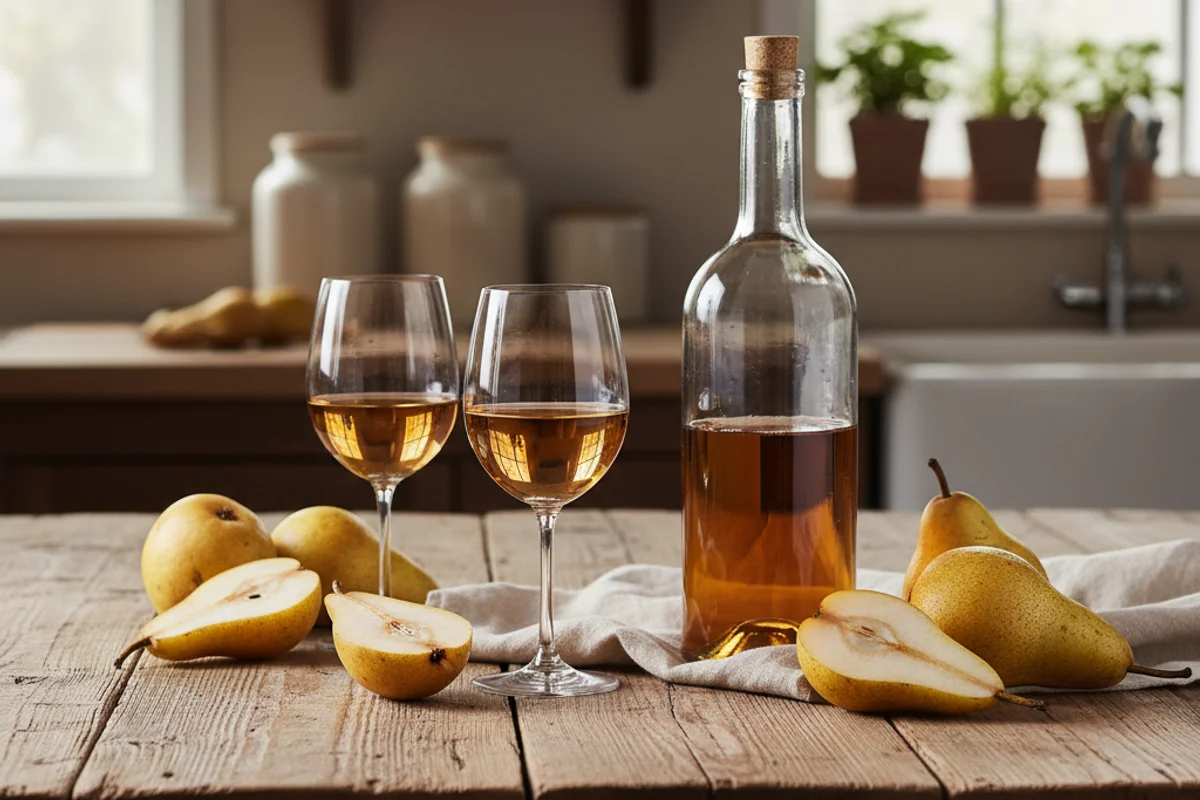
Pears are the quiet overachievers of the fruit wine world. They bring a soft, honeyed sweetness, a floral nose that borders on perfume, and just enough delicacy to keep things interesting. The catch? That gentleness cuts both ways — pear wine can taste flat and watery if you don’t pay attention to acid and tannin. Get those two things right, and you’ll have a wine that’s light, crisp, and surprisingly complex. Aim to keep alcohol under 12% and let the fruit do the talking.
The beginner trap: Squeezing the fruit bag at the end of primary fermentation is tempting but will flood your wine with pectin haze that’s nearly impossible to clear.
Ingredients
- 4–6 lbs ripe pears, fresh or frozen (thawed)
- 1/2 lb golden raisins, finely chopped (sultanas work too)
- 1-3/4 lbs granulated white sugar, plus extra to hit target gravity
- 3-1/4 quarts water, more or less
- 1-1/2 tsp acid blend (find it at any homebrew shop)
- 1/2 tsp pectic enzyme
- 1/8 tsp grape tannin (or 1/4 cup unsweetened strong-brewed black tea as a substitute)
- 1 Campden tablet, crushed
- 1 tsp yeast nutrient
- 1/8 tsp powdered ascorbic acid (vitamin C), optional — for browning-prone pears
- 1 packet Champagne yeast (Lalvin EC-1118 is a solid grocery-store-adjacent option)
Method
- Cut one pear in half, set both halves cut-side up, and wait 15 minutes. If the flesh turns slightly brown, add 1/16 tsp ascorbic acid to your ingredient list; if it turns very brown, use 1/8 tsp.
- Bring the water to a boil and dissolve the sugar completely into it. Set aside.
- Wash, stem, core, and seed the pears — every seed must go. Chop them roughly and place them in a sanitized nylon mesh straining bag along with the chopped raisins.
- Tie the bag closed and place it in your sanitized primary fermenter. Mash the fruit through the bag using a potato masher or the bottom of a sanitized bottle.
- Pour the hot sugar water over the bag. Drape a clean cloth over the fermenter and secure it with a rubber band.
- After one hour, add the ascorbic acid (if using), crushed Campden tablet, acid blend, grape tannin, and yeast nutrient. Stir well, cover, and wait 12 hours.
- Add the pectic enzyme, re-cover, and wait another 12 hours.
- Pull out enough juice to float your hydrometer and check the specific gravity. Add sugar as needed to reach 1.080–1.085, then return the juice to the fermenter.
- Prepare a yeast starter at least 2 hours ahead (6–8 hours is better), then add the activated yeast to the must. Cover again with cloth.
- Stir once daily and gently squeeze the bag to coax out flavor. After about 7 days, when active bubbling slows down, lift out the bag and let it drip drain for a full hour — do not squeeze it.
- Taste the juice. You should clearly sense both acid and tannin. If either feels weak, stir in an extra 1/2 tsp acid blend or 1/8 tsp tannin.
- Let the must settle for 24 hours, then siphon it into a glass secondary fermenter. Top up to within one inch of the bung and fit an airlock.
- Rack after 2–3 weeks, top up, and refit the airlock. Rack again every two months until the wine runs clear.
- Once clear, wait 30 days and check the bottom of the vessel for any sediment — even a fine dust means you wait another 30 days and rack again. Repeat until 30 days pass with zero sediment.
- Stabilize the clear wine by stirring in 1/2 tsp potassium sorbate and one freshly crushed Campden tablet dissolved in a splash of wine.
- Pull out one cup of the wine, dissolve 1/2 cup (1/4 lb) of sugar into it, and stir it back into the batch. Refit the airlock and wait 20–30 days to confirm fermentation doesn’t restart.
- If all is quiet, rack into bottles and age 6–12 months before opening.
Why this works
Pears are naturally low in tannin and can be unpredictable in acid levels, which is why this recipe leans on raisins and acid blend. Raisins contribute body, a small tannin boost, and extra fermentable sugar — they’re doing structural work, not just adding flavor. Pectic enzyme is non-negotiable here because pears are loaded with pectin, the same gelling agent used in jam. Without it, that pectin forms a persistent haze no amount of racking will fix. Adding it after the Campden tablet (and waiting 12 hours between them) matters because sulfite from the tablet inhibits the enzyme — give the SO₂ time to off-gas first so the enzyme can actually do its job.
Notes
Frozen pears work well and often yield more juice because freezing ruptures cell walls. If your pears are from the grocery store, Bartlett (Williams) and Bosc both ferment reliably. Acid blend is usually citric, malic, and tartaric acids mixed — if you can’t find it locally, order online or use 1 tsp of lemon juice per 1/2 tsp acid blend as a rough emergency substitute (though the flavor profile will shift slightly).