Acorns
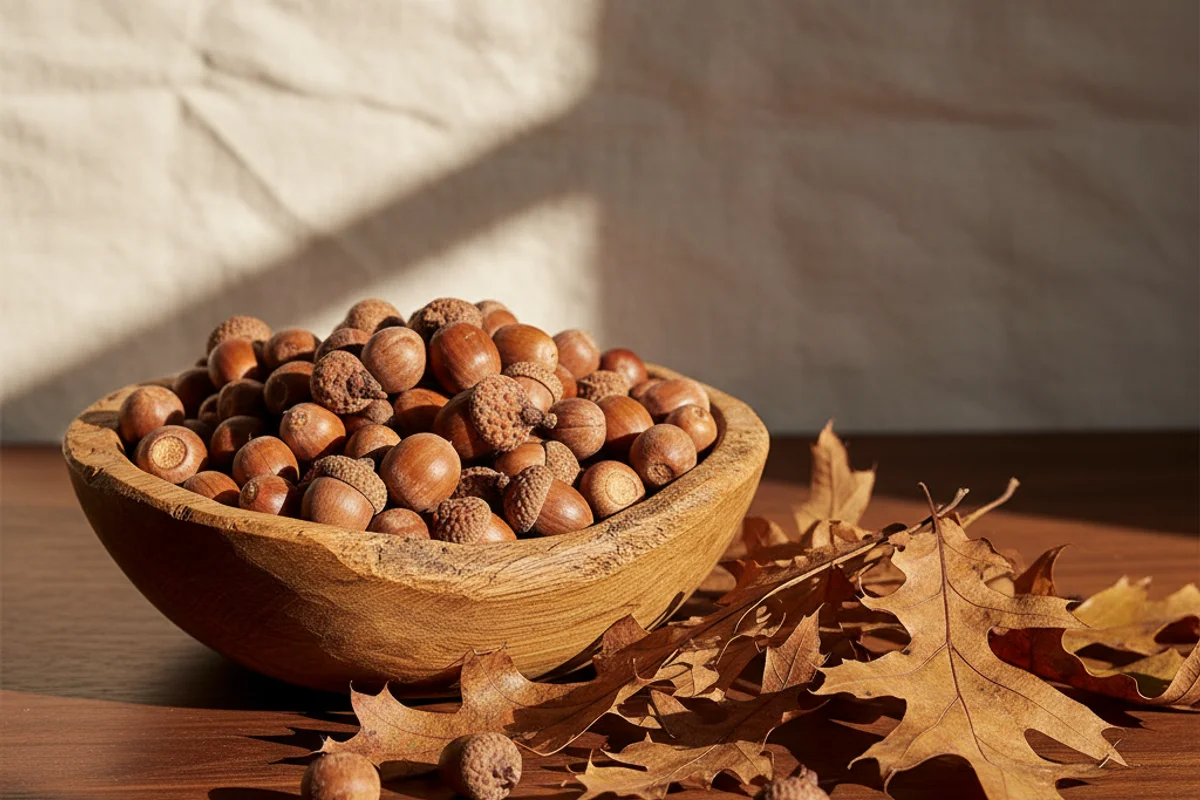
Walk into any forest in fall and you’re stepping on free wine. Acorns — the seeds of oak trees — carry a surprising amount of starch and subtle earthy flavor that, once properly handled, ferments into a pale golden wine with a dry, full-bodied character reminiscent of a Sauternes. The catch is that raw acorns are loaded with bitter tannins that will ruin your batch and your afternoon if you skip the leaching step. Done right, though, this is one of the most rewarding foraged wines you can make.
The beginner trap: Skipping or rushing the simmering step — that 30-minute cook is what pulls the bitter tannins out of the acorn meat before it ever touches your must.
Ingredients
- 1 cup acorn meats, shelled and finely chopped
- 2½ lbs (1.13 kg) granulated white sugar, divided
- 1½ tsp acid blend (or 1 tsp cream of tartar + ½ tsp citric acid)
- ½ tsp pectic enzyme
- 1 tsp yeast nutrient
- 1 packet Sauterne wine yeast (or any dry white wine yeast, such as Lalvin 71B)
- Water to make 1 gallon (3.8 L)
Method
- Shell your acorns and chop the meats finely in a blender or food processor. Measure out exactly 1 cup of chopped meat — measure after chopping, not before.
- Bring 1 quart of water to a boil, add the chopped acorn meats, then reduce to a simmer. Cover and cook for 30 minutes.
- Add half the sugar (1¼ lbs) to your primary fermenter. Strain the hot acorn liquid directly onto the sugar and stir until fully dissolved. Discard the solids.
- Add enough cool water to bring the total volume to 1 gallon. Let the must cool to room temperature (around 70°F / 21°C).
- Stir in the acid blend, pectic enzyme, and yeast nutrient. Cover and let rest for 12 hours.
- Activate your yeast according to the packet instructions, then add it to the must. Cover and ferment for 5–7 days, stirring daily.
- Stir in the remaining sugar (1¼ lbs) until fully dissolved, then transfer to a 1-gallon glass secondary fermenter. Fit an airlock and ferment for 30 days.
- Rack to a clean vessel, top up to minimize headspace, and refit the airlock. Repeat this process every 60 days for 6 months.
- Stabilize with potassium sorbate and potassium metabisulfite, then sweeten to taste if desired. Wait 10 days for sediment to settle, then rack into bottles.
- Allow at least 6 months in bottle before tasting — a year will reward you further.
Why this works
Acorns are rich in tannins — specifically ellagitannins and gallotannins — which evolved to make the seeds unpalatable to most animals. Simmering the chopped meat in water pulls these water-soluble compounds out through a process called leaching, leaving behind the starchy, mildly nutty solids and a lightly flavored liquid. That liquid carries just enough character to give the wine complexity without bitterness. The pectic enzyme breaks down any residual plant cell walls, improving clarity. Splitting the sugar addition — half at the start, half after a few days of active fermentation — prevents osmotic stress on the yeast, which keeps fermentation healthy and reduces off-flavor production.
Notes
Acorns vary in bitterness by species — white oaks (like Quercus alba) are milder than red oaks and may need less leaching time; red oak acorns may benefit from a second simmer with fresh water. If foraging isn’t an option, this recipe won’t adapt well to store-bought substitutes — it’s inherently a seasonal, foraged project. Acid blend is available at homebrew shops; in a pinch, use ¾ tsp tartaric acid (cream of tartar) plus ¼ tsp citric acid (found in the canning aisle).