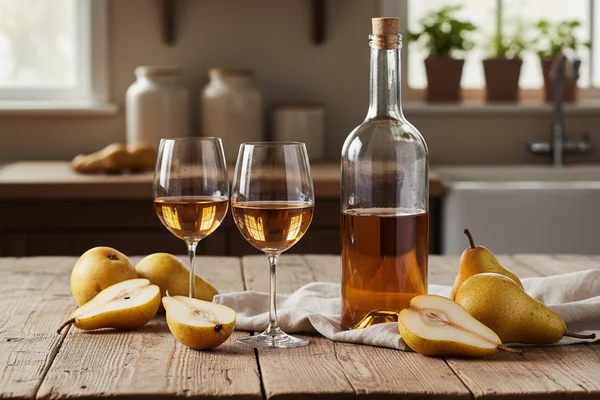
ASIAN APPLE-PEAR WINE
Asian apple-pears are nature’s identity crisis in the best possible way — round like an apple, gritty-crisp like a pear, and fragrant with a faint honeydew undertone that neither fruit can claim alone. They ferment into a pale, delicate wine with a clean sweetness and just enough acidity to keep things interesting. Think dry Riesling’s lighter cousin. The golden raisins here aren’t a quirky add-on — they’re doing real structural work, lending body and a subtle complexity that the apple-pear’s mild juice can’t quite manage on its own.
The beginner trap: Squeezing the fruit bag when you pull it out after primary fermentation forces harsh, bitter compounds into your wine — let it drip drain on its own and walk away.
Ingredients
- 6 lbs ripe Asian apple-pears, fresh or frozen
- ½ lb golden raisins, chopped
- 1½ lbs granulated sugar
- 3¼ quarts water, plus more to top up
- 2 tsp acid blend
- 1 tsp yeast nutrient
- ¼ tsp grape tannin (or 1 cooled cup of strong black tea)
- ½ tsp pectic enzyme
- 1 Campden tablet, crushed
- 1 packet Champagne yeast (or other dry wine yeast)
Method
- Bring the water to a boil and dissolve the sugar completely. Set it aside but keep it hot.
- Wash, core, and roughly chop the apple-pears; remove every seed. Place the chopped fruit and raisins into a nylon mesh straining bag, tie it closed, and set it in your primary fermenter.
- Mash the fruit inside the bag using a potato masher or a clean piece of hardwood, then pour the hot sugar water directly over the pulp.
- Cover the fermenter and let it cool to room temperature (below 75°F / 24°C).
- Add the crushed Campden tablet, acid blend, grape tannin, and yeast nutrient. Stir well, then cover again.
- Wait 12 hours, then stir in the pectic enzyme. Cover again.
- Wait another 12 hours, then sprinkle the yeast over the surface. Cover loosely with a clean cloth.
- Stir the must once daily, gently squeezing the bag to coax out flavor and juice.
- After 7 days, lift the bag out and let it hang over the fermenter for a full hour to drip drain. Do not squeeze it.
- Return all drained juice to the primary and let it settle undisturbed for 24 hours.
- Siphon the cleared juice into a glass secondary vessel (carboy), top up with water to minimize headspace, and fit an airlock.
- Rack after 2 weeks, top up again, and refit the airlock.
- Rack every 2 months until the wine runs clear — at least twice more.
- After the final racking, stabilize the wine, wait 10 days, then dissolve ⅛ to ¼ lb of sugar in a small amount of water (2 parts sugar to 1 part water) and stir it in to taste.
- Bottle the wine and age at least 6–12 months before opening. Serve chilled.
Why this works
Asian apple-pears are low in tannin and moderate in acid, which makes them pleasant to eat but a bit structurally thin as a wine base. The chopped golden raisins solve two problems at once: they boost body through extra fermentable sugars and add trace tannins and nutrients that yeast love. The pectic enzyme is equally important — apple-pears are high in pectin, and without an enzyme to break it down, your finished wine can turn out hazy no matter how long you wait. Adding pectic enzyme after the Campden tablet (not at the same time) matters because sulfite fumes from the tablet can degrade the enzyme before it ever gets to work.
Notes
Frozen Asian apple-pears work well here and often yield more juice since freezing ruptures cell walls. If you can’t find grape tannin at a homebrew shop, one cup of strong, cooled black tea makes a solid everyday substitute. Acid blend is available at any homebrew retailer, but if you’re in a pinch, a small amount of lemon juice (start with 2 tablespoons and adjust) can fill in.