BLACKCAP BERRY WINE
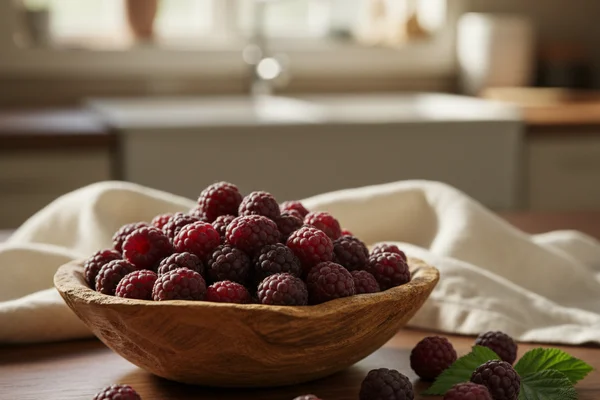
Black raspberries — also called blackcaps — are the darker, more intense cousin of the red raspberry. They pack a deep, jammy flavor with a slight earthy edge and enough natural astringency to keep things interesting. That astringency is also why this wine works best finished sweet: it softens the rough edges and lets the fruit take center stage. The result is a rich, jewel-toned wine that rewards patience. Plan on six months of fermentation and a full year of aging before you crack a bottle.
The beginner trap: Skipping the full six-month fermentation and one-year aging minimum — this wine tastes harsh and unbalanced if you rush it.
Ingredients
- 4 lbs black raspberries, fresh or frozen
- 1¾ lbs granulated white sugar
- 7 pts (3.5 quarts) water
- 1 Campden tablet, crushed
- 1 tsp pectic enzyme
- 1 tsp yeast nutrient
- 1 packet Lalvin RC212 yeast (also sold as Bourgovin; Red Star Côte des Blancs is a workable substitute)
Method
- Dissolve sugar in water and bring to a boil, stirring until fully clear.
- Wash and destem the berries, place them in a nylon straining bag, tie it closed, and crush the bag by hand into your primary fermenter.
- Pour the hot sugar-water over the bag of crushed berries to set the color and pull out the juice; let the must cool to room temperature.
- Stir in the yeast nutrient and crushed Campden tablet, then cover the fermenter.
- After 12 hours, stir in the pectic enzyme and recover.
- After another 12 hours, pitch the yeast, cover, and stir the must daily for 7–8 days.
- Lift out the straining bag and let it drip-drain over the fermenter for about an hour — do not squeeze it.
- Continue fermenting in the primary, stirring daily, until the specific gravity drops below 1.015.
- Rack to a dark secondary (or wrap a clear carboy in a towel), top up with water, and fit an airlock.
- Rack into a clean secondary after 2 months, refit the airlock, and repeat at the 4-month and 6-month marks.
- After the final 6-month rack, stabilize the wine, sweeten to taste, and refit the airlock.
- After 10–14 days with no renewed fermentation, bottle in dark glass and store in a cool, dark place for at least one year before drinking.
Why this works
Blackcaps contain high levels of anthocyanins — the same pigment compounds that give blueberries and red cabbage their color. Hot sugar-water poured directly over the crushed fruit acts like a heat-set dye: it denatures the cell walls quickly and locks in that deep purple-red color before oxidation can dull it. The staggered addition of Campden tablet, then pectic enzyme, then yeast is deliberate. Campden (sulfite) knocks out wild microbes first. Pectic enzyme then breaks down the pectin in the fruit cell walls for better juice extraction — but it needs a sulfite-free window to work, since high sulfite levels slow it down. Only after both have done their jobs does the yeast go in.
Notes
Frozen black raspberries work very well here — freezing ruptures cell walls and actually improves juice extraction. If you can only find red raspberries at the store, they’ll make a pleasant wine but will lack the depth and dark color of true blackcaps. Protect the color at every stage: use a dark secondary, avoid unnecessary splashing, and bottle in dark glass.