BLANC DU BOIS WHITE WINE
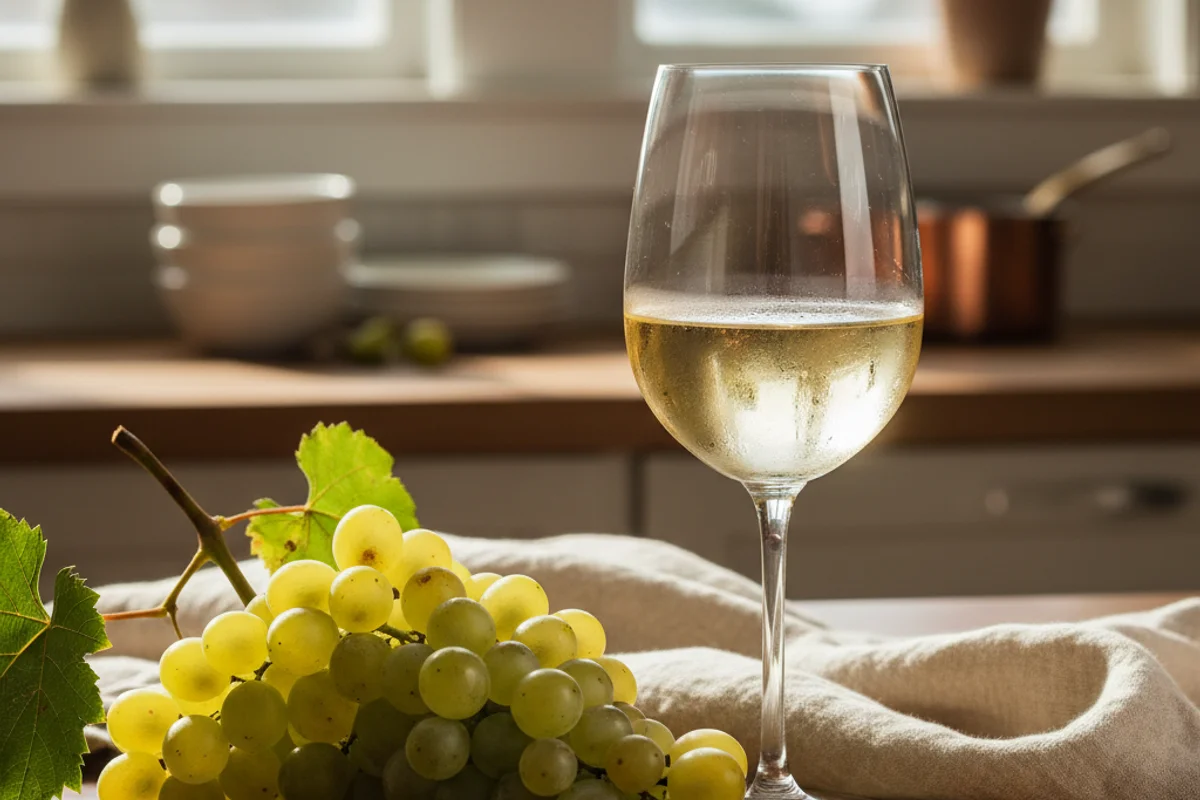
Blanc du Bois (say it “Blahnc duw Bwah”) is a Southern hybrid grape with a split personality: treat it carelessly and you get something flat and forgettable; treat it right and you get a bright, dry white with a citrus finish that sits somewhere between grapefruit and lemon without being either. It thrives in hot, humid climates where European grapes give up, and when the juice is handled fast and cold, it rewards you with clean, fruity aromatics that punch well above their weight. This is a grape that earns its reputation — but only if you respect the process.
The beginner trap: Letting the pressed juice sit at room temperature even briefly causes it to oxidize and turn brown fast, wrecking the delicate aromatics before fermentation ever starts.
Ingredients
- 65–70 lbs fresh Blanc du Bois grapes (harvested at or above 19° Brix)
- ¼ tsp potassium metabisulfite (used 2–3 times throughout)
- ½ tsp pectic enzyme
- Sugar, as needed to reach specific gravity 1.090–1.095 (plain white granulated sugar works fine)
- 2½ tsp yeast nutrient
- 1 packet Lalvin EC-1118 (Prise de Mousse) wine yeast
- 2½ tsp potassium sorbate (used at stabilization)
- Bentonite fining agent, prepared per package instructions
Method
- Wash, destem, crush, and press the grapes in one continuous operation — work as quickly as you safely can.
- Stir ¼ tsp potassium metabisulfite into the fresh juice, then cover the container and move it immediately into a refrigerator set to 34°F.
- After 24 hours, add the pectic enzyme and stir gently; return the juice to the refrigerator for another 48 hours.
- Carefully move the container to your work surface without disturbing the settled sediment at the bottom.
- Rack the clear juice into a sanitized 6-gallon carboy, leaving all dark precipitated solids behind.
- Stir in the yeast nutrient, then check the specific gravity and add dissolved sugar as needed to reach 1.090–1.095; stir until fully dissolved.
- Pull off 1 liter of juice into a sanitized jar; sprinkle the EC-1118 yeast on the surface, cover with plastic wrap, and let it activate for 12–14 hours (it will work even at cold temperatures).
- Add the yeast starter to the carboy and cover the opening with a paper towel secured with a rubber band; wait 48 hours, then switch to an airlock.
- Once vigorous fermentation slows, stir the wine well and transfer it into a sanitized 5-gallon carboy; stir in prepared bentonite slurry according to package directions and reattach the airlock.
- Ferment to dryness — allow at least 45 days total before moving on.
- Rack the wine, top up the carboy to minimize headspace, and reattach the airlock; wait 30 days.
- Rack again, this time stirring in the dissolved potassium sorbate and another ¼ tsp potassium metabisulfite; sweeten to taste if desired, top up, and reattach the airlock.
- Wait 30 more days, then bottle. The wine is drinkable in 3 months and noticeably better at 6.
Why this works
Cold settling — chilling the juice to 34°F for 72 hours before fermentation — does two important things at once. First, the cold slows oxidation enzymes in the juice, limiting the browning reaction that ruins color and aroma. Second, solids including grape pulp, skin fragments, and protein clumps sink to the bottom through a process called cold sedimentation, so you can rack off clean, clear juice before yeast ever enters the picture. Cleaner juice means fewer off-flavors and a more aromatic finished wine. EC-1118 is chosen here because it ferments reliably at low temperatures and works quickly even when juice is still cold, giving wild spoilage organisms less time to get established.
Notes
Blanc du Bois grapes are grown mostly in Texas, Florida, and the Gulf South; check with local vineyards, home winemaking supply shops, or agricultural co-ops in late summer. If your grapes come in below 19° Brix, chaptalizing (adding sugar) is standard practice — don’t panic. Potassium metabisulfite can be sourced at any homebrew shop; in a pinch, Campden tablets work at 1 tablet per gallon. Bentonite is a common fining clay available at homebrew retailers or online.