Blending Wines
Two wines that are merely good on their own can become something genuinely great together. Blending is how commercial winemakers punch up body, balance acidity, or smooth out a rough finish — and you can do the exact same thing at your kitchen table with five wine glasses and a tablespoon. This tutorial uses Tokay (a sweet, nutty fortified wine) and Zinfandel as the working example, but the method applies to any two wines you want to marry. Think of it as a bracket tournament where your palate is the only judge that matters.
The beginner trap: Skipping the fine-tuning round and scaling up from a rough first pass — that extra step of narrowing the ratio is what separates a good blend from a great one.
Ingredients
- 1 bottle Tokay (or any sweet, amber-style fortified wine — cream sherry or Madeira work well)
- 1 bottle Zinfandel (or any full-bodied red wine you want to blend with)
- 5 wine glasses
- Measuring spoons (tablespoon set)
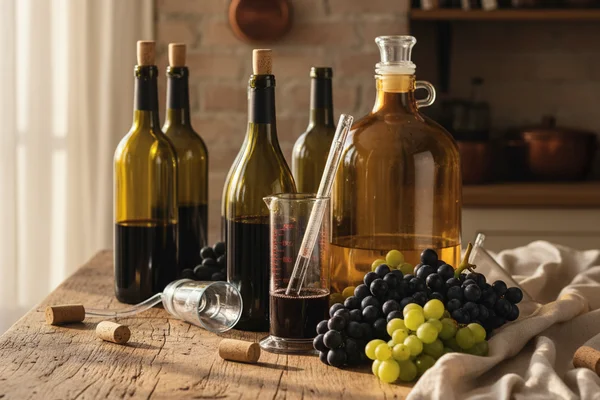
- A small graduated measuring cylinder or ml-marked syringe (optional, for precision)
- Pen and masking tape or sticky notes (for labeling glasses)
Method
- Label four glasses: T20/Z80, T40/Z60, T60/Z40, and T80/Z20 — these represent the percentage of each wine in the mix.
- Fill each glass using 5 tablespoons total: Glass 1 gets 1 tbsp Tokay + 4 tbsp Zinfandel; Glass 2 gets 2 tbsp + 3 tbsp; Glass 3 gets 3 tbsp + 2 tbsp; Glass 4 gets 4 tbsp + 1 tbsp.
- Stir each glass and taste them in order, palate-cleansing with water between each one.
- Pick your two favorites — these are your “finalists.” Set them aside and rinse the other two glasses.
- Now zoom in: set up five glasses spanning the range between your two finalists in small steps (roughly 5–10 percentage points apart).
- Fill each fine-tuning glass to 5 tablespoons using the new ratios, stir, and taste each one again.
- Pick the single winner. That ratio — expressed as a percentage — is your blend formula. Scale it up to your full batch volume.
Why this works
Blending exploits a quirk of sensory perception: flavor compounds interact in non-linear ways. A tannic, dry red and a sweet fortified wine don’t just average out — at the right ratio, the tannins in the red bind to the extra sugar in the Tokay, making both elements seem softer and more integrated. This is the same principle behind co-fermentation in traditional winemaking. The two-round bracket approach works because your palate fatigues quickly; narrowing a wide range first (20% jumps), then zeroing in with fine steps (5–10% jumps), keeps your senses sharp enough to detect real differences instead of chasing noise.
Notes
This method works for any two-wine blend — try a sharp, high-acid fruit wine paired with a softer grape wine to tame the tartness. If you don’t have a graduated cylinder, a 10 ml medicine syringe from a pharmacy gives excellent precision and costs almost nothing. For a three-wine blend, tackle it as two separate rounds: blend wines A and B first to find their best ratio, then treat that blend as a single component and repeat the process with wine C.