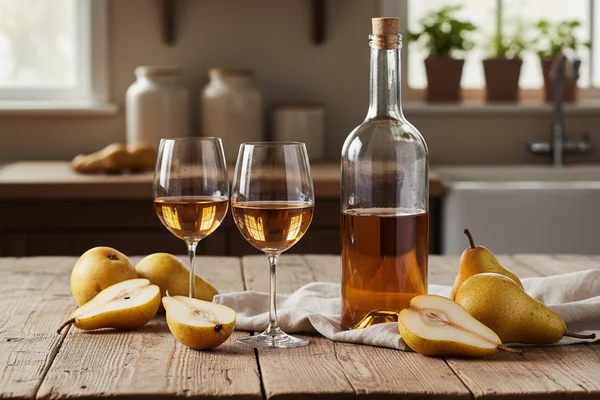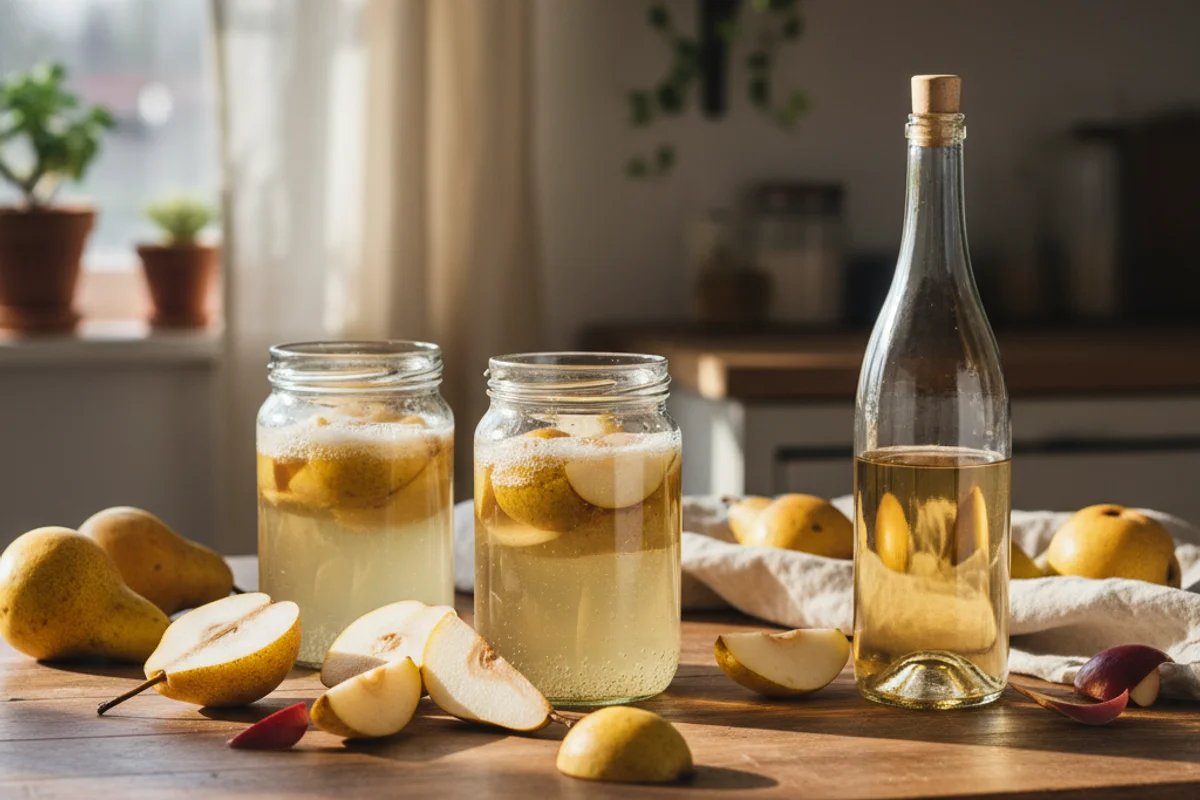
COOKING PEAR WINE
Cooking pears are the ugly ducklings of the pear world — rock-hard, gritty, and about as appealing to eat raw as a bar of soap. But heat and time change everything. Once you simmer those tough little fruits and hand-press the juice out, you get a surprisingly complex base with earthy, floral notes and a backbone sturdy enough to carry either a bone-dry finish or a gentle sweetness. This recipe covers both styles. Either way, plan on waiting at least a year before you judge it — young cooking pear wine is rough around the edges, but age smooths it out remarkably well.
The beginner trap: Simmering the pears too long — keep it under 20 minutes or you’ll lock in a pectin haze that no amount of fining will fully fix.
Ingredients
Sweet Version
- 5 lb. cooking pears (Bradford, Kieffer, or any hard variety), unpeeled
- 1¾ lb. granulated sugar
- 1 lemon, juiced
- 2 oranges, juiced
- ¾ tsp. pectic enzyme
- 7 pints (3.5 quarts) water
- 1 tsp. yeast nutrient
- 1 packet Côte des Blancs wine yeast (or any low-alcohol, fruity white wine yeast)
Dry Version
- 5 lb. cooking pears (Bradford, Kieffer, or any hard variety), unpeeled
- 1¾ lb. granulated sugar
- 2 lemons, juiced
- 1 orange, juiced
- ¾ tsp. pectic enzyme
- 7 pints (3.5 quarts) water
- 1 tsp. yeast nutrient
- 1 packet Pasteur White wine yeast (or any dry-finishing white wine yeast)
Method
- Wash the pears thoroughly, then chop them into roughly ½-inch pieces — skin on, cores and all.
- Combine the chopped pears and the 7 pints of water in a large pot, bring to a boil, then immediately reduce to a gentle simmer. Hold at a simmer for no more than 20 minutes, then remove from heat and let cool to lukewarm.
- Pour the pear mash into a nylon straining bag set over your primary fermenter, capturing all the liquid. Hand-squeeze the bag firmly to extract as much juice as possible, but don’t force pulp through the mesh.
- Add the sugar to the primary and pour the warm pear liquid over it, stirring until fully dissolved.
- Stir in the lemon juice, orange juice, pectic enzyme, and yeast nutrient. Mix well.
- Let the must cool to 75°F, then add your activated yeast starter and cover the primary loosely.
- After 5–7 days of vigorous fermentation, transfer the wine to a secondary fermenter (carboy), top up with water to minimize headspace, and fit an airlock.
- After 3 weeks, rack the wine into a clean vessel, top up, and reattach the airlock. Repeat this racking every 2 months for the next 6 months.
- For dry wine: Once clear, bottle the wine. If it won’t clear on its own, fine with bentonite according to the package directions, wait 7–10 days until clear, then rack and bottle.
- For sweet wine: Once clear, taste for sweetness. If you want it sweeter, stabilize with ½ tsp. potassium sorbate and 1 crushed Campden tablet, then stir in sugar to taste. Wait 10 days to confirm no re-fermentation has started, then bottle.
- Wait at least 6 months before opening a bottle — a full year is better.
Why this works
Cooking pears are loaded with pectin, the same carbohydrate that makes jam gel. When you boil fruit for too long, pectin breaks down into smaller fragments that scatter light and cause a stubborn, milky haze in your finished wine. Keeping the simmer under 20 minutes limits that breakdown. Pectic enzyme then does the heavy lifting — it chops remaining pectin chains into glucose and galactose, which yeast can ferment or simply dissolve harmlessly into the wine. The citrus juice serves double duty: it drops the pH into a range that discourages spoilage bacteria, and it adds tartaric and citric acids that keep the flavor bright during the long aging period this wine needs.
Notes
Frozen pears work fine here — thaw them completely before chopping, and expect them to release more juice than fresh fruit. If you can’t find wine yeast locally, Lalvin 71B (widely available online) is a solid substitute for the sweet version; EC-1118 works for the dry version but will ferment very dry and lean. For a holiday variation, add two 3-inch cinnamon sticks and 4–5 whole cloves in a spice bag during the simmer — remove the bag before straining the fruit, and you’ll have a spiced pear wine worth cracking open the following Christmas.