GOOSEBERRY WINES
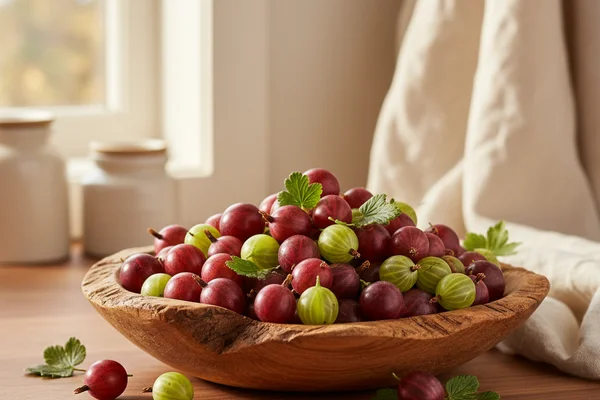
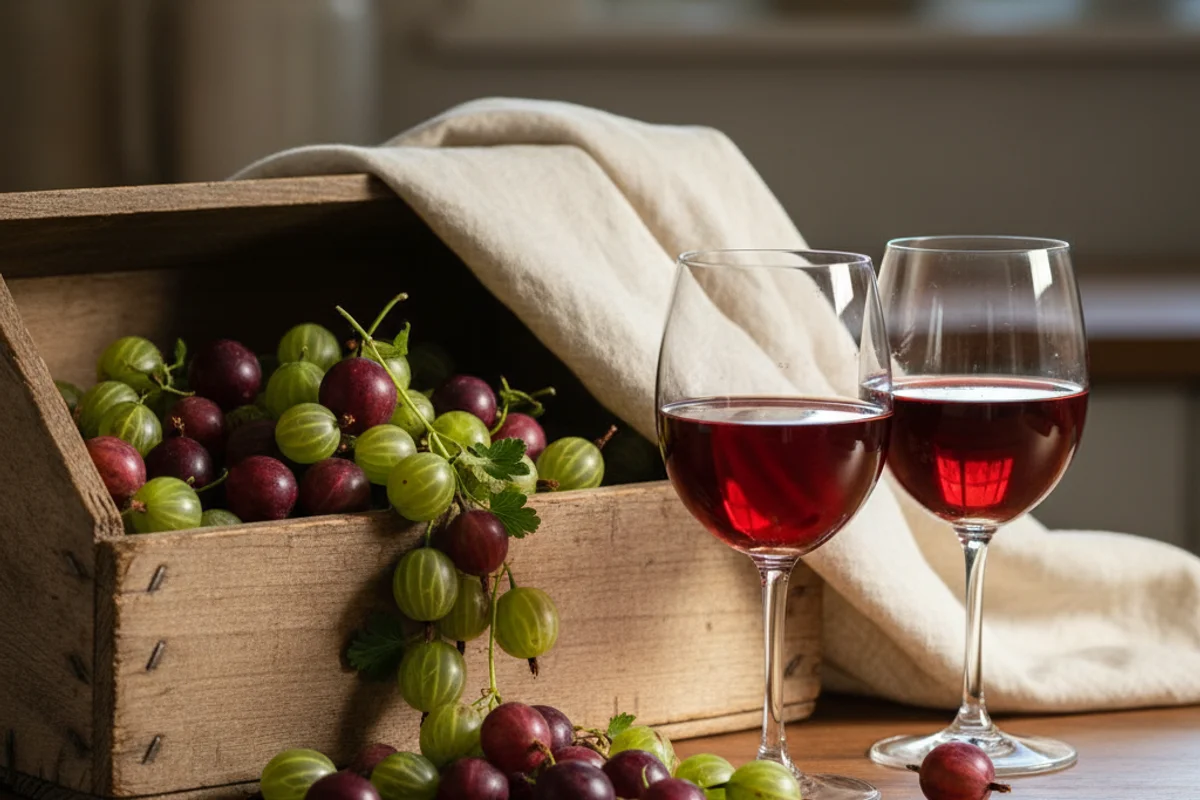
Gooseberries are the tart little rebels of the berry world — thin-skinned, intensely flavored, and loaded with enough natural acid to make your jaw clench if you eat one straight off the bush. That sharp, almost electric brightness is exactly what makes them brilliant for winemaking. When fermentation does its work and some aging smooths the rough edges, you get a wine with genuine backbone: crisp, floral, and faintly tropical, somewhere between a dry Riesling and a tart white currant. Three recipes below, ranging from dead simple to layered and complex.
The beginner trap: Squeezing the fruit bag to get more juice will press bitter, cloudy compounds into your wine — always let the bag drip drain on its own.
Gooseberry Wine 1 — Classic
Ingredients
- 3 lbs ripe gooseberries, fresh or frozen, washed and stemmed
- 1¾ lbs granulated white sugar
- 7 pts (3.5 quarts) water
- 1 Campden tablet, crushed
- ¼ tsp pectic enzyme
- 1 tsp yeast nutrient
- 1 packet Champagne wine yeast (or any dry white wine yeast)
Method
- Combine sugar and water in a pot and heat, stirring, until the sugar fully dissolves and the liquid just begins to boil. Remove from heat.
- Place washed, stemmed gooseberries into a nylon mesh straining bag, tie it closed, and set it in the bottom of your primary fermenter. Crush the berries through the bag using a potato masher or your fist.
- Pour the hot sugar-water over the bagged fruit. Cover the fermenter with a clean cloth and let it cool to room temperature.
- Once cool, stir in the yeast nutrient and crushed Campden tablet. Re-cover and wait 12 hours.
- Add the pectic enzyme, stir, re-cover, and wait another 12 hours.
- Add activated yeast. Stir the must daily for 7 days.
- Lift the straining bag and let it drip drain over the fermenter — do not squeeze. Discard the pulp. Cover and let the liquid settle overnight.
- Rack the cleared liquid into a clean secondary fermenter (carboy), top up to minimize headspace, and fit an airlock.
- Rack, top up, and refit the airlock every 30 days until the wine is clear and no new sediment forms over a full 30-day period.
- Stabilize, sweeten to taste if desired, wait 10 days, then rack into bottles. Age at least 12 months before opening.
Gooseberry Wine 2 — With White Grape Concentrate
Ingredients
- 2½ quarts fresh gooseberries, fresh or frozen, washed and stemmed
- 1½ lbs granulated white sugar
- 1 can (11 oz) frozen white grape juice concentrate, thawed (Welch’s 100% white grape works fine)
- 6½ pts (about 3¼ quarts) water
- 1 Campden tablet, crushed
- ¼ tsp pectic enzyme
- ¼ tsp wine tannin (or 1 cup strong cooled black tea as a substitute)
- 1 tsp yeast nutrient
- 1 packet Champagne wine yeast (or any dry white wine yeast)
Method
- Dissolve sugar in water while bringing it to a boil, then remove from heat.
- Place gooseberries in a nylon straining bag, tie it shut, and crush the berries in the bottom of your primary fermenter using a potato masher.
- Pour the hot sugar-water over the bagged fruit. Stir in the grape juice concentrate, tannin, and yeast nutrient. Cover and let cool to room temperature.
- Add the crushed Campden tablet, stir, re-cover, and wait 12 hours.
- Add the pectic enzyme, stir, re-cover, and wait another 12 hours.
- Add activated yeast. Stir daily for 8 days.
- Lift the bag and drip drain — no squeezing. Discard the pulp, re-cover, and let the liquid settle overnight.
- Rack into a secondary fermenter, top up, and fit an airlock.
- Rack, top up, and refit the airlock every 30 days until the wine is clear with no new sediment forming over 30 days.
- Stabilize, sweeten if desired, wait 10 days, then bottle. Age at least 12 months.
Gooseberry Wine 3 — With Raisins and Banana
Ingredients
- 2 lbs ripe gooseberries, fresh or frozen, washed and stemmed
- 1 lb green (less-ripe) gooseberries, fresh or frozen, washed and stemmed
- ½ lb golden raisins (or sultanas), roughly chopped
- ½ lb ripe bananas (about 2 medium), peeled and thinly sliced
- 2 lbs granulated white sugar
- 7 pts (3.5 quarts) water
- 1 tsp citric acid (or 3 tbsp fresh lemon juice as a substitute)
- 1 Campden tablet, crushed
- 1 tsp pectic enzyme
- 1½ tsp yeast nutrient
- 1 packet Champagne wine yeast (or any dry white wine yeast)
Method
- Combine banana slices, sugar, and water in a large pot. Bring to a gentle simmer over medium heat, stirring until the sugar fully dissolves. Hold the simmer for 20 minutes.
- Strain out and discard the banana solids. Return the liquid to a simmer.
- Add the chopped raisins, all the gooseberries, and simmer covered for another 20 minutes.
- Pour the hot liquid, raisins, and gooseberries into your primary fermenter. Stir in the citric acid and yeast nutrient. Cover and let cool to room temperature.
- Stir in the crushed Campden tablet, re-cover, and wait 12 hours.
- Stir in the pectic enzyme, re-cover, and wait another 12 hours.
- Add activated yeast. Stir daily for 3 days.
- Strain the must into a secondary fermenter, discarding all fruit solids. Top up and fit an airlock.
- Rack, top up, and refit the airlock every 30 days until the wine runs clear with no new sediment over a 30-day period.
- Refrigerate the carboy for 3 days to drop any remaining sediment. Stabilize, sweeten if desired, wait 10 days, then bottle. Age at least 12 months.
Why this works
Gooseberries are naturally high in pectin — the same gelling agent that makes jam thick. In wine, that pectin turns into a stubborn haze that no amount of racking will fix. That is why pectic enzyme is non-negotiable here. The enzyme breaks the pectin chains apart, allowing everything to drop clear. The 24-hour wait after adding Campden before adding the enzyme matters too: sulfite from the Campden tablet would deactivate the enzyme on contact, so you give the sulfite time to off-gas first. In Recipe 3, simmering the banana separately extracts its body-building starches and sugars without dumping raw starch into the must, which would cause its own clarity problems. The raisins add fermentable sugar, a little tannin, and depth — think of them as a flavor backstop.
Notes
- Frozen gooseberries work great in all three recipes and are often easier to find than fresh. Freezing actually helps break down the cell walls, so you get slightly better juice extraction during the crush step.
- If you cannot find wine tannin for Recipe 2, a cup of strong, cooled black tea stirred in at the same stage gives you a functional substitute.
- Gooseberries vary a lot in ripeness and sweetness — if your fruit tastes very tart before fermentation, nudge the sugar up by a few ounces rather than trying to correct it after the fact.