Allegheny Shadbush Berries
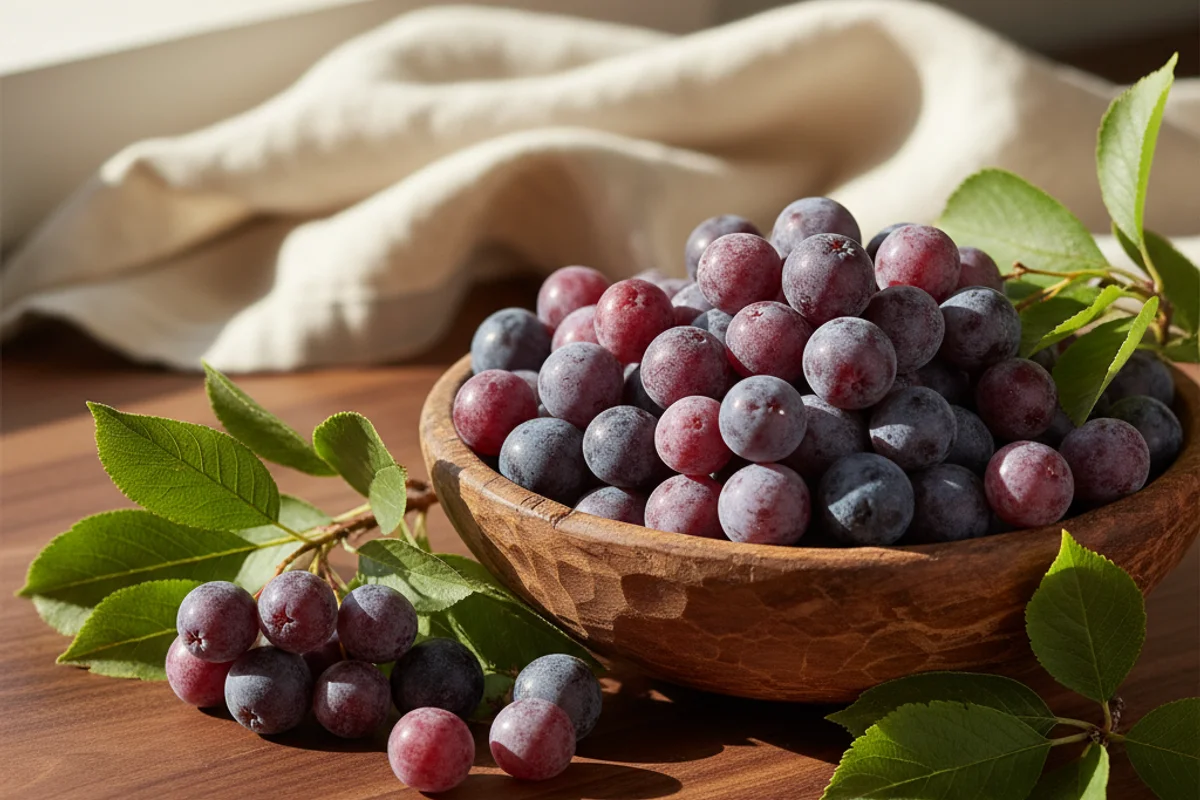
Think of shadbush berries as nature’s answer to blueberries — but wilder, with a subtle almond undertone from the seeds and a deep, jammy color that stains everything it touches. These small, purplish-black berries ripen in early summer on native serviceberry trees across the eastern US. Cooked down and fermented with golden raisins for body, they build into a full, rich wine that rewards patience. Nine months is the floor; two years is where it really sings.
The beginner trap: Rushing past the 10-hour pre-fermentation wait after adding pectic enzyme — skip it and you’ll end up with a hazy, pectin-clouded wine that won’t clear no matter how long you wait.
Ingredients
- 4 lbs shadbush (serviceberry) berries, fresh or frozen, destemmed
- 1 lb golden raisins, chopped fine
- 2 lbs granulated white sugar
- ¾ tsp tartaric acid (or substitute ½ tsp acid blend)
- 1 tsp pectic enzyme
- 5–6 pints water
- 1 tsp yeast nutrient
- 1 packet wine yeast (Lalvin 71B or EC-1118 work well)
- 2 Campden tablets (potassium or sodium metabisulfite)
Method
- Wash and destem the berries, then crush them by hand or with a masher. Place in a saucepan, bring to a low boil, then reduce heat and simmer covered for 10 minutes.
- Fold the top layer of berries under so everything cooks evenly, replace the lid, and simmer another 10 minutes.
- Pour the cooked berries into a nylon straining bag (a paint-strainer bag from a hardware store works perfectly) and let the juice drip into your primary fermenter until the pulp cools completely.
- While you wait, dissolve all the sugar into 3 cups of boiling water, stir until clear, and set aside to cool.
- Place the chopped raisins into a second straining bag and tie it closed.
- Add the berry juice, both bags (berry pulp and raisins), tartaric acid, pectic enzyme, yeast nutrient, and all but ⅔ cup of the sugar-water to the primary fermenter. Stir well.
- Cover the fermenter loosely and wait at least 10 hours before adding yeast — this gives the pectic enzyme time to work.
- Activate your wine yeast according to the packet, then stir it into the must. Cover well and move to a warm spot (70–75°F).
- Squeeze both bags and stir the must twice daily. After 5 days of active fermentation, gently press the berry bag to extract remaining juice and discard the spent pulp and seeds.
- Re-cover and ferment for another 5 days, then gently squeeze the raisin bag to extract its juice and remove it.
- Siphon the liquid off the sediment into a glass secondary (carboy), add the reserved ⅔ cup sugar-water, top up with water to the shoulder, and fit an airlock. Move to a cooler spot (60–65°F).
- Rack the wine three times, 30 days apart. Add one crushed, dissolved Campden tablet at the first racking and again at the final racking.
- After the third rack, stabilize with potassium sorbate, wait 2–3 weeks, then rack into bottles. Store in a dark place.
- Taste after 9 months, but plan to cellar it longer — this wine keeps improving for 2+ years.
Why this works
Shadbush berries are rich in pectin — the same stuff that makes jam gel. Heat breaks down cell walls and extracts color, flavor, and juice, but it also releases that pectin into the must. Pectic enzyme (pectinase) is a protein that chops those long pectin chains into small sugars, which yeast can use and which won’t cloud your finished wine. That’s why the 10-hour enzyme rest before pitching yeast matters so much: you need the enzyme to do its job before alcohol builds up, since alcohol slows enzyme activity significantly. The raisins add unfermentable body compounds and a subtle dried-fruit richness that rounds out what can otherwise be a sharp, lean berry wine.
Notes
Frozen serviceberries work just as well as fresh — freezing actually helps break down cell walls and improves juice extraction. If you can’t find shadbush or Allegheny serviceberry specifically, any Amelanchier species (Saskatoon, juneberry, or common serviceberry) will substitute directly. Tartaric acid is available at homebrew shops; if you only have citric acid on hand, use the same amount, but tartaric gives a cleaner, more wine-like finish.