BANANA WINE
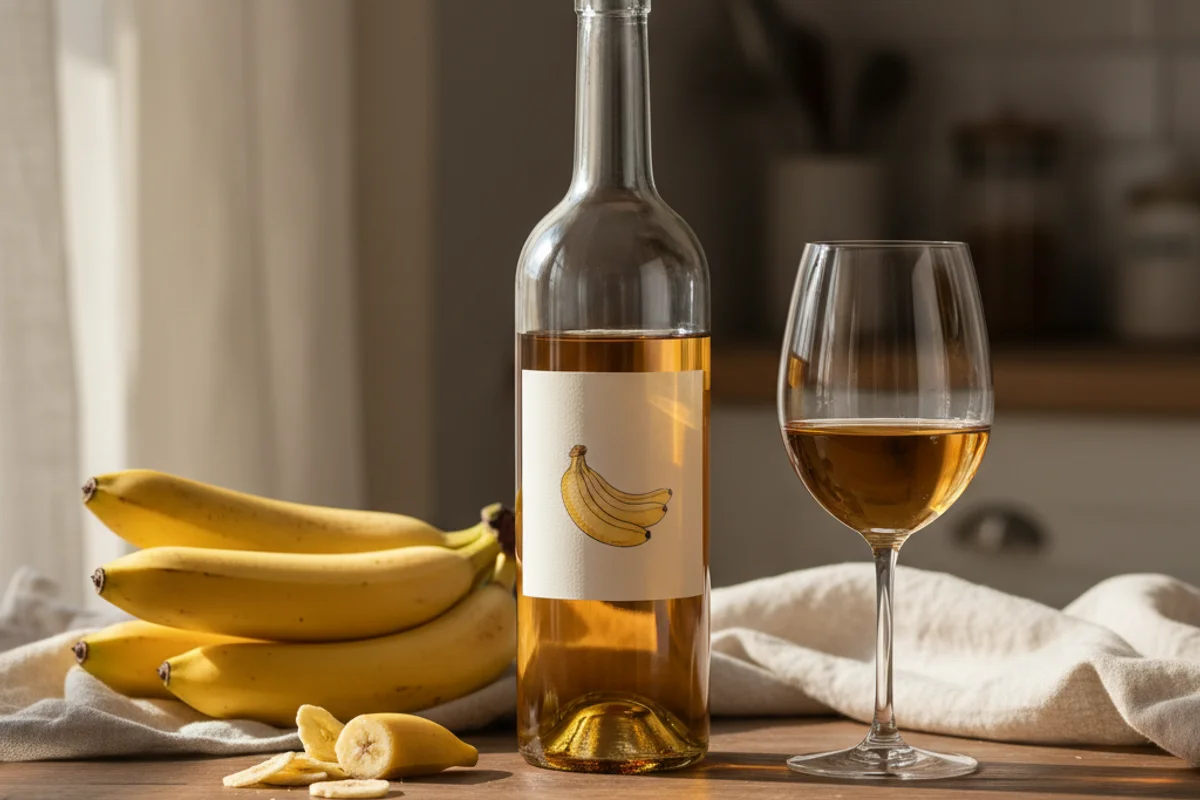
Bananas are one of winemaking’s quiet overachievers. They bring a soft, honeyed body and a gentle tropical sweetness that can carry a wine on their own or quietly prop up a thinner fruit wine blend. The trick is knowing that bananas are mostly starch and sugar — and that starch is the troublemaker. Handle them right and you get a smooth, semi-dry white-style wine with real depth. Rush it and you get a cloudy, stubborn mess that refuses to clear.
The beginner trap: Skipping the amylase enzyme when the wine won’t clear — banana starch hazes are persistent and will not drop out on their own without enzymatic help.
Ingredients
- 4½ lbs peeled ripe bananas (fresh or frozen), mashed
- ½ lb banana peels, finely chopped
- 1½ cups (12 oz) white grape juice concentrate (frozen, thawed)
- 1¾ lbs granulated white sugar
- 2 tsp citric acid (or juice of 3 lemons)
- ⅛ tsp grape tannin (or 1 cup strong-brewed plain black tea)
- 6½ pts (about 13 cups) water
- 1 tsp yeast nutrient
- 1 packet white wine yeast (such as Lalvin EC-1118 or 71B)
- Amylase enzyme (optional, for clearing — find at homebrew shops or online)
Method
- Mash the bananas thoroughly and finely chop the peels. Place both into your primary fermenter.
- Bring the water to a full boil and dissolve the sugar completely in it. Pour the hot sugar water over the bananas and peels, then cover the fermenter loosely and let it cool to room temperature.
- Once cool, add the grape concentrate, citric acid, grape tannin, and yeast nutrient. Stir well until everything is fully dissolved.
- Activate your yeast according to the packet instructions, then add it to the must. Cover the fermenter with a cloth or loose lid.
- Ferment at room temperature for two days, stirring daily. The must will be active and foamy — this is normal.
- After two days, strain the liquid through a fine mesh bag or several layers of cheesecloth into your secondary fermenter (a glass carboy or food-grade jug). Squeeze gently to get the liquid out, but don’t force the pulp through.
- Fit an airlock and let the wine ferment to dryness — this typically takes 3–5 weeks. Rack off the sediment, top up with a little water or similar wine to minimize headspace, and refit the airlock.
- Allow up to 90 days for the wine to clear naturally. If it stays hazy after that, add amylase enzyme per the package directions and wait another few weeks.
- Once clear, rack again, top up, and refit the airlock. Age for 2 months, then stabilize with potassium sorbate and potassium metabisulfite per package instructions. Refit the airlock and wait another 30 days.
- Rack the finished wine into bottles and let them rest for at least 3 months before drinking.
Why this works
Bananas are loaded with amylopectin starch, especially when less than fully ripe. That starch doesn’t ferment — yeast can only eat simple sugars. Left alone, starch molecules clump together into a persistent haze that neither time nor fining agents can fully fix. Amylase enzyme breaks those long starch chains into simple sugars and smaller fragments that either ferment away or drop out of suspension. That’s why this recipe keeps amylase in the back pocket. The grape concentrate adds fermentable sugar, a mild acidic backbone, and trace nutrients that give the yeast something structured to work with beyond pure banana sweetness.
Notes
Frozen bananas work great here and are often cheaper — thaw completely and use the liquid too. For the grape tannin, a strong cup of plain black tea (brewed with 2 bags, cooled) is a reliable grocery-store swap. If you prefer a sweeter finish, stabilize the wine before bottling and back-sweeten with a small amount of sugar syrup to taste.