BEET, APRICOT AND RAISIN DRY SHERRY
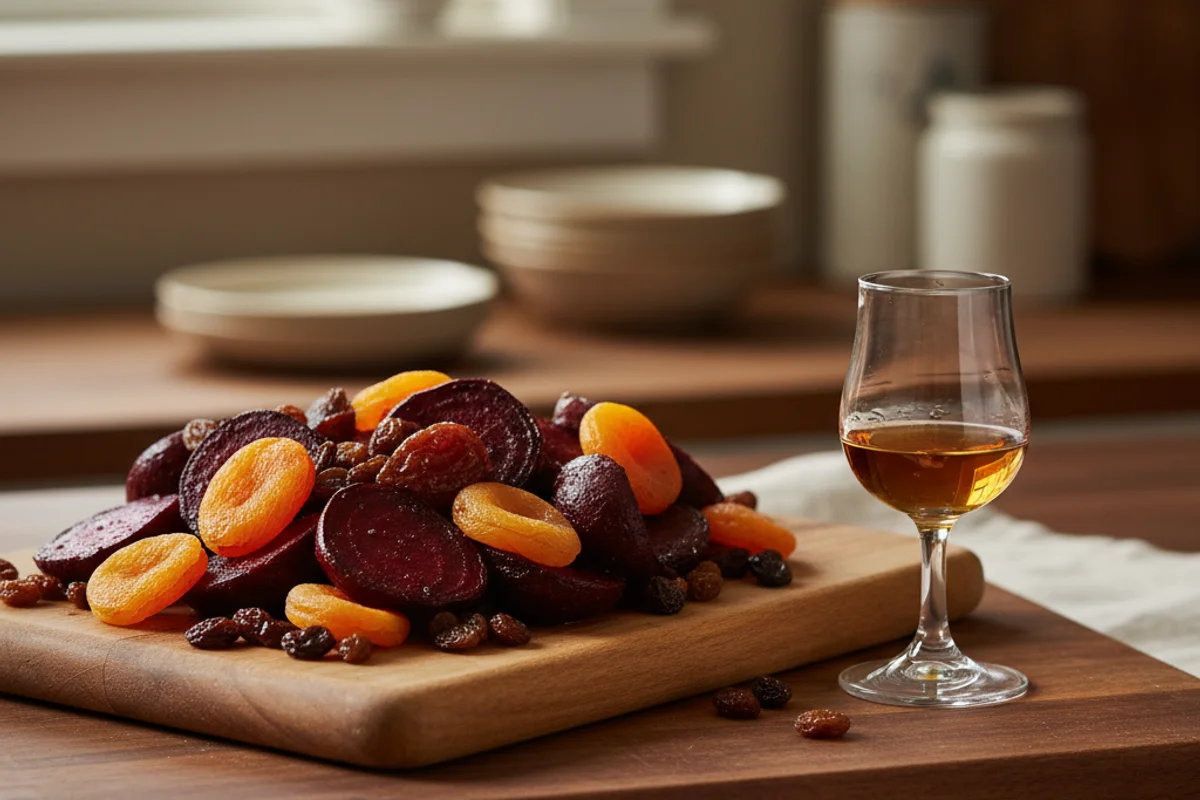
Here’s a wine that sounds like it shouldn’t work — earthy beets, jammy dried apricots, and plump golden raisins — yet together they build something genuinely nutty, oxidative, and complex. This is a sherry-style wine, which means you’re not just fermenting fruit; you’re courting a particular kind of controlled aging. The result, given enough patience, lands somewhere between a fino and an amontillado: dry, savory, and layered with a depth that grocery-store ingredients have no business producing.
The beginner trap: Sealing this wine tightly after fermentation is exactly wrong — sherry-style wines need intentional headspace and a cotton plug to develop their character, so resist every instinct to top it up and airlock it.
Ingredients
- 3 lb. beets, scrubbed and chopped
- 12 oz. dried apricots, chopped
- 1/2 lb. golden raisins, chopped
- 1-1/4 lb. granulated sugar
- 1 pt. white grape concentrate (frozen concentrate from the grocery store works fine)
- 1 oz. gypsum (sold as brewing gypsum; find it at homebrew shops or online)
- 1/2 oz. cream of tartar (baking aisle)
- 1/4 oz. pectic enzyme (homebrew shop or online)
- Water to make 1 gallon total
- Sherry wine yeast and yeast nutrient (Lalvin EC-1118 is a widely available substitute if Sherry yeast is hard to find)
Method
- Dissolve the sugar in 1-1/4 cups of boiling water, let the syrup cool completely, and set it aside in a jar — you’ll add it in stages later.
- Boil the chopped beets in 6 pints of water for 30 minutes, then strain the hot liquid directly over the chopped apricots and raisins in your primary fermentation vessel.
- Stir in the cream of tartar, gypsum, yeast nutrient, and 1/2 cup of the reserved sugar syrup; cover and let the mixture cool to room temperature.
- Once cool, stir in the pectic enzyme and your activated yeast, cover the vessel, and ferment on the fruit pulp for 4 days, stirring twice each day.
- Strain the must through a fine mesh strainer or nylon sieve, pressing the pulp lightly, then stir in the white grape concentrate.
- After 10 days, add another 1/2 cup of sugar syrup; continue adding 1/2 cup of syrup each time the specific gravity drops to 1.005 or below (roughly every 3 days) until all the syrup is used.
- Top up with water to reach 1 gallon total, then let fermentation finish — this typically takes another 10–14 days.
- Rack the wine into a 1-1/2 to 2 gallon vessel, leaving a meaningful amount of air space above the wine, and plug the opening loosely with a wad of cotton (not an airlock).
- If you see sediment with pulp particles after 2 weeks, rack once more into a clean vessel and re-plug with cotton; otherwise, leave it alone.
- Move the vessel to a cool spot (55–60°F) and do not disturb it — a yeast film called flor may form on the surface anywhere from 3 weeks to 4 months from now.
- If flor forms, wait patiently until the entire film has sunk to the bottom, then carefully siphon the clear wine through a double layer of cheesecloth into bottles.
- If flor never forms after 6 months, siphon the wine into a clean gallon jug, sweeten slightly with grape concentrate or sugar water (1/3 lb. sugar dissolved in 1 cup water) to top it up, then bottle in dark glass and store in a dark cabinet.
- Age at least 3 years before opening — longer is better.
Why this works
Sherry gets its signature character from two things: oxidation and flor. Flor is a film of wild or resident yeast that forms on the wine’s surface when there’s headspace and the alcohol is in the right range. This film actually protects the wine from harsh oxidation while simultaneously metabolizing compounds that produce a distinctive nutty, yeasty flavor — the hallmark of a fino-style sherry. The cotton plug lets just enough oxygen move in and out without inviting contamination. Beets contribute fermentable sugars and earthy depth, while the apricots and raisins add glycerol body and fruity esters. The gypsum lowers pH slightly and sharpens the wine’s crispness, and the cream of tartar helps stabilize acidity throughout the long aging period.
Notes
If fresh beets are out of season, canned beets work in a pinch — drain and skip the boiling step, using the liquid from the cans as part of your water volume. Frozen beets are another solid option; thaw and chop before use. If you can’t find white grape concentrate at a homebrew shop, look for frozen white grape juice concentrate (no preservatives) in the grocery store freezer aisle — check the label and avoid any with added vitamin C (ascorbic acid), which can interfere with fermentation.