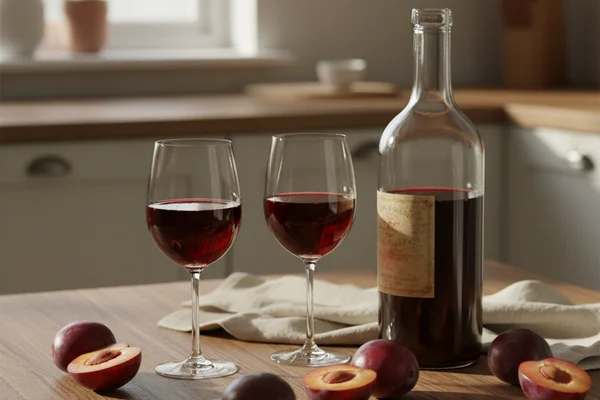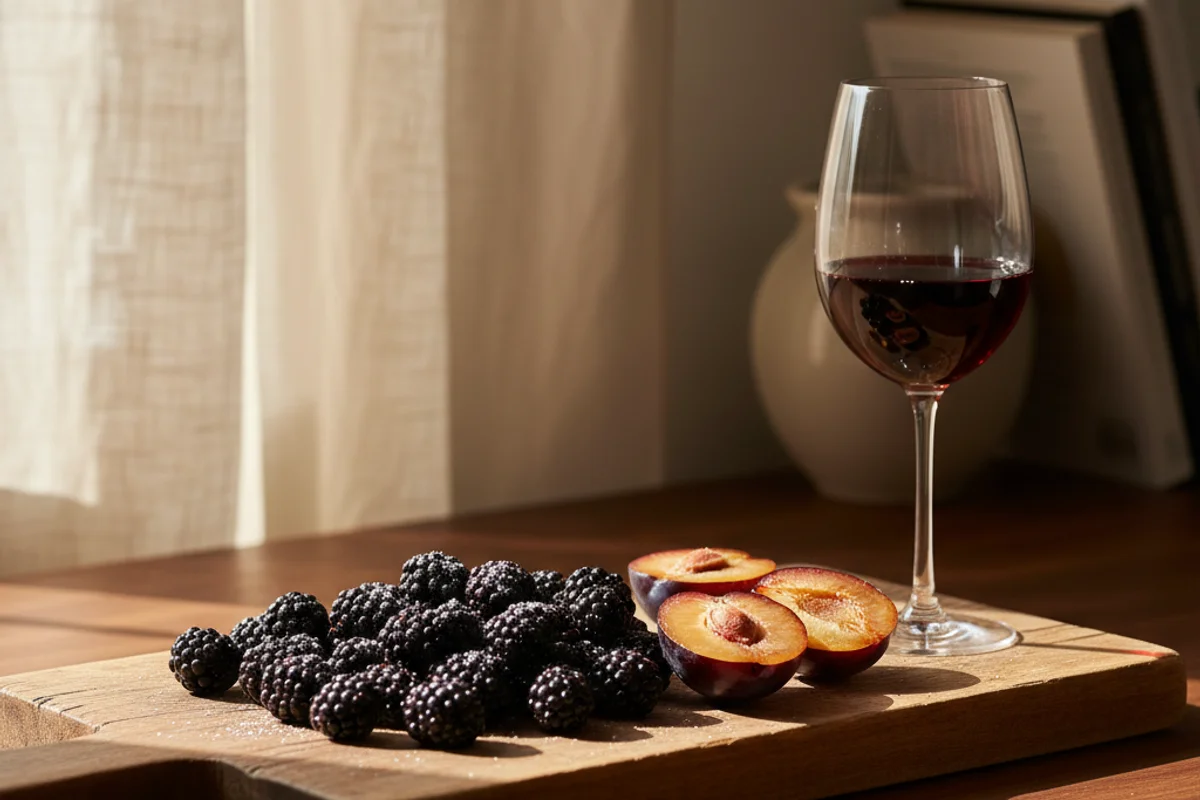
BLACKBERRY-BLACK-PLUM WINE
Blackberries bring loud, jammy fruit and a spine of tannin. Black plums bring depth, a little stone-fruit sweetness, and enough acidity to keep things interesting. Together they build a wine that’s almost port-dark in the glass and tastes like the best pie you never baked. This is a slow wine — patience is the real ingredient — but the result is rich, complex, and worth every month it sits quietly in the dark.
The beginner trap: Skipping the two-day enzyme rest before pitching yeast means the pectin never breaks down, and your finished wine will be permanently hazy no matter how long you wait.
Ingredients
- 4 lbs blackberries, fresh or frozen
- 2 lbs black plums (any dark-skinned variety), fresh or frozen
- 2¼ lbs granulated white sugar
- 7 pts (3.5 quarts) water
- 1 tsp pectic enzyme (sold at homebrew shops; no common substitute)
- 1 Campden tablet, crushed (potassium metabisulfite; find it at homebrew shops)
- 1 packet wine yeast plus yeast nutrient
Method
- Bring the water to a full boil, then set it aside while you prep the fruit.
- Wash and sort the blackberries; pit and roughly chop the plums.
- Mash the chopped plums in a large bowl, then load them into a nylon straining bag along with the blackberries. Tie the bag closed and set it in the bottom of your primary fermenter.
- Use a potato masher to crush the blackberries right through the bag.
- Pour the sugar into the primary, then pour the boiling water over the bag and sugar, stirring until the sugar fully dissolves.
- Let the must cool to lukewarm (around 70–75 °F), then stir in the crushed Campden tablet and the pectic enzyme.
- Cover the fermenter loosely and leave it alone for 48 hours.
- Stir in the yeast and yeast nutrient, then cover again.
- Ferment for 7 days, pushing the bag down and giving it a gentle squeeze once each day.
- Lift the bag and let it drip-drain completely — do not squeeze hard at this stage or you’ll add bitter tannins.
- Transfer the liquid to a dark secondary fermenter (a dark glass carboy or a jug wrapped in a paper bag works), fit an airlock, and leave it for 2 months.
- Rack off the sediment into a clean vessel; wait another 2 months, then rack again.
- Once the wine runs clear, rack one final time, refit the airlock, and bulk-age for 4 more months.
- Rack into bottles and age for at least 1 full year before opening.
Why this works
Blackberries and plums are both high in pectin — the same stuff that makes jam gel. When you add pectic enzyme before fermentation, it cuts those long pectin chains apart so they can’t form a haze cloud later. The 48-hour wait gives the enzyme time to work before yeast activity (and heat from fermentation) would degrade it. The repeated racking schedule isn’t busywork either: each time you move the wine off its lees, you remove dead yeast cells that, left too long, break down and release off-flavors. The long bottle age lets harsh tannins from the blackberry seeds and skins slowly polymerize and mellow, turning a rough young wine into something genuinely smooth.
Notes
Frozen fruit is an excellent choice here — the freeze-thaw cycle breaks cell walls and releases juice faster than fresh fruit does. If black plums aren’t available, any dark-fleshed plum (Damson, Friar, or Black Beauty) will do the job. If you can’t find wine yeast, a dry bread yeast will ferment the must, but flavor and alcohol tolerance will suffer — Lalvin EC-1118 or Red Star Premier Classique are widely available online and worth ordering.