Cabernet Sauvignon
Cabernet Sauvignon is the closest thing grapes have to a world traveler with strong opinions. The same variety grown in Napa tastes nothing like one from Bordeaux or Rioja — dark fruit, cedar, a whisper of tobacco, sometimes even a faint green pepper note that sounds weird until you taste it and realize it belongs. Starting from fresh or frozen Cab juice skips the crushing and pressing drama and gets you straight to the interesting part: fermentation, oak, and time. Patience is the main ingredient here.
The beginner trap: Skipping the hydrometer check and adding yeast to juice that’s below 1.095 will leave you with a thin, low-alcohol wine that won’t age well.
Ingredients
- 5 gallons Cabernet Sauvignon juice (fresh or frozen)
- Up to 1 cup finely granulated white sugar (only if starting SG is below 1.095)
- 6 Campden tablets, crushed (potassium metabisulfite powder works too — use ¼ tsp)
- 3 tsp yeast nutrient
- 2 tsp pectic enzyme
- 5 oz American white oak chips or French oak chips, in a fine mesh bag
- 1 packet wine yeast — Montrachet, Pasteur Red, or Champagne yeast
Method
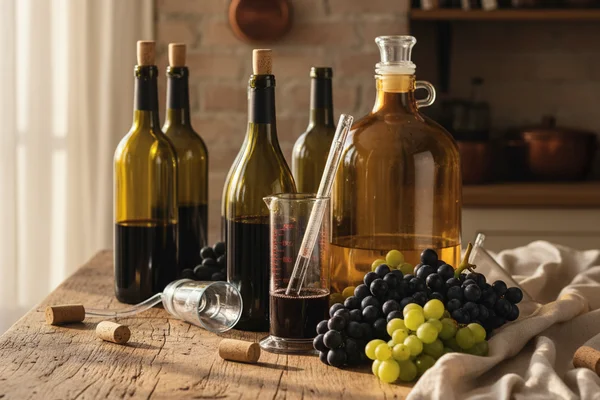
- Use a hydrometer to check the specific gravity (SG) of your juice. If it reads below 1.095, stir in small amounts of sugar until you hit that mark.
- Add the crushed Campden tablets and yeast nutrient to the juice and stir well. Cover the vessel and wait 12 hours.
- Add the pectic enzyme, stir, cover, and wait another 12 hours.
- Transfer the juice to a sanitized 6-gallon carboy, pitch the yeast, and fit an airlock.
- Ferment until SG drops to 1.010, then rack into a sanitized 5-gallon carboy, topping up with extra juice or water to minimize headspace. Refit the airlock.
- Continue fermenting until the wine reaches dryness — SG at 0.990 or lower.
- Rack the wine, top up, and set it aside for two months with the airlock in place.
- Rack again, then add the oak chips in their mesh bag. Move the carboy to a cool place — around 38°F is ideal, like a spare refrigerator.
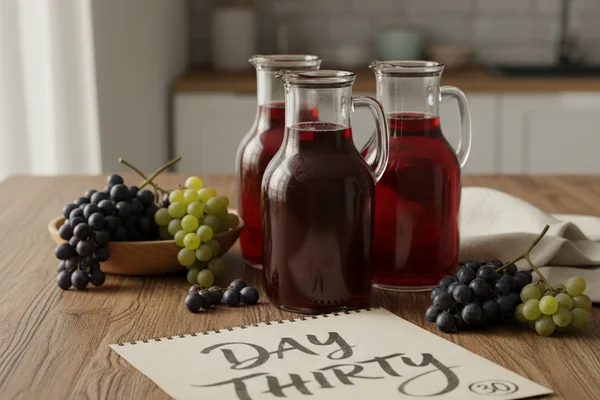
- Taste the wine after 30 days. If the oak flavor is where you want it, rack and remove the chips. If it needs more, wait one to two more weeks, then rack.
- Top up, refit the airlock, and return to the cool spot for another 2 to 4 months.
- Rack one final time, add a stabilizer (potassium sorbate plus one crushed Campden tablet), and wait 10 days before bottling.
Why this works
Cab juice is naturally high in tannins and complex phenolic compounds. Keeping the SG above 1.095 ensures enough sugar for a solid alcohol level — roughly 12.5% or higher — which acts as a preservative and helps those tannins integrate during aging. The Campden tablets knock out wild yeast and bacteria before your chosen yeast takes over, giving you a clean fermentation. Cold aging after oak contact does two things at once: it slows any remaining microbial activity and causes tartrate crystals to drop out of solution, which means less grit in your glass later. The oak chips contribute tannin, vanilla compounds called lactones, and low-level oxidation — the same chemistry that happens in a barrel, just faster.
Notes
This wine is drinkable after one year but noticeably better at two. If you have less than 5 gallons of juice, scale down into smaller carboys — a 3-gallon and a 1-gallon combo works well — and consider blending in a small amount of Merlot concentrate to fill out the batch. Frozen Cab juice from a reputable supplier works just as well as fresh; thaw it completely and let it reach room temperature before you start.