Canned Peaches and Pears
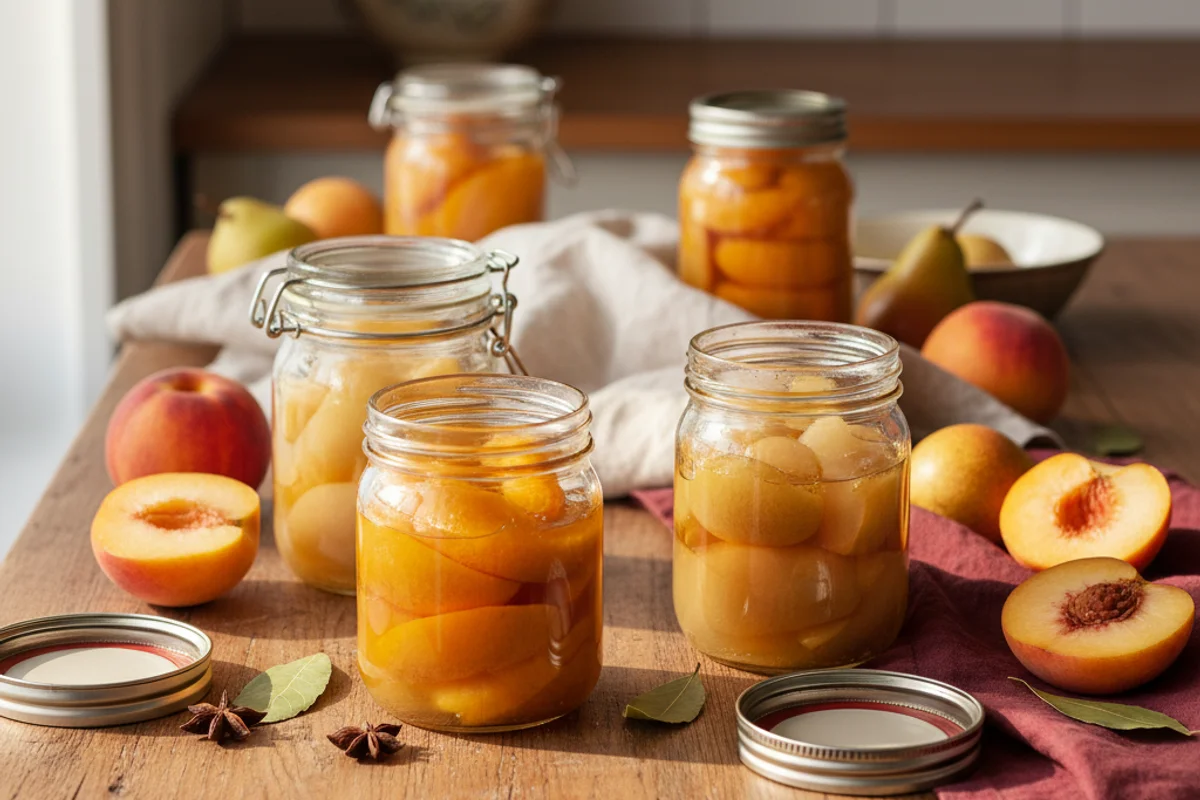
Think of canned peaches and pears as fruit that’s already halfway to wine. The canning process breaks down cell walls, releases sugars, and softens everything into a pulpy, syrup-soaked mass that yeast finds surprisingly inviting. What you won’t get is the bright, floral aroma of fresh fruit — that volatilizes long before the can is sealed. What you can get is a smooth, mellow stone-fruit wine with real body and a clean finish, especially if you start with a brand that actually tastes good straight from the can. That last part matters more than any additive you’ll add.
The beginner trap: Skipping the hydrometer and adding the full listed sugar amount without accounting for the sweetness already packed into the canning syrup — which turns your finished wine into dessert sauce.
Ingredients
- 32 oz (one large can) peaches or pears, packed in syrup — reserve the liquid
- 1 cup fresh-squeezed orange juice (bottled, no pulp, works fine)
- 3½ quarts water
- About 1 lb 11 oz granulated white sugar — use your hydrometer, not this number
- 2 tsp acid blend (found at homebrew shops; substitute ½ tsp citric acid + ½ tsp tartaric acid if needed)
- ½ tsp pectic enzyme
- ¼ tsp grape tannin (or 1 cup strongly brewed, cooled black tea)
- 1 tsp yeast nutrient
- 1 Campden tablet, crushed
- 1 packet Champagne yeast (Red Star Pasteur Blanc or similar)
Method
- Drain the canned fruit into a bowl and set the syrup aside. Chop the fruit into rough chunks and load it into a nylon straining bag; tie the bag closed and place it in your primary fermenter.
- Pour the reserved syrup and the orange juice over the bagged fruit.
- Bring the water to a boil, then pull it off the heat. Stir in 1 lb of sugar until fully dissolved, then check the specific gravity with your hydrometer.
- Continue adding sugar ¼ cup at a time, stirring and checking gravity each time, until you hit a specific gravity of 1.088–1.090. Pour this liquid over the fruit in the primary.
- Add the acid blend, grape tannin, yeast nutrient, and crushed Campden tablet; stir well. Cover the fermenter with a clean cloth and wait 12 hours.
- After 12 hours, stir in the pectic enzyme. Re-cover and wait another 12 hours.
- Sprinkle the yeast over the surface and re-cover. Fermentation should start within 24–48 hours.
- Once fermentation is active, push the fruit bag under the liquid once daily for 5 days. It will float back up — that’s fine. Stir the must each time you push it down.
- After 5 days, lift the bag and let it drip drain into the primary for several minutes. Do not squeeze it. Discard the spent fruit.
- Let the liquid settle for a few hours, then rack it into a clean, sanitized secondary fermenter (glass carboy or food-grade jug) and attach an airlock.
- Rack again after 2 months, topping up with a similar wine or water to minimize headspace. Repeat after another 2 months.
- After a final 2 months, add wine stabilizer (potassium sorbate + Campden), wait 10 days, then rack one more time.
- Taste and sweeten if desired: dissolve up to ¼ cup sugar in ⅛ cup warm water, stir it in, then bottle. Age at least 6 months before opening.
Why this works
Canned fruit sits in a sugar syrup that’s already begun breaking down pectin — the structural glue in plant cells. That’s good news for juice yield, but leftover pectin causes haze in finished wine. Pectic enzyme chews through those remaining pectin chains and drops them out of suspension, giving you a clearer pour. The Campden tablet does two jobs on day one: it knocks out wild yeast and bacteria hitching a ride from the fruit, and it buys time for the pectic enzyme to work before your chosen yeast takes over. Adding pectic enzyme while sulfite levels are still high actually slows it down, which is why the recipe staggers them 12 hours apart — sulfite first, enzyme second, yeast last.
Notes
Check the label on your canned fruit before you buy. If it lists potassium sorbate or sodium benzoate as a preservative, the must will not ferment — those compounds are specifically designed to stop yeast. Sulfite-preserved fruit can usually be worked around with a strong yeast starter, but sorbate and benzoate are dealbreakers. For a stronger aroma, stir in one can of frozen peach or pear juice concentrate with the water in step 3, then adjust your sugar addition downward accordingly — the concentrate adds significant sugar of its own.