Cloudberries
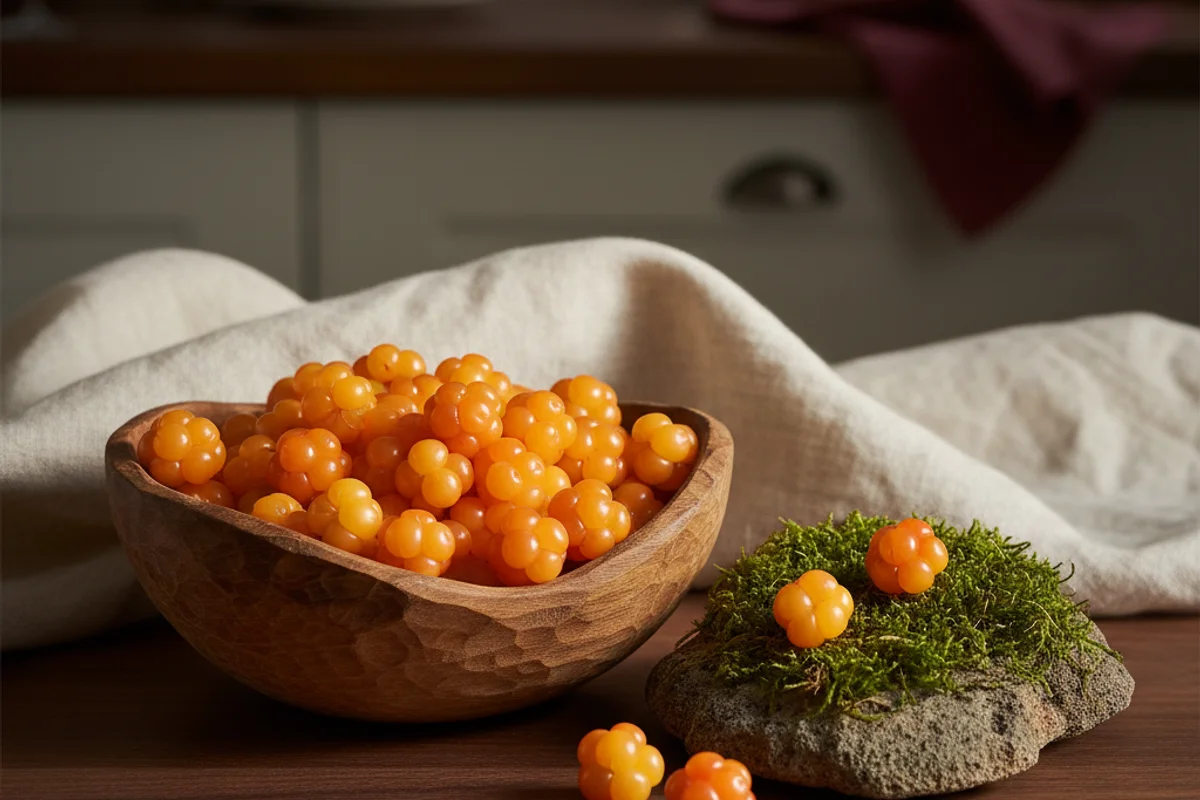
Imagine a raspberry and an apricot had a child and raised it in an Arctic bog. That’s roughly what a cloudberry tastes like — tart, floral, and faintly tropical, with a soft amber color that looks stunning in the glass. Rubus chamaemorus grows low to the ground across Scandinavia, Alaska, and northern Canada, ripening to a warm orange-gold. It’s rare enough that most people never taste one fresh. Turn it into wine, though, and you’ve got something genuinely special: full-bodied, strong, and complex enough to reward a full year of patience.
The beginner trap: Skipping or shortening the pectic enzyme rest will leave your wine permanently cloudy, because cloudberries are loaded with pectin that breaks down slowly.
Ingredients
- 4 lbs cloudberries, fresh or frozen, destemmed and crushed
- 3 lbs granulated white sugar
- 10 cups water, plus more to top up to 1 gallon
- 1 Campden tablet, crushed (potassium metabisulfite works too)
- ½ tsp pectic enzyme
- ½ tsp grape tannin powder (or 1 cup strong unsweetened black tea)
- 1 tsp yeast nutrient
- ½ tsp yeast energizer
- 1 packet Lalvin EC-1118 yeast (Champagne yeast), activated per packet instructions
Method
- Wash, destem, and crush the cloudberries in your primary fermenter (a food-grade bucket works fine).
- Dissolve the sugar completely in 10 cups of warm water, then pour it over the crushed fruit.
- Stir in the crushed Campden tablet, cover the bucket with a cloth, and let it sit for 12 hours.
- Add the pectic enzyme, stir well, re-cover, and wait another 12 hours.
- Stir in the tannin, yeast nutrient, and yeast energizer, then pitch the activated EC-1118 yeast.
- Ferment in the primary for 4 days, stirring the must twice a day to keep the fruit cap wet and the yeast active.
- Pour the must through a nylon straining bag into a 1-gallon glass jug (secondary), squeezing the bag gently to extract juice without forcing bitter solids through.
- Fit an airlock; once the vigorous bubbling slows, top the jug up to the shoulder with plain water to minimize headspace.
- Let it ferment to dryness at around 75°F — expect about one month.
- Rack into a clean 1-gallon jug, top up, reattach the airlock, and repeat every 3 months for a full year.
- After the final racking, stabilize with a fresh Campden tablet and ½ tsp potassium sorbate, then sweeten to a specific gravity of 1.025–1.030 if desired before bottling.
Why this works
EC-1118 is a Champagne yeast chosen for good reason here. Cloudberry must ferments dry easily because of its high sugar load (3 lbs per gallon pushes the potential alcohol well above 14%), and a weaker yeast might stall partway through and leave you with an unstable, partially sweet wine prone to re-fermentation in the bottle. EC-1118 tolerates high alcohol and low nutrients without flinching. The pectic enzyme breaks down cell-wall pectin that would otherwise form a permanent haze — fruit pectin doesn’t fall out on its own, no matter how long you wait. The long, patient racking schedule (quarterly for a year) drops out sediment in stages and lets the wine mellow, which matters a lot with a high-alcohol, full-bodied fruit wine like this one.
Notes
Cloudberries are hard to find fresh outside of their native range, but frozen cloudberries imported from Scandinavia show up in specialty grocery stores and online — they work just as well, sometimes better, since freezing breaks down cell walls and improves juice extraction. If you can’t find grape tannin powder, a cup of strong brewed black tea is a reliable everyday substitute. This wine is genuinely better with a touch of residual sweetness at bottling; don’t skip the back-sweetening step if you want the fruit character to shine.