CONVERSIONS AND EQUIVALENTS
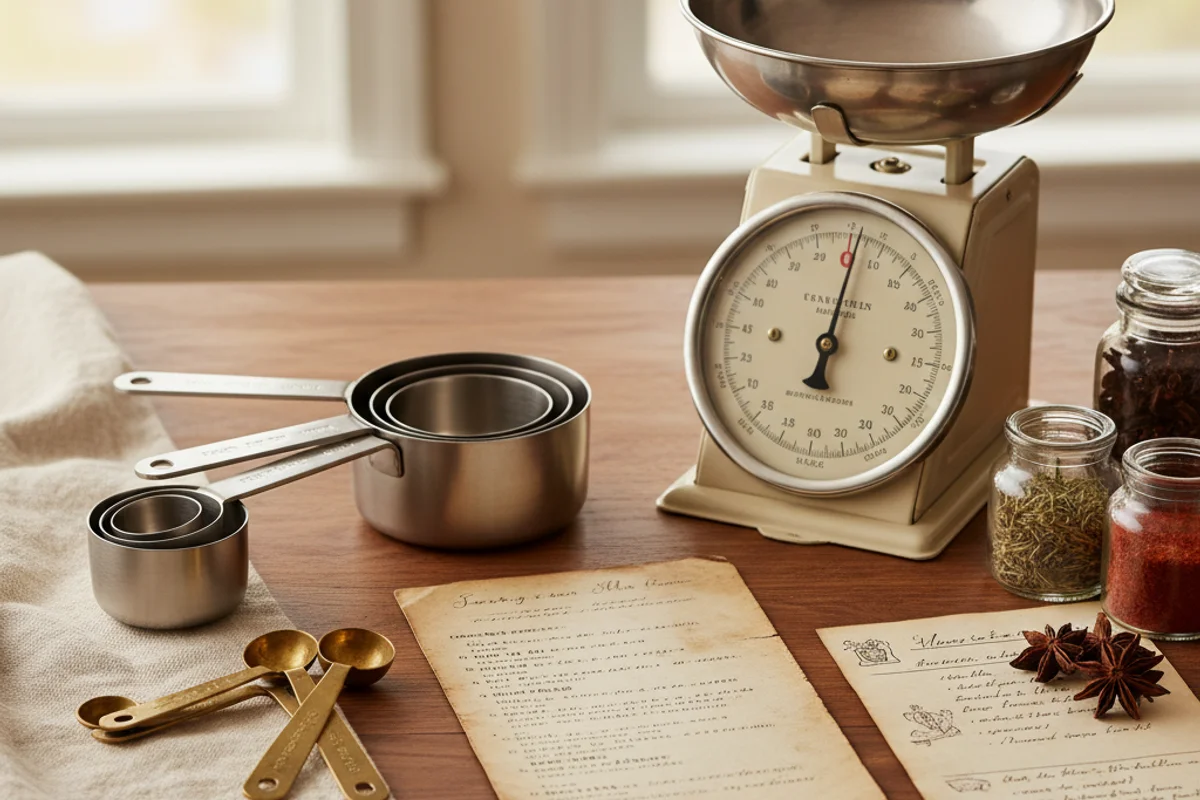
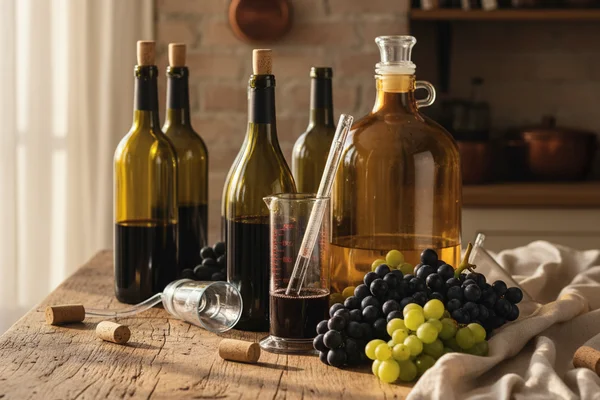
Numbers run the show in winemaking. Get them wrong and your carefully tended must ends up too sweet, too thin, or short by a full bottle. The problem is that winemaking recipes come from everywhere — the UK, Australia, the US, continental Europe — and each of those places plays by slightly different rules. A “gallon” in a British recipe is not the same animal as a gallon on an American measuring jug. Neither is a pint, a cup, or an ounce. Before you scale a single recipe, you need a rosetta stone for units.
The beginner trap: Assuming a gallon is a gallon — a British Imperial gallon holds about 20% more liquid than a US gallon, which throws off sugar additions, yeast nutrient doses, and final yield counts all at once.
Liquid Equivalents
US Gallon vs. Imperial Gallon
| One US liquid gallon equals… | One Imperial liquid gallon equals… |
|---|
| 0.832 Imperial gallons | 1.2 US liquid gallons |
| 3.785 liters | 4.546 liters |
| 128 US fluid ounces | 160 Imperial fluid ounces |
| 133.2 Imperial fluid ounces | 153.7 US fluid ounces |
| 8 US liquid pints | 8 Imperial liquid pints |
| 6.66 Imperial liquid pints | 9.6 US liquid pints |
| 4 US liquid quarts | 4 Imperial liquid quarts |
| 3.33 Imperial liquid quarts | 4.8 US liquid quarts |
| 5 standard bottles (750 ml) | 6 standard bottles (750 ml) |
Common Measures to Milliliters
| Measure | Milliliters |
|---|
| 1 US cup | 237 ml |
| 1 Imperial cup | 250 ml |
| ½ US cup | 118 ml |
| ⅓ US cup | 79 ml |
| ¼ US cup | 60 ml |
| 2 tablespoons | 30 ml |
| 1 teaspoon | 5 ml |
| 1 US pint | 473 ml |
| 1 US quart | 946 ml |
| 1 US gallon | 3,785 ml |
Weight Equivalents
US to Metric
| US Weight | Grams | Kilograms |
|---|
| 1 oz | 28.35 g | 0.028 kg |
| 2 oz | 56.70 g | 0.057 kg |
| 4 oz | 113.40 g | 0.113 kg |
| 8 oz | 226.80 g | 0.227 kg |
| 12 oz | 340.19 g | 0.340 kg |
| 1 lb (16 oz) | 453.59 g | 0.454 kg |
| 2 lb | 907.19 g | 0.907 kg |
| 3 lb | 1,360.78 g | 1.361 kg |
| 4 lb | 1,814.37 g | 1.814 kg |
| 5 lb | 2,267.96 g | 2.268 kg |
| 10 lb | 4,535.92 g | 4.536 kg |
Metric to US
| Metric Weight | US Ounces | US Pounds |
|---|
| 1 g | 0.035 oz | 0.002 lb |
| 5 g | 0.176 oz | 0.011 lb |
| 10 g | 0.353 oz | 0.022 lb |
| 25 g | 0.882 oz | 0.055 lb |
| 50 g | 1.764 oz | 0.110 lb |
| 100 g | 3.527 oz | 0.220 lb |
| 500 g | 17.637 oz | 1.102 lb |
| 1 kg | 35.274 oz | 2.205 lb |
| 2 kg | 70.548 oz | 4.409 lb |
| 5 kg | 176.370 oz | 11.023 lb |
Wine Bottle Sizes
| Bottle Name | Volume |
|---|
| Sample | 175 ml |
| Split | 187 ml |
| Third | 250 ml |
| Half | 375 ml |
| Pot (Beaujolais) | 500 ml |
| Clavelin (Jura) | 620 ml |
| Standard | 750 ml |
| Liter | 1,000 ml |
| Magnum | 1,500 ml |
| Tregnum | 2,250 ml |
| Double Magnum / Jeroboam (Sparkling) | 3,000 ml |
| Jeroboam (Bordeaux) | 4,500–5,000 ml |
| Rehoboam | 4,500 ml |
| Imperial (Bordeaux) / Methuselah (Sparkling) | 6,000 ml |
| Salmanazar | 9,000 ml |
| Balthazar | 12,000 ml |
| Nebuchadnezzar | 15,000 ml |
| Sovereign | 50,000 ml |
Temperature: Celsius to Fahrenheit
| °C | °F | °C | °F |
|---|
| 0 | 32.0 | 22 | 71.6 |
| 1 | 33.8 | 23 | 73.4 |
| 2 | 35.6 | 24 | 75.2 |
| 3 | 37.4 | 25 | 77.0 |
| 4 | 39.2 | 26 | 78.8 |
| 5 | 41.0 | 27 | 80.6 |
| 6 | 42.8 | 28 | 82.4 |
| 7 | 44.6 | 29 | 84.2 |
| 8 | 46.4 | 30 | 86.0 |
| 9 | 48.2 | 32 | 89.6 |
| 10 | 50.0 | 35 | 95.0 |
| 12 | 53.6 | 36 | 96.8 |
| 15 | 59.0 | 37 | 98.6 |
| 17 | 62.6 | 38 | 100.4 |
| 20 | 68.0 | 39 | 102.2 |
| 21 | 69.8 | 40 | 104.0 |
Quick formula: °F = (°C × 9/5) + 32 | °C = (°F − 32) × 5/9
Specific Gravity to Brix
| SG | Brix | SG | Brix | SG | Brix | SG | Brix |
|---|
| 1.000 | 0.00 | 1.033 | 8.28 | 1.066 | 16.11 | 1.099 | 23.53 |
| 1.001 | 0.26 | 1.034 | 8.53 | 1.067 | 16.34 | 1.100 | 23.75 |
| 1.002 | 0.51 | 1.035 | 8.77 | 1.068 | 16.57 | 1.101 | 23.96 |
| 1.003 | 0.77 | 1.036 | 9.01 | 1.069 | 16.80 | 1.102 | 24.18 |
| 1.004 | 1.03 | 1.037 | 9.26 | 1.070 | 17.03 | 1.103 | 24.40 |
| 1.005 | 1.28 | 1.038 | 9.50 | 1.071 | 17.26 | 1.104 | 24.62 |
| 1.006 | 1.54 | 1.039 | 9.74 | 1.072 | 17.49 | 1.105 | 24.83 |
| 1.007 | 1.80 | 1.040 | 9.98 | 1.073 | 17.72 | 1.106 | 25.05 |
| 1.008 | 2.05 | 1.041 | 10.22 | 1.074 | 17.95 | 1.107 | 25.27 |
| 1.009 | 2.31 | 1.042 | 10.46 | 1.075 | 18.18 | 1.108 | 25.48 |
| 1.010 | 2.56 | 1.043 | 10.70 | 1.076 | 18.40 | 1.109 | 25.70 |
| 1.011 | 2.81 | 1.044 | 10.94 | 1.077 | 18.63 | 1.110 | 25.91 |
| 1.012 | 3.07 | 1.045 | 11.18 | 1.078 | 18.86 | 1.111 | 26.13 |
| 1.013 | 3.32 | 1.046 | 11.42 | 1.079 | 19.08 | 1.112 | 26.34 |
| 1.014 | 3.57 | 1.047 | 11.66 | 1.080 | 19.31 | 1.113 | 26.56 |
| 1.015 | 3.82 | 1.048 | 11.90 | 1.081 | 19.53 | 1.114 | 26.77 |
| 1.016 | 4.08 | 1.049 | 12.14 | 1.082 | 19.76 | 1.115 | 26.98 |
| 1.017 | 4.33 | 1.050 | 12.37 | 1.083 | 19.98 | 1.116 | 27.20 |
| 1.018 | 4.58 | 1.051 | 12.61 | 1.084 | 20.21 | 1.117 | 27.41 |
| 1.019 | 4.83 | 1.052 | 12.85 | 1.085 | 20.43 | 1.118 | 27.62 |
| 1.020 | 5.08 | 1.053 | 13.08 | 1.086 | 20.65 | 1.119 | 27.83 |
| 1.021 | 5.33 | 1.054 | 13.32 | 1.087 | 20.88 | 1.120 | 28.05 |
| 1.022 | 5.57 | 1.055 | 13.55 | 1.088 | 21.10 | 1.121 | 28.26 |
| 1.023 | 5.82 | 1.056 | 13.79 | 1.089 | 21.32 | 1.122 | 28.47 |
| 1.024 | 6.07 | 1.057 | 14.02 | 1.090 | 21.54 | 1.123 | 28.68 |
| 1.025 | 6.32 | 1.058 | 14.26 | 1.091 | 21.77 | 1.124 | 28.89 |
| 1.026 | 6.57 | 1.059 | 14.49 | 1.092 | 21.99 | 1.125 | 29.10 |
| 1.027 | 6.81 | 1.060 | 14.72 | 1.093 | 22.21 | 1.126 | 29.31 |
| 1.028 | 7.06 | 1.061 | 14.96 | 1.094 | 22.43 | 1.127 | 29.52 |
| 1.029 | 7.30 | 1.062 | 15.19 | 1.095 | 22.65 | 1.128 | 29.73 |
| 1.030 | 7.55 | 1.063 | 15.42 | 1.096 | 22.87 | 1.129 | 29.94 |
| 1.031 | 7.80 | 1.064 | 15.65 | 1.097 | 23.09 | 1.130 | 30.15 |
| 1.032 | 8.04 | 1.065 | 15.88 | 1.098 | 23.31 | | |
Why this works
Specific gravity measures how dense your must is compared to plain water (SG 1.000). Sugar dissolved in water raises that density. Brix is just a different scale for the same thing — it tells you the percentage of sugar by weight in the liquid. Yeast eat sugar and produce alcohol, so both numbers let you predict your final ABV before fermentation starts. A must at SG 1.090 (about 21.5 Brix) will yield roughly 12% ABV if fermented dry. The two scales are not perfectly linear across the full range, which is why a lookup table beats a back-of-the-envelope calculation every time.
Notes
Bookmark this page and use it every time you adapt a recipe from a foreign source — mental unit conversions under pressure are where mistakes happen. If a recipe calls for an Imperial gallon and you only have US gallon equipment, multiply all liquid additions by 1.2 to keep everything in proportion. For small additive doses (campden tablets, nutrients, acid), the milliliter table above is your safest reference since those doses are highly sensitive to volume errors.