CRANBERRY-CURRANT WINE
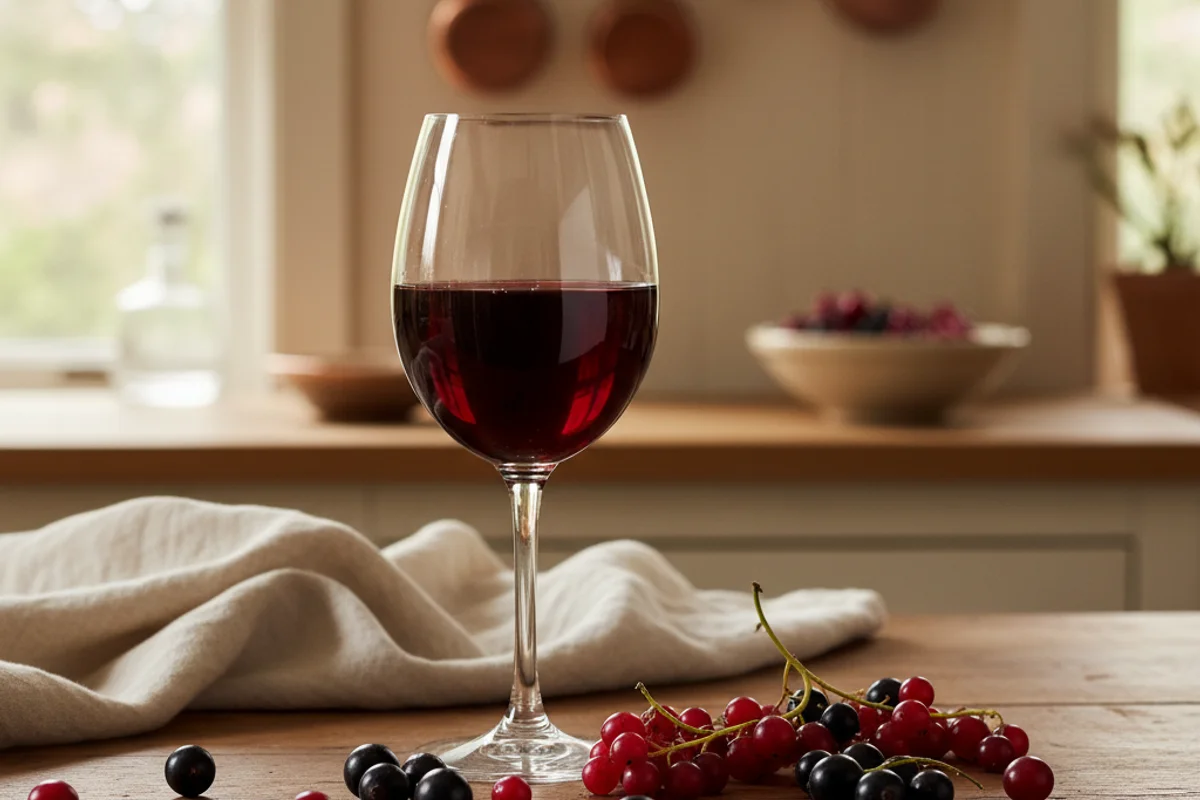
Cranberries are one of the few fruits that can go toe-to-toe with grapes in the winemaking world. They bring sharp acidity, a deep ruby color, and a bold flavor that holds up through months of aging. Black currants add a darker, jammier layer — earthy and almost winey on their own. Together, these two fruits build a wine with real structure: tart enough to wake you up, complex enough to make you slow down. Serve it cold and it drinks like something far more expensive than it is.
The beginner trap: New winemakers almost always squeeze the fruit bag when draining — don’t, because that forces bitter, cloudy pulp into your must and ruins clarity.
Ingredients
- 2 lbs cranberries, fresh or frozen, roughly chopped
- 1 lb black currants, fresh or frozen
- 2 lbs invert sugar (see Notes)
- 6⅔ pints (about 3.3 quarts) water
- ½ tsp pectic enzyme
- 1 tsp yeast nutrient
- ⅛ tsp wine tannin (or 2 oz strong unsweetened black tea as a substitute)
- 1 packet Montrachet wine yeast (or any dry wine yeast)
Method
- Make your invert sugar ahead of time and set it aside to cool.
- Bring the water to a full rolling boil while you wash and sort through the cranberries and currants, discarding any damaged fruit.
- Roughly chop the cranberries with a knife or food processor, then load them into a nylon straining bag along with the currants. Tie the bag closed and place it in your primary fermenter.
- Crush the currants through the bag using your hands or a clean piece of hardwood — you want the skins broken, not the bag.
- Pour the boiling water directly over the bag, then stir in the invert sugar, tannin, pectic enzyme, and yeast nutrient.
- Cover the fermenter and let it rest for 12 hours to cool and allow the pectic enzyme to start working.
- Activate your yeast according to the packet instructions, then add it to the must.
- Punch the bag down twice a day — press it under the liquid, but never squeeze it.
- After 7 days, lift the bag and let it drip drain into the fermenter until it stops on its own; discard the pulp.
- Re-cover the fermenter and wait for the specific gravity to fall to 1.015.
- Rack the wine into a glass secondary fermenter, fit an airlock, and move it somewhere dark and cool.
- Rack every 2 months for the next 6 months, refitting the airlock each time.
- Stabilize the wine, refit the airlock, and leave it undisturbed in a dark place for 4 more months.
- Rack one final time, sweeten to taste if desired, then bottle. Age at least 6 more months before opening.
Why this works
Cranberries are loaded with natural pectin — the same stuff that makes jam gel. In wine, that pectin breaks down into a haze that won’t settle out on its own. Pectic enzyme (pectinase) cuts through that pectin early in fermentation, which is why you add it before the yeast and give it 12 hours to work. The boiling water also helps rupture cell walls in the fruit, releasing more juice and flavor. Invert sugar — sucrose that’s been split into glucose and fructose — ferments more cleanly and evenly than plain table sugar, which gives the yeast an easier job and leaves less risk of a stuck fermentation.
Notes
To make invert sugar at home, dissolve 2 lbs of white granulated sugar in about a cup of water, add ½ teaspoon of citric acid or a squeeze of lemon juice, and simmer for 20 minutes — plain table sugar works as a direct substitute if you skip this step, though fermentation may be slightly slower. Frozen cranberries from the grocery store work just as well as fresh and are available year-round; frozen black currants (sometimes sold as “cassis”) can be found in the freezer section of many international grocery stores.