CUSTARD APPLE WINE
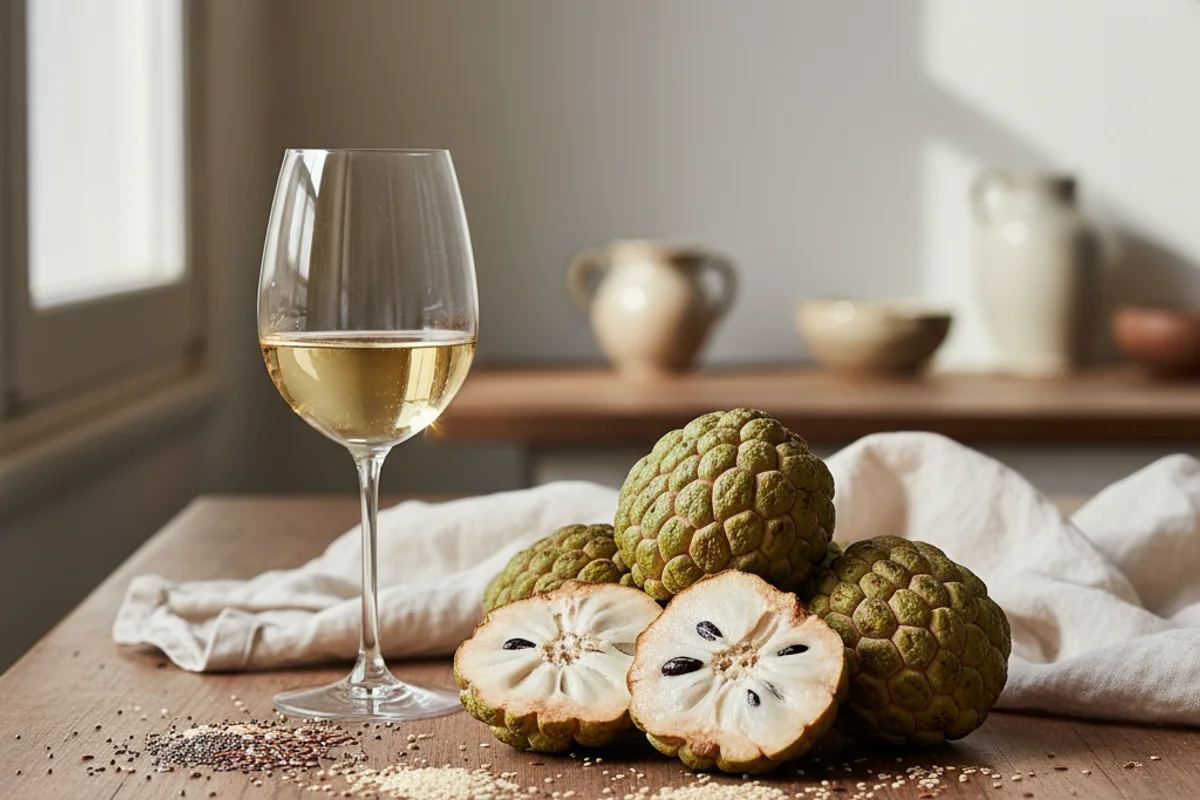
Imagine a fruit that tastes like someone blended a banana, a pear, and a vanilla custard, then wrapped the whole thing in green, scaly armor. That’s the custard apple — also sold as atemoya — and it makes a wine that is floral, lush, and just a little exotic. The flesh is intensely sweet and low in acid, which means you have real chemistry work to do. Get the balance right, though, and you end up with something genuinely surprising in the glass.
The beginner trap: Custard apple flesh is loaded with pectin, so skipping or shortchanging the pectic enzyme step will leave you with a permanently hazy wine that no amount of patience will fix.
Ingredients
- 8 lb. custard apples (atemoya or cherimoya; fresh or frozen)
- 1½ lb. granulated sugar
- 2 qt. water
- 1¼ tsp. acid blend
- 1 tsp. pectic enzyme
- 1 tsp. yeast nutrient
- ⅛ tsp. grape tannin (or 1 cup strong black tea, cooled)
- 1 Campden tablet, crushed
- 1 packet Côte des Blancs wine yeast (or any dry white wine yeast)
Method
- Bring 1 pint of the water to a boil and dissolve the sugar in it completely. Add the remaining water, stir, and set aside to cool to room temperature.
- Wash the fruit, cut it into wedges, then chop those into roughly ½-inch pieces — skin on, seeds discarded. Place the pieces into your primary fermentation bucket.
- Sprinkle the pectic enzyme evenly over the fruit and cover the bucket loosely.
- Once the sugar water has cooled to room temperature, stir in the crushed Campden tablet until dissolved, then pour it over the fruit. Cover and leave undisturbed for 10–12 hours.
- After the waiting period, add the acid blend, grape tannin, and yeast nutrient. Activate your yeast according to the packet instructions, then add it to the must. Stir everything together.
- Cover the bucket and stir the must twice daily. Use a hydrometer to track fermentation — when the specific gravity falls below 1.020, it’s time to press.
- Pour the must through a nylon straining bag set over a clean container. Squeeze the bag gently by hand to extract the liquid without forcing bitter compounds out of the pulp.
- Transfer the liquid to a glass carboy or secondary fermenter, top up with water to within 2 inches of the top, and fit an airlock.
- After 3 weeks, rack the wine into a clean vessel, top up again, and reattach the airlock. Repeat this racking every 6 weeks for the next 3 months.
- Once the wine runs clear, taste it. If you want it sweeter, dissolve ½ tsp. potassium sorbate and 1 crushed Campden tablet in a small amount of wine, stir it in, then add sugar to taste. Wait 10 days to confirm fermentation has not restarted, then bottle.
- If the wine does not clear on its own, fine it with bentonite following the package directions. Rack once more after 7–10 days, then bottle. This wine is drinkable at 3 months but rewards patience.
Why this works
Custard apples sit at a tricky intersection: very high natural sugar (some varieties hit 12 °Brix on their own) paired with very low natural acid. That combination would produce a flat, cloying wine without intervention. Adding acid blend brings pH into a range where yeast thrive and where the finished wine actually tastes bright rather than flabby. The pectic enzyme is equally critical — it breaks down the long-chain pectin molecules in the fruit’s flesh that would otherwise scatter light and make your wine look like diluted yogurt. Côte des Blancs yeast is a smart pick here because it ferments at lower temperatures and tends to preserve delicate fruit aromatics instead of blowing them off as volatile esters.
Notes
Frozen custard apples or frozen cherimoya pulp (sometimes found in Latin grocery stores) work well and can actually be easier to work with since freezing breaks down cell walls and improves juice extraction. If you cannot find acid blend, a mix of tartaric and citric acid from a homebrew shop is a fine substitute. If your finished wine tastes thin, a small addition of glycerin (1–2 tsp. per gallon) at bottling can restore some of that characteristic silky body.