DRIED CRANBERRY WINE
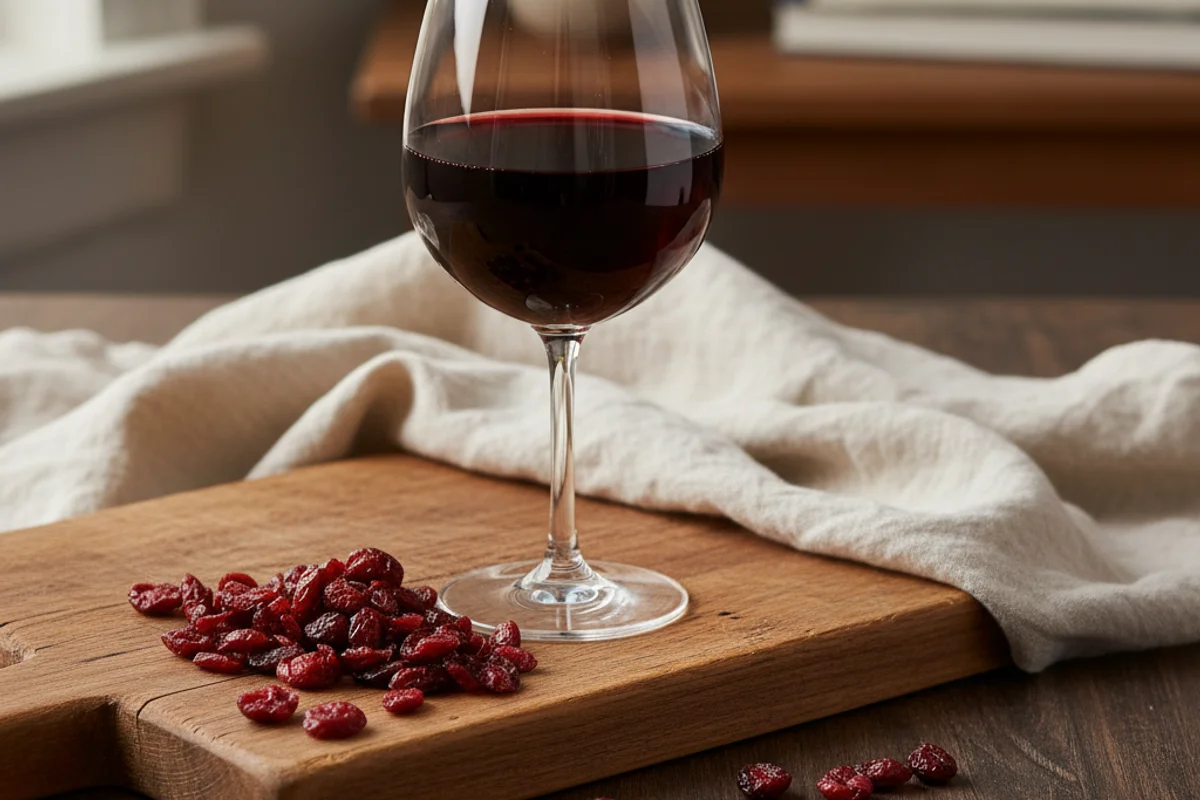
Dried cranberries are a winemaker’s secret weapon. Stripping out the water concentrates everything — the tartness, the color, the bold fruit character — into a small, shelf-stable package you can buy at any grocery store year-round. What you get in the glass is a deep ruby wine with sharp berry notes, a clean acid bite, and enough structure to stand up to some residual sweetness. Think cranberry sauce meets Burgundy, and you’re in the right neighborhood.
The beginner trap: Using dried cranberries that contain sorbic acid (potassium sorbate) — check the label, because sorbate will block fermentation and ruin the batch entirely.
Ingredients
- 1 lb dried cranberries, unsulfited (check the label — no sorbic acid)
- 2 lbs granulated sugar
- 1 tsp pectic enzyme
- 1 tsp yeast nutrient
- 1/8 tsp wine tannin (or 1 cup strong-brewed black tea as a substitute)
- 1 Campden tablet, crushed (skip this if your cranberries were sulfited)
- Water to make 1 gallon total
- 1 packet Lalvin RC212 wine yeast (or any Burgundy-style red wine yeast)
Method
- Chop the dried cranberries coarsely, or pulse them a few times in a food processor to break them up.
- Place the chopped cranberries in your primary fermenter and pour 1 quart of warm water over them.
- Stir in the crushed Campden tablet, cover the fermenter, and leave it alone for 12 hours.
- Add the pectic enzyme, re-cover, and wait another 12 hours.
- Meanwhile, bring the remaining water to a boil, dissolve the sugar completely into it, then let it cool to room temperature.
- Once the pectic enzyme treatment is done, add the cooled sugar water, yeast nutrient, and tannin to the fermenter and stir everything together well.
- Sprinkle the yeast on top, cover the fermenter loosely, and stir the must twice a day for 7 days.
- Strain out the cranberry solids, rack the liquid into a 1-gallon secondary fermenter, and fit an airlock.
- Rack the wine every 60 days for 6 months, topping up to minimize headspace and replacing the airlock each time.
- Stabilize with Campden and potassium sorbate, sweeten to taste, then wait 10–14 days before racking into bottles.
- Store bottles in a cool, dark place for at least 6 more months before opening.
Why this works
Dried fruit packs a surprising challenge: all that concentrated sugar and dense cell structure means juice extraction is slow. Chopping the cranberries breaks open more cells right away, giving you better color and flavor. The pectic enzyme is the real hero here — it breaks down pectin, a structural carbohydrate in the fruit cell walls, which improves juice yield and prevents a hazy finished wine. The two-stage wait (12 hours for sulfite off-gassing, then 12 more for enzyme action) makes sure neither step interferes with the other. RC212 yeast was bred for thick-skinned, high-tannin red fruit, which makes it a natural fit for cranberries’ bold character.
Notes
If your dried cranberries are sweetened (most store-bought ones are), consider reducing the added sugar by about 1/4 lb and tasting as you go at the back-sweetening stage. Unsweetened dried cranberries can sometimes be found at natural food stores or online, but sweetened Ocean Spray–style cranberries work fine. If you can only find sulfited cranberries, simply omit the Campden tablet at step 3.