ELDERFLOWER WINE (2)
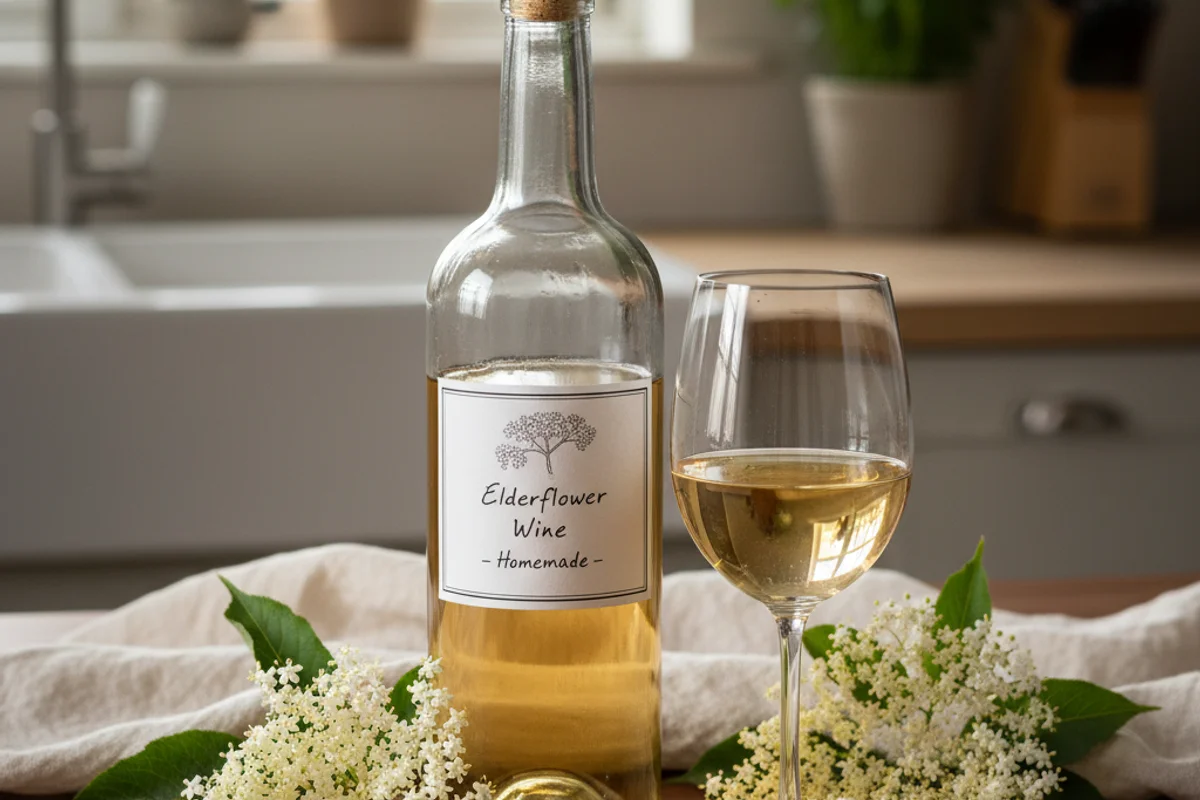
Elderflowers have a narrow window — blink and they’re gone. But catch them at peak bloom and you get a floral, honey-tinged fragrance that no grape can replicate. This recipe pairs those blossoms with white grape juice concentrate to give the wine a fuller body and a familiar fruit backbone. The result is pale, delicate, and surprisingly complex — somewhere between a dry Muscat and a meadow in June. It takes patience (plan on nine months, minimum), but the payoff is a wine that tastes like you spent far more effort than you actually did.
The beginner trap: Leaving green stems and stalks attached — they carry bitter, grassy compounds that will haunt every glass.
Ingredients
- 6½ pts (about 13 cups) water
- 2 lbs granulated sugar
- 1 pt fresh elderflowers, stripped from stalks and rinsed
- 12 oz frozen white grape juice concentrate, thawed
- 1½ tsp acid blend (or 1 tsp lemon juice per cup as a backup)
- 1 Campden tablet, crushed
- 1 tsp yeast nutrient
- 1 packet wine yeast (Lalvin 71B or EC-1118 work well)
Method
- Bring the water to a full boil. While it heats, strip the flowers from every last bit of stalk and rinse them gently to remove insects and dust.
- Add the flowers, sugar, and thawed grape juice concentrate to your primary fermenter. Pour the boiling water over everything and stir until the sugar fully dissolves.
- Cover the fermenter with a clean cloth and let it cool to room temperature — this takes several hours.
- Stir in the acid blend, crushed Campden tablet, and yeast nutrient. Re-cover and leave undisturbed for 24 hours.
- Pitch the yeast, re-cover, and ferment for 6 days, stirring daily.
- Strain out the flowers, then transfer the liquid to a sealed secondary fermenter and fit an airlock.
- When the specific gravity reaches 1.005, rack into a clean vessel, top up to minimize headspace, and refit the airlock.
- After 3 more months, stabilize with a fresh Campden tablet plus potassium sorbate, sweeten to taste if desired, and wait 10 days.
- Rack into bottles and age at least 6 months before opening.
Why this works
Elderflowers release their aroma compounds — primarily linalool and hotrienol — best in hot water, which is why the boiling pour-over is worth the extra step. The grape juice concentrate adds fermentable sugars and natural grape acids, giving the yeast a richer environment than flowers alone would provide. That translates to better body and a more stable finished wine. The 24-hour Campden rest knocks out wild yeast and bacteria before your chosen strain takes over, so you get a clean, predictable fermentation instead of a wild, unpredictable one. The long aging period lets harsh fusel alcohols mellow and allows the floral esters to fully bloom.
Notes
Fresh elderflowers are ideal, but if you forage a large batch you can freeze them in airtight bags and use them within 6 months — just measure the same volume. Acid blend is sold at homebrew shops; if you can’t find it, fresh lemon juice is a workable substitute, though the flavor profile will shift slightly. If your finished wine tastes flat after stabilizing, a small addition of sugar dissolved in a little wine (back-sweetening) goes a long way.