FEIJOA WINE
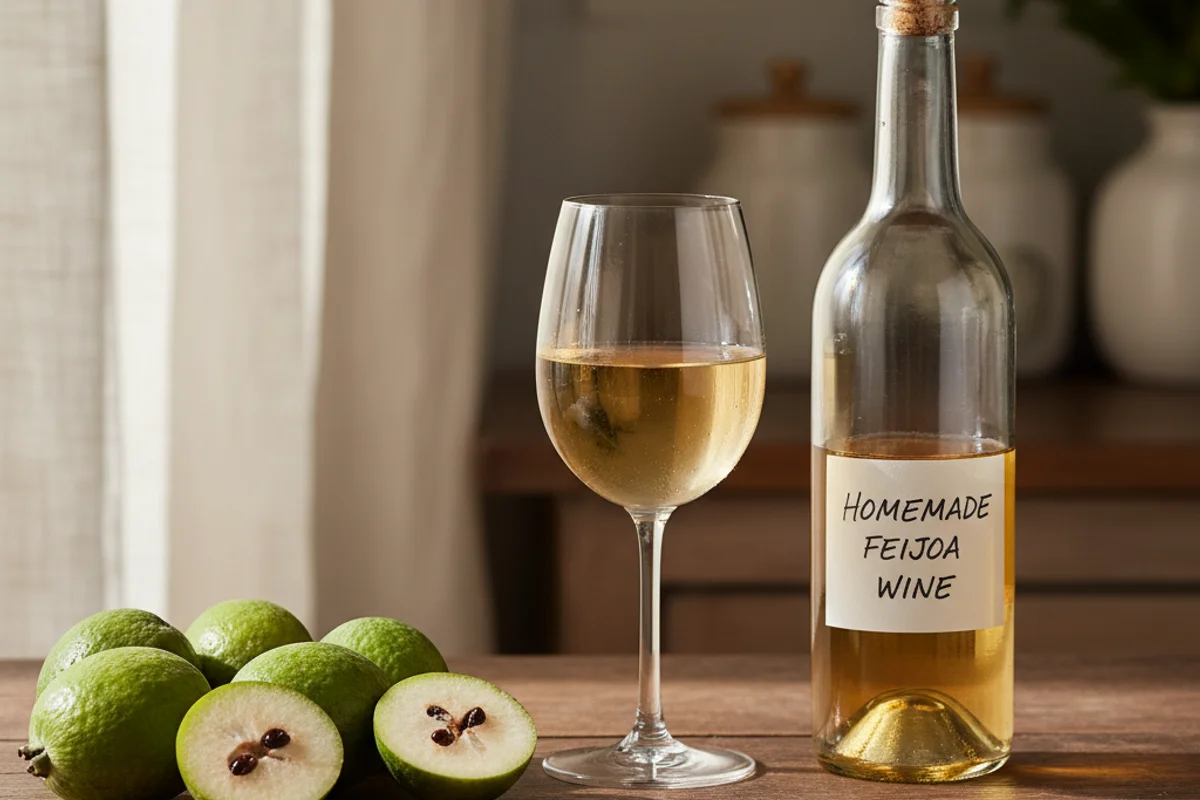
Crack open a feijoa and you get hit with something that doesn’t quite fit any box you already have. It smells like a perfume counter designed by someone who loves both tropical fruit and fresh mint. The flesh is pale yellow, soft, and sweet — somewhere between a ripe banana and a pineapple, with a cool, almost herbal finish that makes it genuinely unlike anything else you’ll ferment. Native to South America but beloved in New Zealand and coastal California, feijoas have a short season and even shorter shelf life, which makes wine an excellent way to capture that fleeting, aromatic weirdness before it disappears.
The beginner trap: Feijoas are loaded with citric acid but contain almost no tartaric or malic acid, so skipping the acid additions will leave your wine flat and unbalanced — add them both, no shortcuts.
Ingredients
- 2½ lbs feijoas, peeled and roughly chopped (fresh or frozen)
- Sugar, enough to raise specific gravity to 1.100 (roughly 1½–2 lbs, measure with a hydrometer)
- Water, enough to bring total volume to 1 gallon
- ½ tsp tartaric acid (find at homebrew shops or online)
- ¼ tsp malic acid (same source; a small squeeze of fresh lemon juice is a rough emergency stand-in)
- ¼ tsp grape tannin powder (or 1 cooled cup of strong black tea)
- 1½ tsp pectic enzyme
- 1 tsp yeast nutrient
- 1 packet wine yeast (a Champagne or Montrachet-style yeast works well)
Method
- Wash the feijoas thoroughly before peeling. Discard the skins and chop the flesh roughly into chunks.
- Place the chopped fruit into a nylon straining bag, tie it closed, and set it in your primary fermenter. Mash and squeeze the bag firmly to release as much juice as possible, then set the bag aside.
- Add enough water to bring the total liquid to 1 gallon. Check the specific gravity with a hydrometer and stir in sugar a little at a time until you hit 1.100.
- Add the tartaric acid, malic acid, tannin, yeast nutrient, and pectic enzyme. Stir well, cover the fermenter, and let it rest for 12 hours.
- Prepare your yeast starter according to the packet instructions, then add the yeast and the bag of fruit pulp back into the fermenter.
- Ferment on the pulp for 6 days, squeezing the bag firmly once each day to pull out juice. On day 6, give the bag a final thorough squeeze and remove it.
- Let the must settle overnight, then siphon the liquid off the sediment into a clean secondary fermenter (a 1-gallon glass jug) and fit an airlock. Pour any overflow into a small sealed container and refrigerate it — you’ll need it for topping up later.
- Ferment in the secondary for 30 days, then rack into a clean jug, top up with your refrigerated reserve, and refit the airlock.
- After another 60 days, rack again and top up. After a final 60 days, rack into bottles if the wine is clear; if it’s still hazy, wait until it clears before bottling.
- The wine is drinkable at 6 months but gets noticeably better with another 6 to 12 months of patience.
Why this works
Feijoas are chemically lopsided. They carry plenty of citric acid — a weaker organic acid that fades quickly in wine — but almost none of the tartaric or malic acids that give wine its backbone and stability. Adding both fills that structural gap and gives the yeast a healthy, low-pH environment where spoilage organisms struggle to compete. The pectic enzyme is equally important: feijoas contain pectin, a gel-forming carbohydrate that will trap your wine in a permanent haze if you don’t break it down early. Enzyme added before fermentation begins tears apart those pectin chains while the alcohol level is still low enough for the enzyme to work efficiently. Skip it and no amount of racking will fix the cloudiness later.
Notes
Feijoas have a brutally short shelf life — if you find them fresh, use them within two days of ripening or freeze them immediately. Frozen feijoas work just as well in this recipe, and freezing actually helps break down cell walls for better juice extraction. If tartaric or malic acid isn’t available locally, look for pre-mixed “acid blend” at any homebrew retailer and use ¾ tsp total as a substitute.