GEWÜRZTRAMINER (from juice)
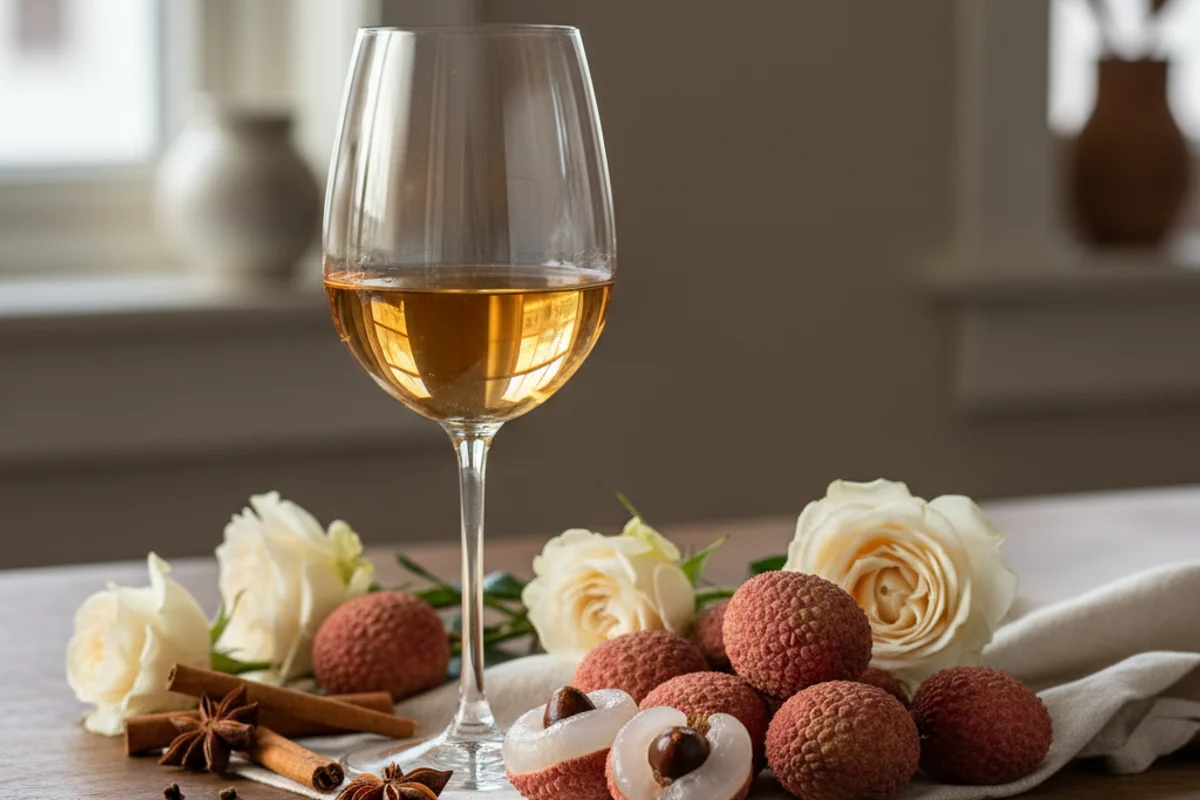
Gewürztraminer is the wine world’s drama queen — and I mean that as a compliment. This Alsatian grape delivers an almost overwhelming rush of lychee, rose petal, and baking spice in a full-bodied, deeply golden package. Starting from juice (fresh-pressed or previously frozen) puts you miles ahead of the kit crowd, but it also hands you real juice chemistry to manage. Nail your sugar and acid targets before fermentation starts, protect the wine aggressively from oxygen throughout aging, and you’ll have a bottle that smells like a perfume counter in the best possible way.
The beginner trap: Gewürztraminer oxidizes faster than almost any other white grape juice, so skipping or skimping on sulfite additions at each racking will turn your hard work flat and brown before it ever hits a glass.
Ingredients
- 5 gallons Gewürztraminer grape juice (fresh or frozen/thawed)
- 3½ tsp yeast nutrient
- ¼ tsp potassium metabisulfite (Campden), plus an additional ¼ tsp for the second carboy — and more on hand for later rackings
- Sugar as needed to reach a specific gravity of 1.095 (roughly 13% potential ABV)
- Acid blend as needed to reach a titratable acidity (TA) of 0.65%
- 1 packet Red Star Côtes des Blancs wine yeast (or any cool-fermenting white wine yeast, such as Lalvin 71B or EC-1118)
Method
- Sanitize a 6- or 6½-gallon carboy, then strain the thawed juice into it over ¼ tsp potassium metabisulfite and the yeast nutrient.
- Test the specific gravity with a hydrometer and the acidity with a titration kit; add sugar to reach SG 1.095 and acid blend to reach TA 0.65% if either falls short.
- Let the juice rest, loosely covered, for 10 hours to let the sulfite do its antimicrobial work.
- Rehydrate and activate your yeast according to the packet directions, then stir the starter into the juice.
- Cover the mouth of the carboy with two layers of cheesecloth or muslin secured with a rubber band — this lets CO₂ escape while keeping contaminants out during the early, foamy ferment.
- Two days after fermentation becomes visibly vigorous, swap the cloth cover for a proper airlock.
- When the specific gravity drops to 0.998 or lower, rack the wine off the lees into a clean carboy, top up with a similar wine or water to minimize headspace, and refit the airlock.
- After 30 days, rack again into a sanitized carboy that already contains ¼ tsp potassium metabisulfite, top up, and refit the airlock.
- Rack once more after another 30 days, top up, and refit the airlock.
- After a final 30-day rest, rack, add stabilizer (potassium sorbate if you want a touch of residual sweetness, or just another dose of metabisulfite to keep it dry), and refit the airlock.
- Wait 10–14 days to confirm fermentation is completely finished, then bottle under cork.
- Cellar the bottles for at least 6 months before opening — the bouquet develops significantly with time and rewards your patience.
Why this works
Gewürztraminer juice is naturally high in sugar and moderately acidic, which sets up a slow, cool fermentation that preserves its aromatic compounds — primarily terpenes like linalool and geraniol, the molecules responsible for that unmistakable lychee-and-rose character. The problem is that those same aromatic compounds are fragile. Oxygen grabs them fast through a process called oxidation, breaking the molecules down into flat, sherry-like off-flavors. Potassium metabisulfite releases sulfur dioxide (SO₂) gas, which acts as both an antioxidant and an antimicrobial shield. Each racking is an oxygen exposure event, so replenishing SO₂ at every transfer keeps the wine’s aromatic integrity intact through the long aging process that makes this grape shine.
Notes
If your juice came frozen from a home harvest (like Lonni’s did), thaw it slowly in a cool space and strain out any solids before measuring gravity and acid. If you can’t source Côtes des Blancs yeast locally, Lalvin 71B is widely available online and produces a similarly aromatic, low-alcohol-stress ferment. Anyone sensitive to sulfites should note that this particular grape genuinely requires higher SO₂ management than most — it is not a good candidate for low-sulfite winemaking.