GUAVA WINES
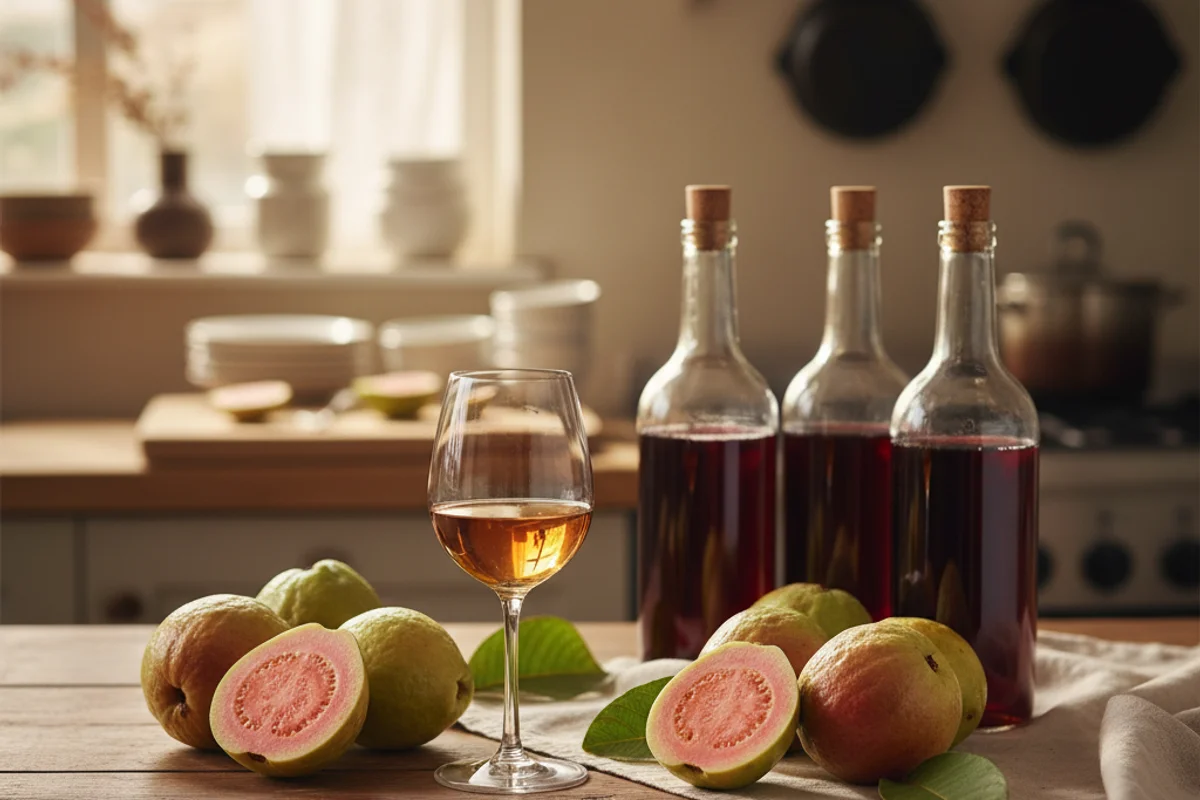
Guava is one of those fruits that tastes like it was engineered for winemaking — floral, tropical, and just tart enough to keep things interesting. The canned version brings consistent sugar levels and zero prep headaches, making it a surprisingly reliable base for a pale, fragrant country wine. Done right, this finishes smooth and aromatic, somewhere between a Riesling and a tropical white. Patience is the only real requirement: this one needs time in the bottle to show what it can do.
The beginner trap: Squeezing the pulp bag dry when removing it pushes bitter, cloudy sediment into your must — let gravity do the work instead.
Ingredients
- 3 lbs guava halves (three 1-lb cans in syrup; fresh or frozen peeled, seeded guava works too)
- 1¾ lbs granulated white sugar
- ½ oz citric acid (or juice of 3 lemons as a grocery-store substitute)
- ½ tsp wine tannin (or 1 cup strong unsweetened black tea)
- 1 tsp pectic enzyme
- 1 tsp yeast nutrient
- 1 packet Champagne wine yeast
- Water to bring total volume to 1 gallon
Method
- Drain the canned guava and save the packing syrup in a sealed jar in the fridge — you’ll use it later for topping up.
- Dice the guava fruit and place it inside a nylon straining bag; tie the bag closed and set it in your primary fermenter.
- Add the sugar, citric acid, tannin, pectic enzyme, and yeast nutrient; pour in enough water to reach 1 gallon and stir well until the sugar fully dissolves.
- Cover the fermenter and let everything sit for 12 hours so the pectic enzyme can get to work breaking down the fruit.
- Activate your yeast according to the packet directions, then add it to the must.
- Gently squeeze the straining bag twice a day for 4 days to coax juice from the fruit.
- After 4 days, lift the bag and let it drain freely into the fermenter — do not squeeze it at this stage; discard the spent pulp.
- Let the must settle overnight, or until the specific gravity reads around 1.020, then rack into your secondary fermenter and fit an airlock.
- Top up with reserved syrup (or water) after 10 days if the liquid level has dropped.
- After 20 more days, rack again, top up, and refit the airlock; let it ferment undisturbed for 60 days.
- Rack once more, top up, refit the airlock, and wait another 60 days.
- If the wine is clear, rack into bottles; if it’s still hazy, fine with bentonite, wait 2 weeks, then bottle.
- Age at least 6 months before opening — 12 months is noticeably better.
Why this works
Guava is loaded with pectin, the same gelling agent that makes jam thick. Left alone, pectin turns your finished wine cloudy and traps fruity aroma compounds so they never fully express themselves. Pectic enzyme (pectinase) breaks those long pectin chains apart early in fermentation, which clears the path for a brighter, more aromatic wine. The 12-hour wait before pitching yeast gives the enzyme time to work before alcohol levels rise — alcohol slows enzyme activity significantly. Champagne yeast is chosen here because it handles higher sugar loads cleanly and without adding much flavor of its own, letting the guava stay front and center.
Notes
Frozen guava chunks (available at many Latin grocery stores and larger supermarkets) work just as well as canned — thaw completely and treat them as fresh fruit, using 3 lbs after any seeds are removed. If you can’t find wine tannin, a cup of cold-brewed black tea is a perfectly workable stand-in. Bentonite for fining is sold at homebrew shops; in a pinch, sparkling wine fining agents like Chitosan (often found in two-part kits) do the same job.