HIGHBUSH BLUEBERRY WINE
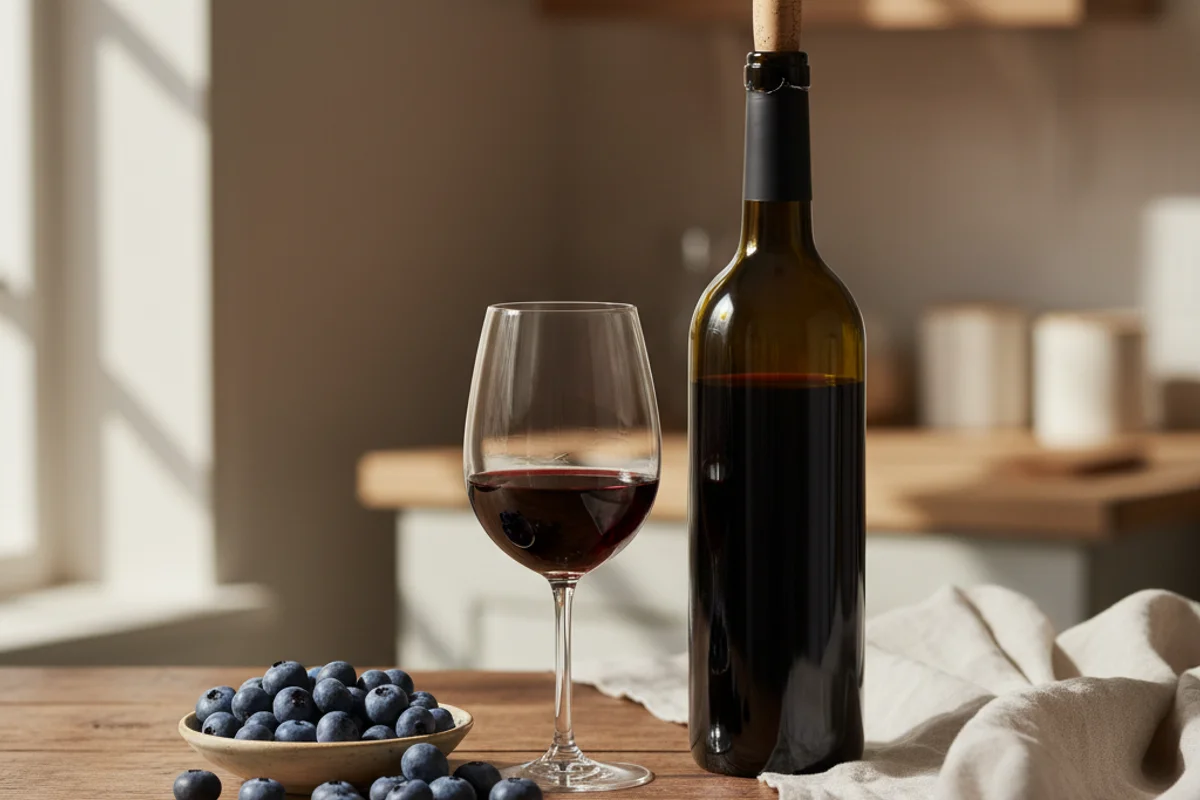
Blueberries are deceptively complex little fruits. Beneath that dusty blue skin you get malic acid, citric acid, tannins, pectin, and a compound called benzoic acid that can make yeast throw a fit before it finally gets going. Push through that slow start and you end up with a wine that’s deeply colored, earthy, and just a little wild — somewhere between a rustic red and a fruit forward rosé. Red grape concentrate adds body and rounds out the mid-palate so the finished wine doesn’t taste thin or one-dimensional. Budget a full year before you open a bottle. This one rewards patience.
The beginner trap: Blueberries are naturally high in pectin, so skipping or under-dosing the pectic enzyme will leave you with a hazy wine that never clears no matter how long you wait.
Ingredients
- 2½ lbs. fresh or frozen highbush blueberries
- 1 cup red grape concentrate (store-bought Welch’s 100% grape juice works as a substitute)
- 1 lb. 6 oz. granulated white sugar
- 1½ tsp. acid blend (available at homebrew shops; or substitute ¾ tsp. citric acid + ¾ tsp. tartaric acid)
- ¾ tsp. pectic enzyme
- 1 tsp. yeast nutrient
- ¼ tsp. yeast energizer (optional but helpful; omit if unavailable)
- Water to make 1 gallon total volume
- 1 packet wine yeast (Lalvin 71B or EC-1118 work well)
Method
- Bring about half a gallon of water to a boil, then set it aside to cool slightly.
- Wash and crush the blueberries and place them in your primary fermentation bucket.
- Add the sugar, acid blend, yeast nutrient, yeast energizer, and pectic enzyme directly to the fruit — but not the yeast yet.
- Pour the hot water over everything and stir well until the sugar fully dissolves.
- Cover the bucket loosely and let it cool to between 70 and 75°F, then top up with cool water to reach one gallon total.
- Prepare your yeast starter according to the packet instructions, then pitch it into the must once it has fully cooled.
- Stir the must once a day for 5 to 6 days, or until the specific gravity drops below 1.030.
- Strain out the fruit pulp and press it to recover as much liquid as possible, then discard the solids.
- Siphon the wine into a one-gallon glass jug (secondary fermenter) and fit it with an airlock.
- After three weeks, rack the wine off its sediment into a clean jug and add a Campden tablet (potassium metabisulfite) to protect against oxidation.
- Rack again two months later; stir in the red grape concentrate at this point if you haven’t already.
- Once the wine is clear, rack one final time, stabilize with potassium sorbate plus a Campden tablet, sweeten to taste if desired, and wait 30 days before bottling.
- Age in the bottle for at least one year — two is better.
Why this works
Blueberries contain benzoic acid, which acts as a natural antimicrobial. That’s great for the berry on the bush, but it means your yeast has to fight harder to establish itself than it would with, say, a strawberry or a peach. Using an activated yeast starter — rather than just sprinkling dry yeast on top — gives the colony a head start so it can overpower that chemical resistance. Meanwhile, the pectic enzyme breaks down the pectin chains that blueberry skins release into the must. Without it, those long carbohydrate molecules trap tiny particles and scatter light, keeping your wine permanently cloudy. Heat deactivates pectic enzyme, so always wait until the must cools below 80°F before you add it.
Notes
Frozen blueberries work just as well as fresh — and often better, since freezing ruptures the cell walls and releases more juice and color with less effort. If you can’t find acid blend at a homebrew shop, a 50/50 mix of citric acid and cream of tartar (potassium bitartrate) is a reasonable stand-in. If fermentation stalls in the first 48 hours, don’t panic — blueberries are notorious slow starters; give it another day before troubleshooting.