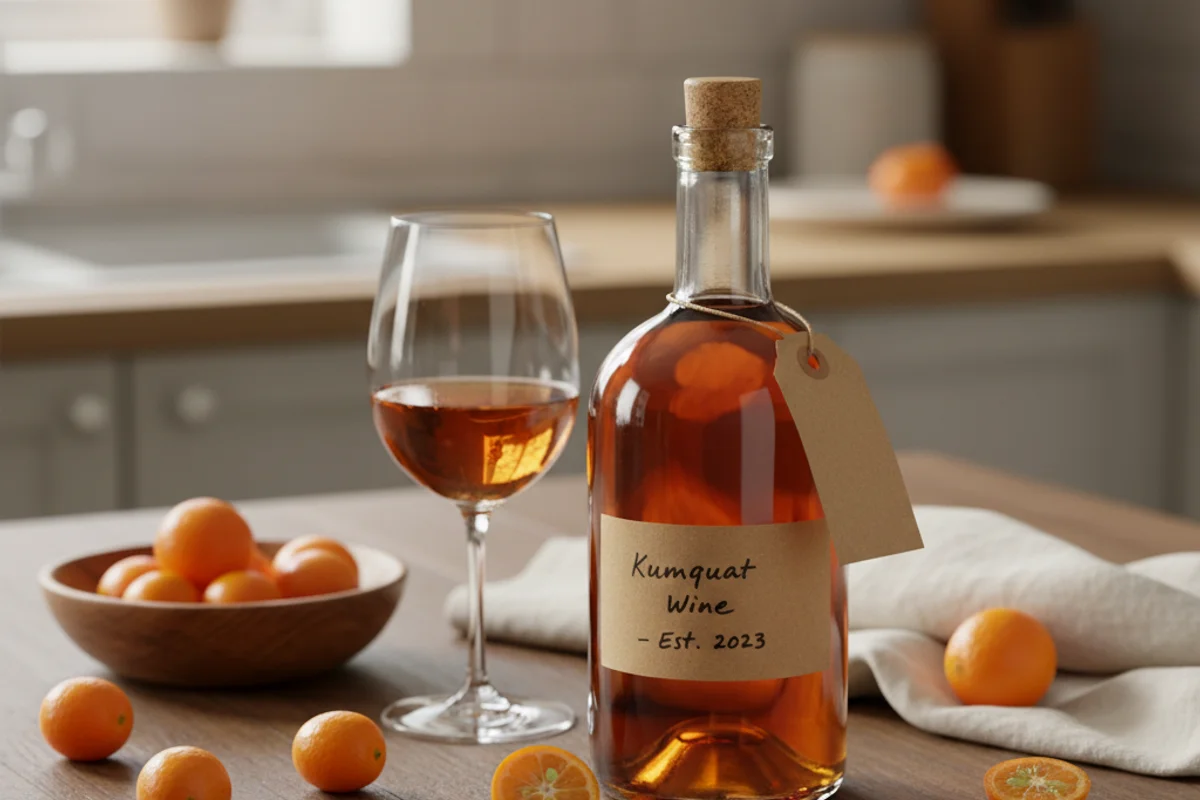
KUMQUAT WINE
Kumquats are the fruit world’s plot twist — you eat the sweet peel and the tart flesh together, and that inside-out flavor dynamic makes for a genuinely interesting wine. Think bright citrus up front, a slightly bitter finish, and a floral note that sneaks in as the wine ages. The catch is that kumquats carry a serious acid load, so this recipe leans on ripe bananas to round out the body and balance the sharpness. The result is a light, aromatic country wine that rewards patience and a willingness to experiment.
The beginner trap: Skipping or shortchanging the banana simmer — those overripe bananas aren’t a quirky add-on, they’re doing real structural work, contributing body and mouthfeel that kumquats alone simply can’t provide.
Ingredients
- 2½ lbs kumquats, fresh or frozen, halved crosswise and seeds removed
- 2½ lbs very ripe bananas (peels on), sliced into ½-inch rounds
- 1¾ lbs granulated white sugar
- 1 tsp pectic enzyme
- 1 tsp yeast nutrient
- ⅛ tsp grape tannin powder (or 1 unsweetened black tea bag, steeped and removed)
- 7 qts water, divided
- 1 packet Lalvin 71B or EC-1118 wine yeast, activated per packet instructions
Method
- Place banana slices — peels and all — into a large pot with 3½ qts of water. Bring to a boil, then reduce heat and simmer for 30 minutes, skimming any foam that rises to the surface.
- While bananas simmer, bring the remaining 3½ qts of water to a boil in a second pot and stir in the sugar until fully dissolved. Remove from heat.
- Halve the kumquats crosswise, pick out any seeds, and collect all released juice into your primary fermenter. Place the halved kumquats into a nylon straining bag, tie it closed, and squeeze the bag firmly into the primary to extract as much juice as possible. Leave the bag in the fermenter.
- Pour the hot sugar-water over the bag in the primary. Strain the banana liquid through a fine-mesh sieve or second nylon bag, pressing to extract all liquid, and add that to the primary as well. Discard the solids.
- Once the must cools to below 75°F, stir in the pectic enzyme, yeast nutrient, and tannin. Cover the primary and let it rest for 12 hours.
- Add your activated yeast, stir gently, and recover the primary. Squeeze the kumquat bag twice daily for 5 days.
- After 5 days, remove the bag, squeeze it thoroughly, and add all drained juice back to the primary. Cover and let the must sit undisturbed for 5 more days.
- Rack the wine into a sanitized glass secondary (carboy), seal with an airlock, and let it ferment out.
- Rack again after 60 days, top up to minimize headspace, and refit the airlock.
- Rack a third time after another 60 days, then stabilize with potassium sorbate and potassium metabisulfite, sweeten to taste, top up, and refit the airlock.
- After 10 days, rack into bottles and age for at least 6 months — 12 months or longer is better.
Why this works
Kumquats have a high titratable acidity, meaning there’s a lot of acid by weight relative to sugar. That acid is great for brightness but brutal for balance if left unchecked. Enter the bananas. Cooking very ripe bananas — peels included — releases soluble starch, pectin breakdown products, and potassium, all of which add viscosity and a soft, full mouthfeel that tames the kumquat’s sharp edges. The pectic enzyme then breaks down lingering fruit pectin, which would otherwise cause a stubborn haze in the finished wine. Yeast strain matters here too: 71B is known to metabolically reduce malic acid during fermentation, softening the overall acid profile even further — exactly what this fruit needs.
Notes
Frozen kumquats work well and are often easier to find than fresh outside of winter months — freezing also helps break down cell walls, so you’ll get better juice extraction. If you can’t find grape tannin powder at a homebrew shop, one cup of strong-brewed, unsweetened black tea makes a reasonable everyday substitute. If the finished wine tastes too tart even after aging, blend in a small amount of a low-acid fruit wine (like banana or peach) rather than simply adding more sugar.