Loquat Wine
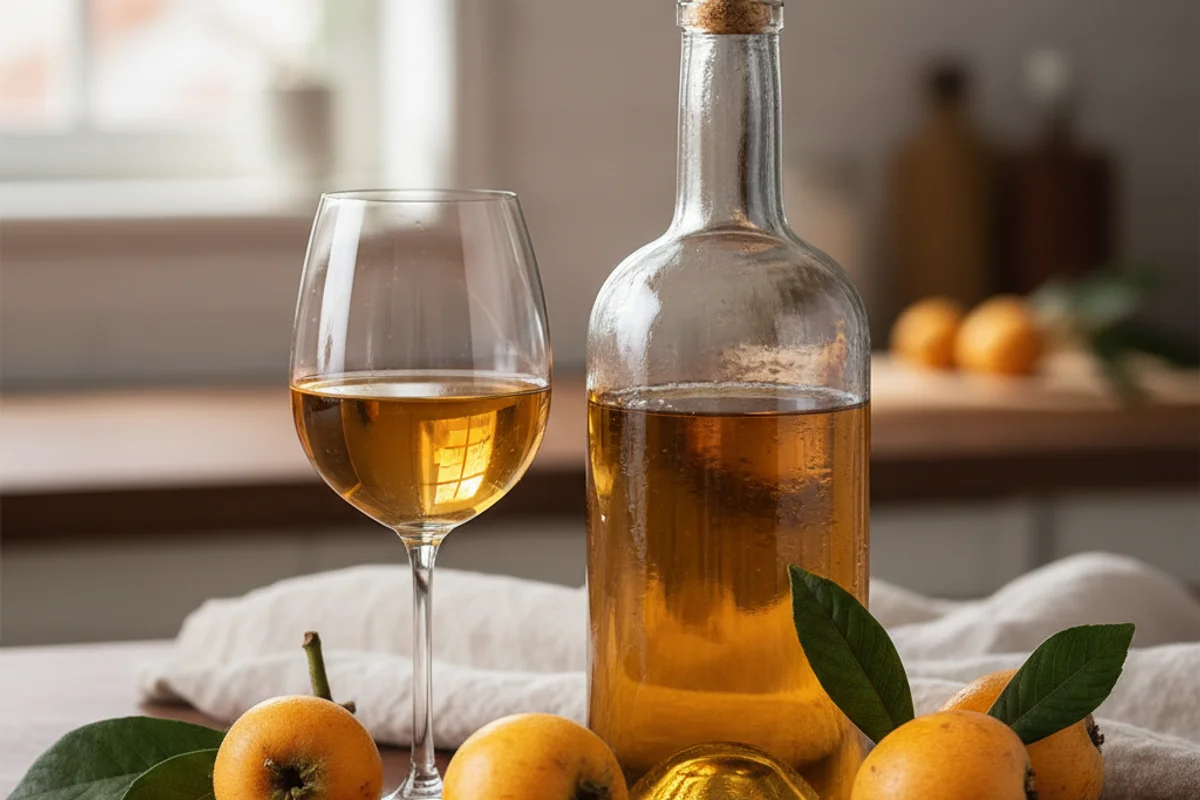
If you’ve ever walked past a loquat tree in late winter and wondered what to do with those clusters of small, golden fruit, here’s your answer. Loquats sit somewhere between an apricot and a peach in flavor — floral, mildly tart, with a honey-like sweetness underneath. That flavor translates beautifully into wine: pale gold in the glass, stone-fruit forward on the nose, and smooth enough to drink young while still rewarding a year of patience in the bottle.
The beginner trap: Skipping the pectic enzyme — loquats are loaded with pectin, and without it your wine will stay stubbornly hazy no matter how long you wait.
Ingredients
- 4 lbs fresh loquats (or frozen, thawed; see Notes)
- 2 lbs granulated sugar, divided
- 1 tsp acid blend (or 1½ tsp lemon juice as a substitute)
- 1 Campden tablet, crushed
- ½ tsp pectic enzyme
- ½ tsp grape tannin (or 1 tbsp very strong black tea, cooled)
- 1 tsp yeast nutrient
- 1 packet wine yeast (Lalvin 71B or EC-1118 work well)
- Water to make 1 gallon total
Method
- Wash the loquats thoroughly, then remove and discard all seeds. Roughly chop the fruit by hand or pulse it in a blender until broken down but not fully puréed.
- In your primary fermenter, combine the chopped fruit with 1 lb of the sugar, the crushed Campden tablet, grape tannin, yeast nutrient, and acid blend. Add enough water to bring the total volume to 1 gallon and stir until the sugar dissolves.
- Cover the fermenter with a clean cloth and let it sit for 12 hours.
- After 12 hours, stir in the pectic enzyme. Re-cover and wait another 12 hours.
- After that second 12-hour rest, sprinkle the wine yeast over the must and stir it in. Re-cover with the cloth.
- Stir the must once daily for 3 days, then add another ½ lb of sugar. Stir to dissolve.
- Continue stirring daily for 4 more days, allowing the fruit pulp to ferment in the liquid.
- Strain the must through a fine mesh bag or nylon jelly bag, squeezing the pulp firmly to extract as much juice as possible. Discard the spent pulp.
- Stir the remaining ½ lb of sugar into the strained juice until fully dissolved, then transfer the liquid to a 1-gallon glass jug (secondary fermenter) and fit an airlock.
- After 30 days, rack the wine off its sediment into a clean jug, topping up with a small amount of water or similar wine to minimize headspace. Refit the airlock.
- Rack every 30 days until the wine runs clear — expect 3 to 4 additional rackings. After the final racking, taste for sweetness.
- If the wine tastes balanced, bottle it. If it’s too dry, add a wine stabilizer (potassium sorbate) and dissolve up to ¼ cup sugar in ¼ cup warm water, add it gradually, and taste as you go before bottling.
Why this works
Loquats contain high levels of pectin — the same stuff that makes jam gel. When you ferment fruit without addressing that pectin, it breaks into smaller chains that scatter light and leave your wine permanently cloudy. Pectic enzyme (pectinase) cuts those chains apart, letting the haze-forming particles clump together and sink to the bottom during racking. That’s why the timing matters: you add it 12 hours after the Campden tablet so residual sulfite doesn’t deactivate the enzyme. Sugar is added in stages to keep the yeast from being stressed by a high-sugar environment right out of the gate, which helps fermentation run cleaner and more completely.
Notes
Frozen loquats work well here — freezing actually helps break down cell walls and improves juice extraction. If you can’t find acid blend at a homebrew shop, fresh lemon juice is a workable substitute. This wine is drinkable at 6 months but noticeably better after a full year in the bottle.