LOWBUSH BLUEBERRY WINE
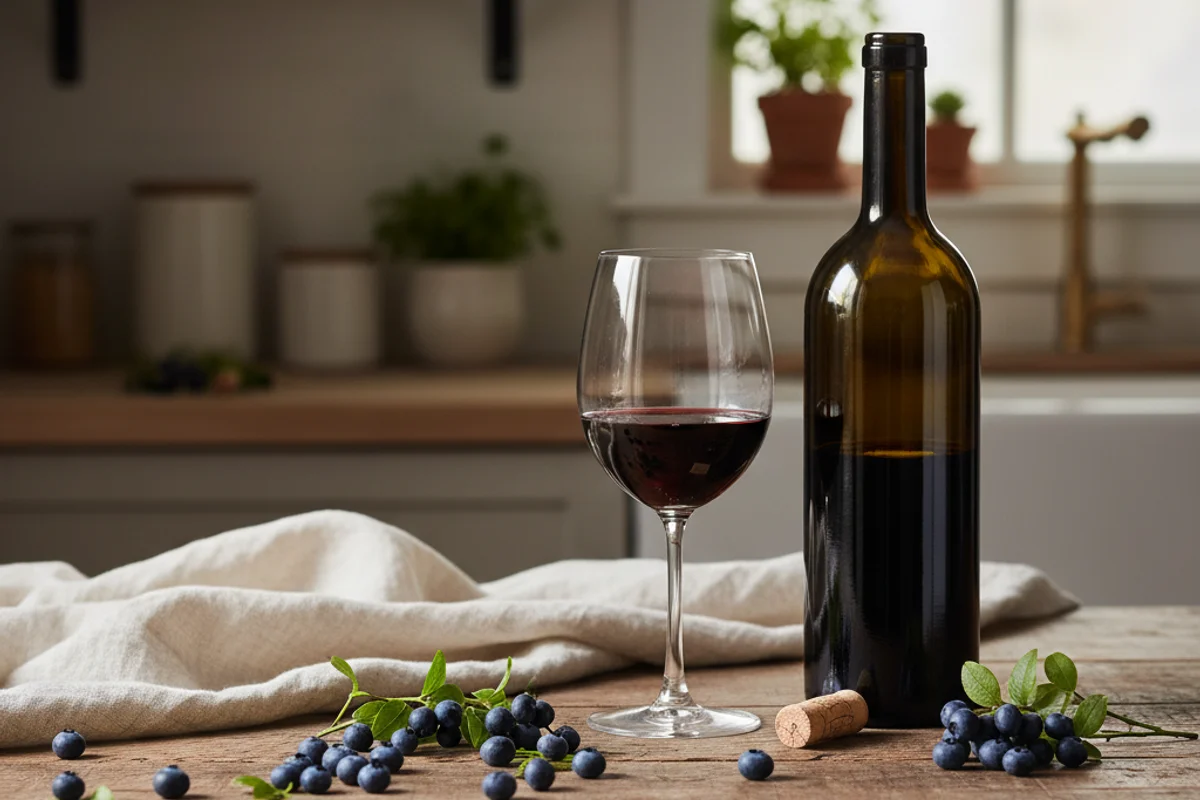
Lowbush blueberries are the scrappy little cousins of the grocery-store giants — smaller, darker, and packed with more flavor per berry. When fermented, they produce a wine with deep purple color, a jammy mid-palate, and enough natural tannin to give it some backbone. This is a light-bodied, dry style that lets the fruit do the talking. Think of it less like grape wine and more like a conversation with the Maine woods in a glass. Patience is mandatory: this wine needs a full year in the bottle before it stops arguing with you and starts making sense.
The beginner trap: Blueberries are loaded with pectin, and skipping the pectic enzyme — or adding it too soon after the Campden tablet — will leave you with a permanently hazy wine that no amount of racking will fix.
Ingredients
- 2 lb. fresh or frozen lowbush blueberries (highbush from the grocery store works fine)
- 1½ lb. granulated sugar
- ½ tsp. pectic enzyme (found at homebrew shops or online)
- 1½ tsp. acid blend (or substitute 1 tsp. lemon juice per tsp. acid blend in a pinch)
- ½ tsp. yeast energizer
- 1 tsp. yeast nutrient
- 1 crushed Campden tablet (potassium or sodium metabisulfite)
- Water to make 1 gallon total
- Wine yeast (Lalvin 71B or EC-1118 both work well)
Method
- Bring water to a boil, stir in the sugar until fully dissolved, then remove from heat and set aside.
- Wash the blueberries and place them in a nylon straining bag. Crush the berries inside the bag, then set the bag into your primary fermentation bucket.
- Pour the hot sugar water over the bag and stir well. Cover the bucket and let it cool to room temperature (about 70–75°F).
- Once cooled, stir in the crushed Campden tablet, acid blend, yeast energizer, and yeast nutrient. Cover and wait 12 hours.
- Add the pectic enzyme, stir gently, then re-cover and wait another 12 hours.
- Prepare your yeast according to packet instructions, then add it to the must. Cover loosely to allow gas to escape.
- Stir daily and press the fruit bag against the side of the bucket to extract color and flavor. Do this for about 7 days, or until the specific gravity reads 1.020.
- Lift out the straining bag, let it drip, and press gently — don’t squeeze hard or you’ll extract harsh tannins. Let the liquid settle overnight.
- Siphon the cleared liquid off the sediment into a 1-gallon glass jug (carboy) and attach an airlock.
- Rack into a clean jug after 30 days, then again every 60 days until the wine is clear and shows no signs of active fermentation for at least 30 days.
- Stabilize with potassium sorbate (follow package directions), wait two weeks, rack once more, and bottle.
- Store the bottles somewhere dark and cool for at least one year before drinking.
Why this works
Blueberries are chemically complex — they carry malic, citric, and tartaric acids alongside natural tannins, pectin, and glucosides. That complexity is a double-edged sword. It gives the finished wine depth and aging potential, but it can also stress or slow yeast during the early stages. The Campden tablet knocks out wild microbes and oxidative enzymes, giving your chosen yeast a clean runway. Adding pectic enzyme after the sulfite has had 12 hours to dissipate ensures the enzyme isn’t destroyed on contact — it then breaks down the pectin chains that would otherwise cause permanent haze. The raisins from the original recipe have been left out here to keep the fruit character clean, but they’re a legitimate body-builder if you want more weight in the glass.
Notes
Frozen blueberries are an excellent choice — the freeze-thaw cycle ruptures cell walls and improves juice extraction without any extra effort. If you can’t find acid blend at a local homebrew shop, order it online or substitute a small amount of tartaric acid (available at some kitchen stores). If the wine tastes flat or lifeless at the 6-month mark, a small addition of acid blend at racking can brighten it considerably.