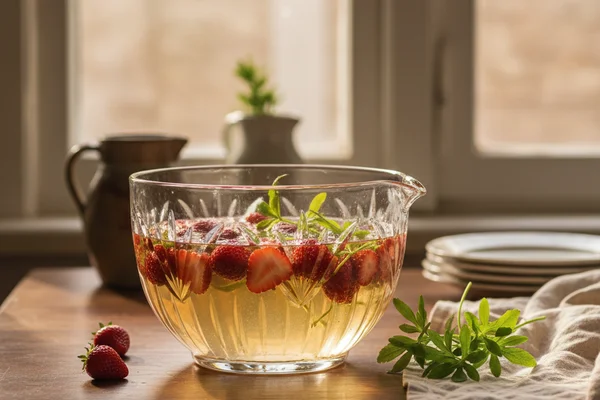
MAY WINE: Another Look
Sweet woodruff (Galium odoratum) is one of those plants that seems unremarkable until you dry it or bruise it — then it hits you with a wave of fresh hay, vanilla, and just a whisper of new-mown grass. That aroma comes from coumarin, a natural compound that blooms when the plant’s cell walls break down. This recipe puts those flowers to work in a dry, aromatic white wine that has been tied to May Day celebrations in Central Europe for centuries. The result is light, crisp, and genuinely unlike anything you’ll find on a store shelf.
The beginner trap: Skipping the 24-hour wait before pitching yeast — that window lets the Campden tablet do its job sanitizing the must, and adding yeast too soon kills your fermentation before it starts.
Ingredients
- 2 quarts fresh woodruff flowers, picked at the stem junction and rinsed
- 2 lbs granulated white sugar
- 7¼ pints water
- ½ oz citric acid (find it in the canning aisle or any homebrew shop)
- ⅛ tsp wine tannin powder (or less — use grape tannin powder from a homebrew shop)
- 1 Campden tablet, crushed
- 1 tsp yeast nutrient
- 1 packet Chablis wine yeast (or any dry white wine yeast)
Method
- Bring the water to a boil and stir in the sugar until fully dissolved. Remove from heat and let it cool to room temperature.
- Combine the woodruff flowers, citric acid, tannin, crushed Campden tablet, and yeast nutrient in your primary fermenter.
- Pour the cooled sugar water over everything and stir to combine. Cover the fermenter loosely and let it sit for 24 hours.
- Activate your yeast according to the packet directions, then add it to the must. Cover the primary fermenter.
- Stir the must twice a day for three days, keeping it covered between stirs.
- After three days, strain out the flowers and transfer the liquid to a clean 1-gallon secondary fermenter. Fit an airlock.
- Let the wine ferment to dryness. When bubbling stops, rack the wine off the sediment into a clean vessel and refit the airlock.
- Once the wine runs clear, stabilize it with a fresh Campden tablet and potassium sorbate. Wait 10 days, then rack again and bottle.
Why this works
Sweet woodruff’s signature scent comes from coumarin — a compound that’s locked inside the plant while it’s alive and green. Once the flowers are picked and exposed to water, enzymes break down the plant tissue and release coumarin in its active, aromatic form. That’s why fresh woodruff smells mild but a must full of soaking flowers fills the room. Citric acid keeps the pH in a range where yeast thrive and where coumarin stays stable in solution. The small amount of tannin isn’t about flavor — it gives the finished wine just enough structure to feel like a wine rather than a fragrant sugar wash.
Notes
Fresh woodruff flowers are the traditional choice, but dried woodruff (available from herbal retailers online) can work in a pinch — use roughly half the volume since the flavor is more concentrated. If you can’t find Chablis yeast, any neutral dry white wine yeast such as Lalvin 71B or EC-1118 will do the job. This wine genuinely improves with a year of aging, so if you can hold off until the following May Day, you’ll be rewarded.