Measuring Additives in Winemaking
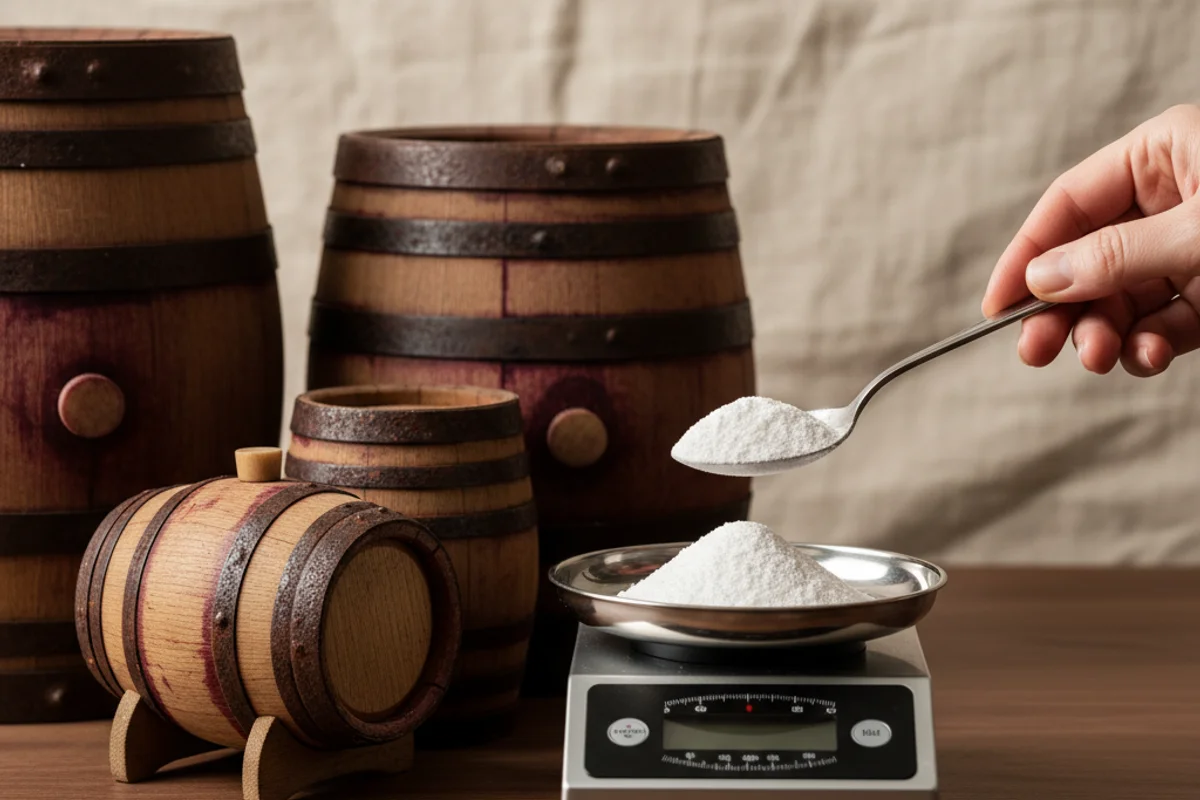
Here’s the thing about winemaking additives: a teaspoon of potassium metabisulfite and a teaspoon of calcium carbonate are not the same thing — not even close. Every powder, crystal, and granule has its own density, and that density determines how much actual mass you’re scooping. Treat all your additives like they weigh the same and you’re not making wine, you’re making guesses. A digital gram scale fixes this instantly and permanently. It’s the single tool that separates a winemaker who repeats success from one who repeats accidents.
The beginner trap: Assuming all powdered additives measure the same by volume — they don’t, and using teaspoon estimates for sulfite additions can easily over- or under-protect your wine.
Quick-Reference: Grams per Volume
These weights were measured for common winemaking additives. Values vary by grind and moisture, so a scale always wins over eyeballing.
| Additive | ½ tsp | 1 tsp | 1 tbsp |
|---|---|---|---|
| Acid blend, powder | 1.2 g | 5.1 g | 14.4 g |
| Ascorbic acid, powder | 0.9 g | 4.6 g | 13.8 g |
| Bentonite, agglomerated | 0.8 g | 3.4 g | 11.1 g |
| Calcium carbonate, powder | 0.5 g | 2.6 g | 6.7 g |
| Citric acid, powder | 1.1 g | 4.9 g | 14.4 g |
| Diammonium phosphate (DAP), powder | 1.2 g | 4.9 g | 14.7 g |
| Gelatin, powder | 0.8 g | 3.2 g | 9.6 g |
| Grape tannin, powder | 0.6 g | 2.8 g | 7.8 g |
| Isinglass, powder | — | 2.4 g | 7.2 g |
| Malic acid, powder | 1.1 g | 4.5 g | 13.2 g |
| Potassium bicarbonate, powder | 0.7 g | 3.3 g | 10.6 g |
| Potassium bitartrate, powder | 0.8 g | 3.8 g | 10.2 g |
| Potassium caseinate, powder | 0.7 g | 3.0 g | 9.0 g |
| Potassium metabisulfite, powder | 1.4 g | 6.2 g | 20.0 g |
| Potassium sorbate, prilled | 0.6 g | 2.5 g | 3.6 g |
| Tartaric acid, powder | 1.3 g | 5.0 g | 15.2 g |
| Yeast hulls, powder | 0.6 g | 2.8 g | 8.7 g |
Standard Dosage Reference
| Additive | Typical Dose |
|---|---|
| Acid blend, powder | 3.9 g/gal raises TA ~0.1% |
| Bentonite, agglomerated | 1–2 g/gal after fermentation; 3–5 g/gal before |
| Calcium carbonate, powder | 2.5 g/gal lowers TA ~0.1% |
| Citric acid, powder | 3.7 g/gal raises TA ~0.1% |
| Gelatin, powder (100 bloom) | 0.5–1.0 g/gal to soften astringent red wine |
| Isinglass, powder | 0.015–0.07 g/gal white wine |
| Malic acid, powder | 3.7 g/gal raises TA ~0.1% |
| Potassium bicarbonate, powder | 3.4 g/gal lowers TA ~0.1%; cold stabilize after |
| Potassium bitartrate, powder | 2–5 g/gal before cold stabilization |
| Potassium caseinate, powder | 0.5–1.0 g/gal to treat oxidized wine |
| Potassium metabisulfite, powder | See SO₂ section below |
| Potassium sorbate | 1–1.25 g/gal with ½–1 crushed Campden tablet |
| Sparkolloid, powder (hot mix) | 0.5–1.5 g/gal after fermentation |
| Tartaric acid, powder | 4.1 g/gal raises TA ~0.1% |
| Yeast hulls, powder | 0.45–0.9 g/gal to prevent sluggish fermentation |
| DAP (yeast nutrient), powder | 0.5–1.0 g/gal must |
| Antifoam liquid (AF-72) | 5–8 drops per 5 gal before vigorous fermentation |
| Pectic enzyme, liquid (grape must) | 1.5–3 drops/gal |
| Pectic enzyme, liquid (high-pectin fruit) | 3–6 drops/gal |
SO₂ (Sulfur Dioxide) from Potassium Metabisulfite
| Form | Amount | Result |
|---|---|---|
| Powder | 1 g | 150 ppm in 1 gal / 30 ppm in 5 gal |
| Powder | ¼ tsp | 225 ppm in 1 gal / 45 ppm in 5 gal |
| Powder | 1½ tbsp in 1 gal water | ~2% solution for equipment washing |
| Powder | 2 oz in 1 qt water | 5% sanitizing solution; use 1 tsp per gal of must |
| Campden tablet (1 tablet = 0.55 g) | 1 tablet | ~75 ppm SO₂ per gallon of must or wine |
Why This Works
Density is the issue. A teaspoon is a unit of volume, not mass. Fluffy, light powders like calcium carbonate pack loosely — you get very few grams per teaspoon. Dense, heavy crystals like potassium metabisulfite pack tightly — you get far more. That gap matters enormously when you’re trying to hit 50 ppm of free SO₂ rather than 150 ppm. Too little sulfite and your wine oxidizes or spoils. Too much and you’ve killed your yeast, flattened your aroma, or left a sharp chemical bite in the glass. A digital kitchen scale accurate to 0.1 g costs around $10–15 at any big-box store. It’s the cheapest insurance in your cellar.
Notes
- A basic digital kitchen scale (0.1 g resolution) handles the vast majority of home winemaking additions; you only need a 0.01 g precision scale if you’re working with very small batches or high-potency fining agents like isinglass.
- Campden tablets are the easiest entry point for sulfite additions — each tablet is pre-measured at 0.55 g, so no scale required for basic SO₂ management.
- All gram-per-volume figures above assume dry, fresh product; clumped or moisture-exposed powders will weigh differently, which is another reason to measure by weight rather than volume whenever precision matters.