OREGON GRAPE WINE
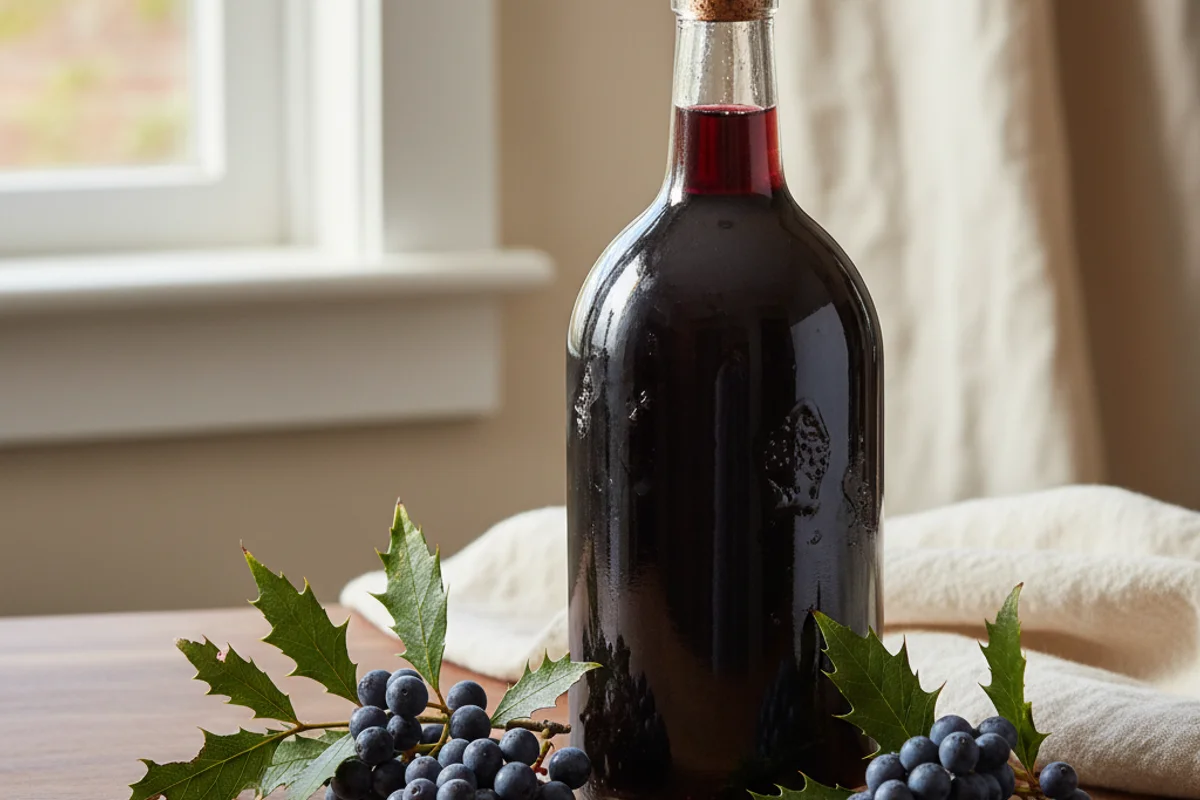
Don’t let the name fool you — Mahonia aquifolium has nothing to do with your local vineyard. This Pacific Northwest native shrub produces clusters of small, tart, inky-blue berries that sit somewhere between a wild blueberry and a cranberry in flavor. The finished wine carries a deep, jewel-like color and a bright acidity that makes it refreshing dry or genuinely lovely with a touch of residual sweetness. Think of it as the Pacific Northwest’s answer to a country fruit wine — bold, a little wild, and completely worth the patience it demands.
The beginner trap: Because Oregon grapes are already high in acid, new winemakers who add extra acid “to be safe” end up with a wine that tastes more like battery acid than a berry — trust the measured amount and stop there.
Ingredients
- 15 lbs Oregon grape berries, fresh or frozen
- 11 lbs granulated white sugar
- 3 tsp acid blend (found at homebrew shops; citric acid works in a pinch)
- 5 tsp yeast nutrient
- 1 tsp yeast energizer (optional but helpful; can substitute an extra tsp of yeast nutrient)
- 6 Campden tablets, crushed
- 6 tsp pectic enzyme
- Water to reach 6 US gallons total volume
- 1 packet Montrachet wine yeast (or any dry red wine yeast)
Method
- Run the berries through a food mill to separate pulp and juice from the seeds, which can leach harsh bitterness into your wine.
- Transfer the pulp and juice to your primary fermenter, then add the sugar, yeast nutrient, yeast energizer, acid blend, and crushed Campden tablets.
- Add water until the total volume reaches 6 gallons, then stir thoroughly until the sugar is fully dissolved.
- Cover the fermenter and leave it alone for 12 hours.
- Add the pectic enzyme, stir well, re-cover, and wait another 12 hours.
- Check your starting gravity — it should read around 1.090 on your hydrometer. Adjust with a little more sugar or water if needed.
- Activate your yeast according to the packet instructions, then add it to the must and stir.
- Stir the must twice daily until the specific gravity drops to 1.030, which usually takes one to two weeks.
- Strain the liquid through a nylon straining bag and transfer it to a 6-gallon glass carboy or secondary fermenter; fit an airlock.
- After 30 days, rack the wine into a clean vessel, top up to minimize headspace, and refit the airlock.
- Repeat that racking process every 60 days for six months total.
- If the wine stays cloudy, fine it with bentonite according to package directions.
- Stabilize with potassium metabisulfite and potassium sorbate, then sweeten to taste if you’d like a semi-sweet or sweet style.
- Wait 10 days after stabilizing, then rack into bottles. Age at least six months before opening — this wine genuinely rewards patience.
Why this works
Oregon grape berries come loaded with natural acid and relatively little sugar, which is the opposite problem you get with most backyard fruits. That’s why this recipe uses a large sugar addition — nearly twice the fruit weight — to push the starting gravity up to a fermentable range. The food mill step is critical chemistry, not just tidiness: the seeds contain compounds called tannins and alkaloids that dissolve slowly into liquid. By removing them before fermentation, you sidestep the extraction of those bitter compounds entirely. Pectic enzyme breaks down the natural pectins in the fruit cell walls, which improves juice yield and prevents a stubborn pectin haze from forming in the finished wine.
Notes
Frozen Oregon grape berries work excellently here — freezing actually ruptures the cell walls and improves juice yield, so you may get a slightly better extraction than with fresh fruit. If you can’t find Oregon grapes locally, check Pacific Northwest specialty stores or online foraging suppliers. Bentonite for fining is available at any homebrew shop; ordinary unflavored gelatin dissolved in warm water is a reasonable grocery-store substitute if you’re in a bind.