PASSION FRUIT WINES
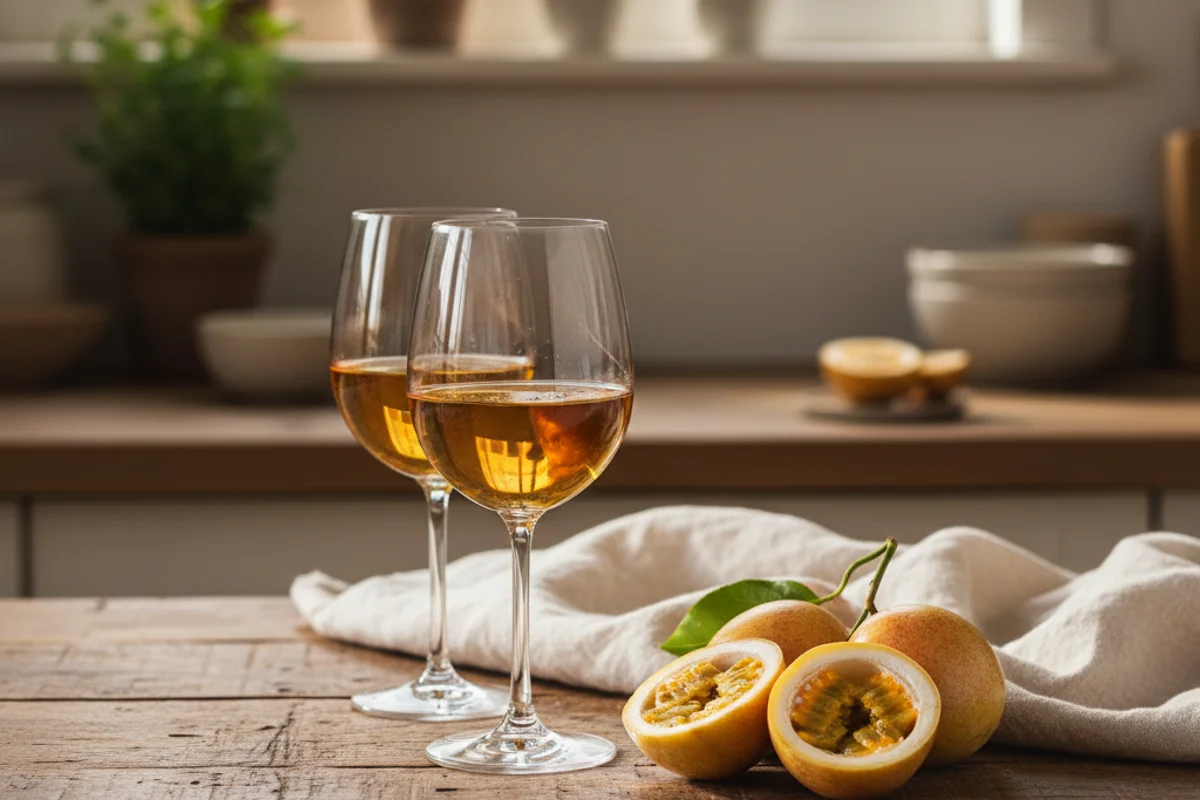
Crack open a passion fruit and you get hit with something almost unfairly tropical — a sharp, floral punch that sits somewhere between mango and citrus with a tang that can make your eyes water. That intensity is exactly what makes it a fascinating base for wine. These two recipes take different roads to the same destination: one leans on white grape juice for a fuller body, the other lets the fruit carry the whole show. Both reward patience. Neither will disappoint.
The beginner trap: Skipping or rushing the pectic enzyme rest — passion fruit pulp is loaded with pectin, and cutting that step short leaves you with a permanently hazy wine that no amount of racking will fix.
Ingredients
Recipe 1 — Fuller Body (1 gallon)
- 4 lbs passion fruit, fresh or frozen
- 2¼ lbs granulated white sugar
- 7 pints (3.5 quarts) unsweetened white grape juice from frozen concentrate
- 1 Campden tablet, crushed
- ½ oz pectic enzyme (liquid or powder, found at homebrew shops)
- 1 tsp yeast nutrient
- 1 packet Lalvin 71B or Lalvin D-47 wine yeast (or any dry white wine yeast)
Recipe 2 — Fruit-Forward (1 gallon)
- 5 lbs passion fruit, fresh or frozen
- 2½ lbs granulated white sugar
- 7 pints (3.5 quarts) water
- 1 Campden tablet, crushed
- ½ oz pectic enzyme
- 1 tsp yeast nutrient
- 1 packet Lalvin 71B or Lalvin D-47 wine yeast (or any dry white wine yeast)
Method
- Sort the fruit and discard anything that looks shriveled, moldy, or clearly unripe. Chop coarsely and load into a nylon mesh straining bag set inside your primary fermenter, capturing all the juice that runs out during chopping.
- Tie the bag closed, then squeeze and crush the fruit through the bag with your hands until the pulp is well broken up.
- Add the sugar, crushed Campden tablet, yeast nutrient, and either the white grape juice (Recipe 1) or water (Recipe 2). Stir until the sugar fully dissolves, then cover the fermenter.
- Let the must rest for 12 hours, then stir in the pectic enzyme. Cover again and wait another 12 hours.
- Activate your yeast according to the packet directions, then add it to the must and replace the cover.
- Once or twice daily, squeeze the bag gently and stir the must. Keep doing this until the specific gravity falls between 1.010 and 1.015 — expect roughly 5 to 7 days of active fermentation.
- Lift the bag and let it drip drain into the fermenter for several minutes; squeeze only very lightly to avoid pressing bitter compounds into the wine.
- Rack the liquid into a clean 1-gallon secondary fermenter (glass jug works fine), top up to reduce headspace, and fit an airlock.
- Rack again every 30 days until the wine runs clear, topping up each time.
- Once clear and dry, stabilize with a crushed Campden tablet and ½ tsp potassium sorbate if you want to back-sweeten; otherwise, rack straight to bottles after 10 days.
- Chill before serving. Taste at 6 months — Recipe 1 is often ready around the one-year mark, while Recipe 2 can benefit from closer to two years of aging.
Why this works
Passion fruit pulp is high in pectin — the same stuff that makes jam gel. In wine, unbroken pectin creates a stubborn protein-pectin haze that light and time cannot clear on their own. Pectic enzyme (pectinase) breaks those long-chain molecules apart, letting the particles clump and settle so racking can actually do its job. The two-stage addition schedule — Campden first, enzyme 12 hours later — matters here. Sulfite from the Campden tablet knocks back wild yeast and bacteria that would otherwise consume the enzyme before it finishes working. Waiting that full 12-hour window before adding pectic enzyme gives the sulfite time to off-gas to a safe level, so the enzyme survives long enough to do its job properly.
Notes
Frozen passion fruit pulp (sold at Latin grocery stores and many larger supermarkets, often labeled maracuyá) works very well and is usually cheaper than fresh; thaw completely and treat it the same way as fresh. If you can only find passion fruit juice or nectar, reduce added water or grape juice proportionally and skip the straining bag. Lalvin 71B and D-47 are common at homebrew shops and online; in a pinch, any packet of dry white wine yeast labeled for fruity or aromatic styles will do the job.