RAMBUTAN WINE
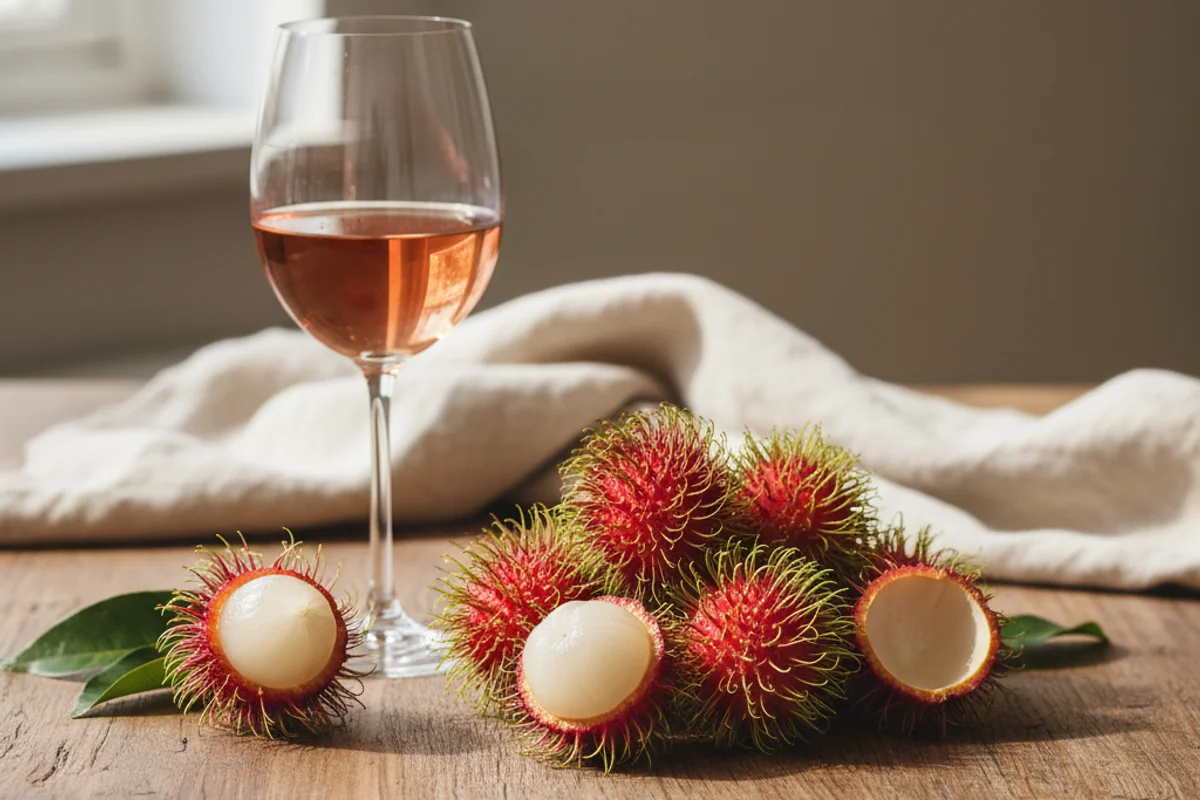
Picture a lychee that decided to grow a full head of soft, spiky hair and move to Southeast Asia. That’s the rambutan — a small, oval fruit with a translucent, juicy interior that tastes floral, sweet, and just a little exotic. Fresh ones are nearly impossible to find in most U.S. grocery stores, but canned rambutan works beautifully here. The finished wine is delicate and semi-sweet, with a flavor profile that’s genuinely hard to place — which, depending on your judges, might work in your favor.
The beginner trap: Keeping the syrup from the canned fruit will throw off your sugar balance and dilute the flavor — always drain and discard it before you start.
Ingredients
- 3¾ lbs rambutan, canned in light syrup (drained weight; roughly four 20-oz cans)
- 1 lb granulated white sugar (target starting gravity: 1.085)
- 7½ pts water
- 1½ tsp acid blend
- 1 Campden tablet, crushed and dissolved in ¼ cup water
- 1 tsp pectic enzyme
- ⅛ tsp grape tannin powder
- 1 tsp yeast nutrient
- 1 packet Hock wine yeast (or any dry white wine yeast such as Lalvin 71B)
Method
- Drain and discard the canned syrup, then chop the fruit roughly. Load it into a nylon straining bag, tie it shut, and place it in your primary fermenter.
- Add the water, sugar, acid blend, tannin, yeast nutrient, and dissolved Campden tablet to the primary. Stir until the sugar fully dissolves.
- Cover the primary and let it sit for 6–8 hours so the Campden can do its sanitizing work.
- Add the pectic enzyme, re-cover, and wait another 6–8 hours.
- Prepare your yeast starter according to the packet instructions, then add it to the primary. Cover loosely and ferment for 5–7 days, or until the specific gravity drops to around 1.015.
- Pull out the fruit bag and press it gently to recover the liquid. Transfer everything to a glass secondary fermenter, top up with water if needed to minimize headspace, and fit an airlock.
- Let fermentation run to dryness, then rack the wine off the sediment into a clean vessel. Top up and refit the airlock.
- Rack again every 30 days until the wine is clear and a full 30-day period passes with no new sediment forming.
- Stabilize the wine, then sweeten to taste if desired (a final gravity near 1.004 gives a pleasant semi-sweet result). If you sweeten, wait three weeks and confirm no renewed fermentation before bottling.
- Bottle the wine and age at least 6 months before opening. Serve well chilled.
Why this works
Rambutan flesh is about 15–16% sugar by weight, split between glucose, fructose, and sucrose. That’s a decent natural sugar load, but not enough on its own to hit a fermentable starting gravity of 1.085 — hence the added sugar. The pectic enzyme is critical here: tropical fruits are loaded with pectin, a structural carbohydrate that clouds wine and refuses to settle out on its own. Pectic enzyme breaks those long pectin chains apart, which dramatically improves clarity and also helps release more flavor from the fruit pulp. The Campden tablet added at the start knocks out wild yeast and bacteria so your chosen yeast strain runs the fermentation without competition.
Notes
Canned rambutan is sold at most Asian grocery stores and many international supermarkets — it’s your most reliable option in North America. If you genuinely cannot find it, canned lychee is the closest substitute and produces a similarly elegant wine. Hock yeast (a style named for German Rhine wines) emphasizes clean fruit character, but any neutral white wine yeast will perform well here.