RED RASPBERRY WINE (1)
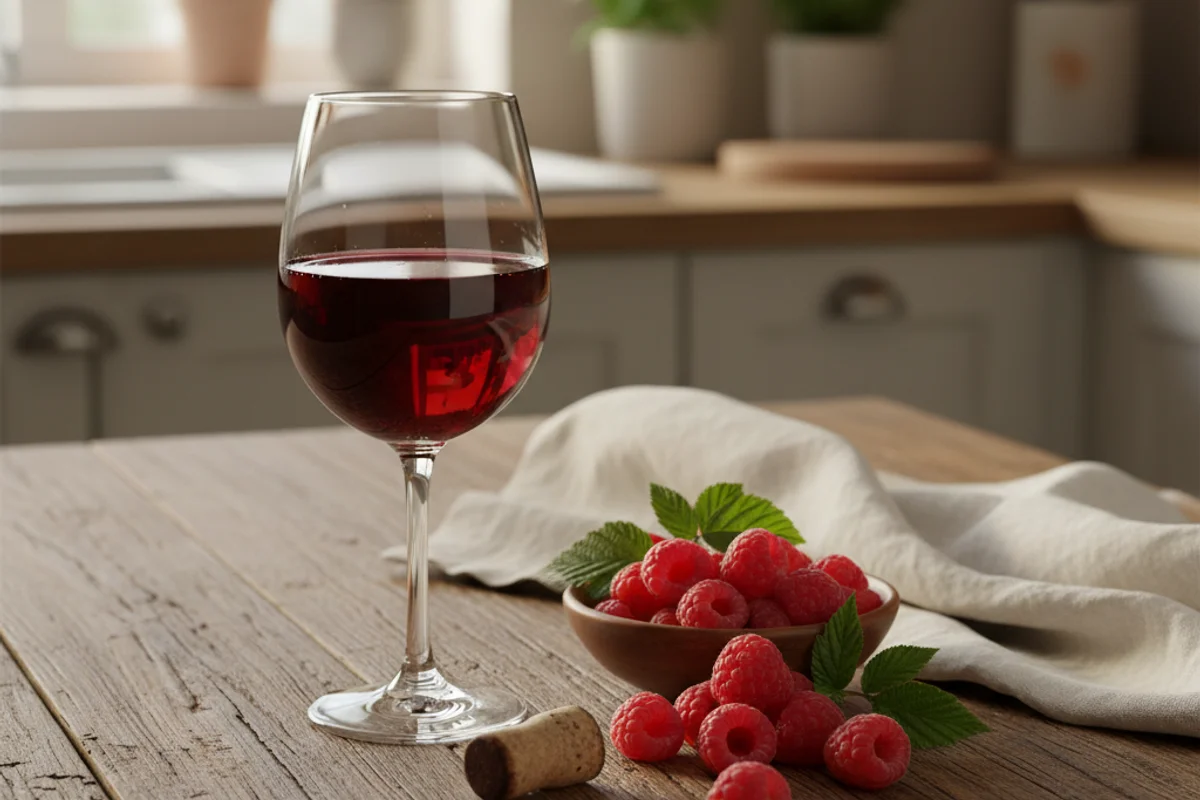
Red raspberries are fragile, loud, and deeply opinionated. They bring bright acidity, floral aromatics, and a color so vivid it looks almost artificial — yet every bit of it is real. Treated right, they produce a dry wine with a clean berry finish and enough backbone to reward patience. This is not a quick-turnaround project. You’re looking at six months of fermentation and another year in the bottle before this wine hits its stride. But when it does, you’ll understand why the wait was non-negotiable.
The beginner trap: Rushing the aging process — this wine needs a full six months to ferment and at least one year in the bottle before it tastes the way it’s supposed to.
Ingredients
- 3–4 lbs fresh red raspberries (or frozen, fully thawed)
- 2¼ lbs granulated white sugar
- 7½ pints water (about 15 cups)
- 1 Campden tablet, crushed
- ½ tsp pectic enzyme
- ½ tsp acid blend (or 1½ tsp lemon juice as a backup)
- ⅛ tsp grape tannin (or the contents of 1 plain black tea bag, steeped and cooled)
- 1 tsp yeast nutrient
- 1 packet Champagne wine yeast (or any dry wine yeast)
Method
- Combine the water and sugar in a large pot and bring to a boil, stirring until the sugar fully dissolves.
- Rinse the raspberries, remove any stems, place them in a nylon straining bag, tie it closed, and set it in the bottom of your primary fermenter. Crush the berries through the bag with your hands.
- Pour the boiling sugar-water directly over the bagged fruit to extract juice and lock in color. Add the acid blend, grape tannin, and yeast nutrient and stir to combine.
- Let the must cool to 70°F, then stir in the crushed Campden tablet. Cover the fermenter tightly with plastic wrap secured with a rubber band.
- After 12 hours, add the pectic enzyme and re-cover. After another 12 hours, add the yeast and re-cover again.
- Stir the must once daily for seven days, keeping it covered between stirrings.
- Lift out the nylon bag and let it drip-drain over the fermenter for about an hour — do not squeeze it.
- Continue fermenting in the primary for a second week, stirring daily.
- Rack the wine into a dark secondary fermenter (or wrap a clear one in brown paper), top up with water to reduce headspace, and fit an airlock.
- Rack into a clean secondary after 2 months. Repeat at 4 months and again at 6 months, then bottle into dark glass.
- Age at least one year in the bottle before opening. Serve chilled.
Why this works
Pouring boiling sugar-water over the fruit does two things at once: it ruptures cell walls to release more juice and pigment, and the heat helps “fix” the anthocyanin pigments that give red raspberries their color. The staggered addition of Campden (a sulfite that knocks out wild yeast and bacteria), followed by pectic enzyme (which breaks down fruit pectin for a clearer wine), followed finally by cultured yeast, gives each additive time to do its job without interference. Pectic enzyme is deactivated by sulfites if added simultaneously — spacing them 12 hours apart solves that problem neatly. Keeping the secondary dark protects those same pigments from UV degradation over the long aging period.
Notes
Frozen raspberries work very well here and are often more affordable year-round — thaw them completely before use and skip the crushing step since freezing has already broken down the cell walls. If you can’t find acid blend at a homebrew shop, a small amount of lemon juice can approximate it, though the balance will be less precise. A plain black tea bag, steeped in a few ounces of hot water and cooled, is a reasonable everyday substitute for grape tannin.