RHUBARB WINE
Rhubarb is the plant world’s drama queen — brutally tart, aggressively vegetal, and somehow still capable of producing a wine that’s bright, clean, and genuinely interesting. The stalks you grab at the grocery store or farmers market carry a sharp, almost citrusy backbone that translates beautifully into a pale, crisp wine. Get the acid balance right and you end up with something closer to a dry Sauterne-style white than anything you’d expect from a vegetable. Yes, rhubarb is technically a vegetable. Let’s move on.
The beginner trap: Skipping the precipitated chalk (calcium carbonate) step means all that harsh oxalic acid stays in your wine — and no amount of aging will fix it.
Ingredients
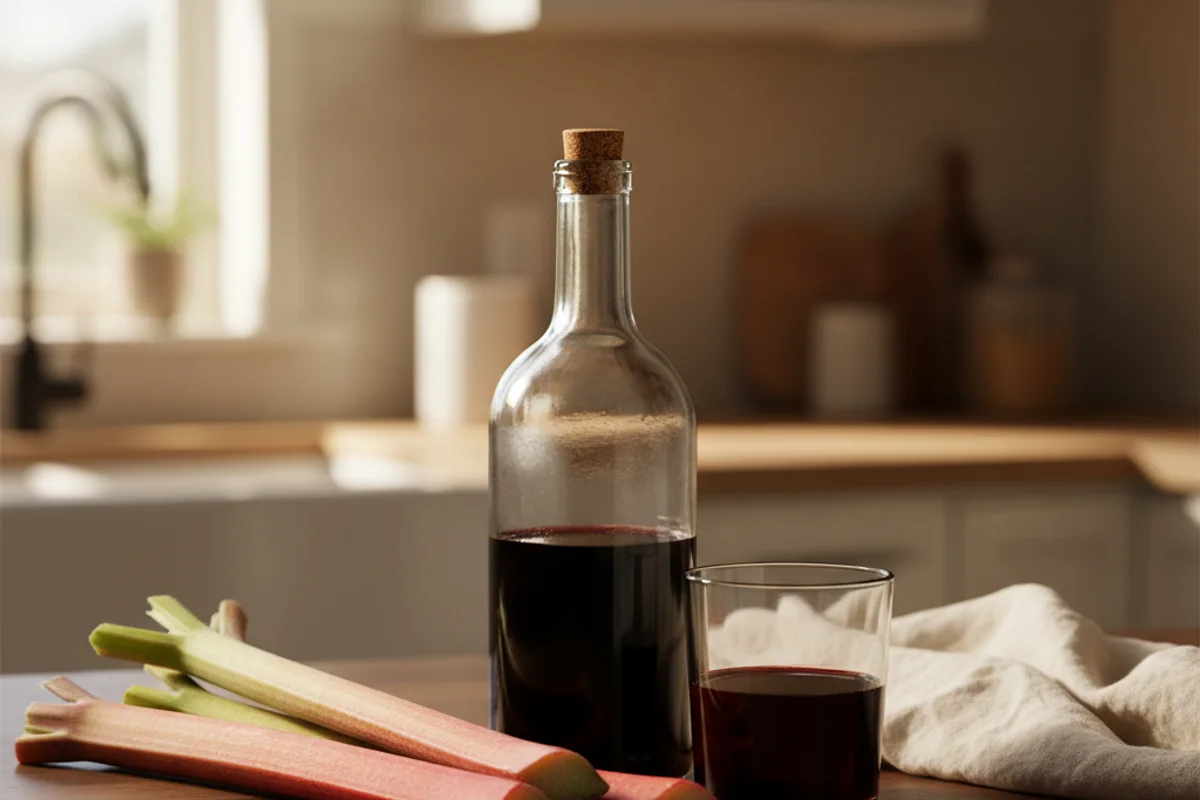
- 6–7 lbs red rhubarb stalks, fresh or frozen, chopped into ½-inch pieces
- 1¾ lbs granulated white sugar
- Juice of 2 large lemons
- Water to reach 1 gallon total volume
- 1 Campden tablet, crushed (sodium or potassium metabisulfite)
- 1 oz precipitated chalk (calcium carbonate; find it at a homebrew shop or online)
- 1½ tsp yeast nutrient
- 1 packet Sauterne wine yeast (or any dry white wine yeast such as EC-1118 or Lalvin 71B)
Method
- Wash and chop the rhubarb into ½-inch pieces, then crush the pieces in your primary fermenter using a sanitized hard object — a clean rolling pin or the bottom of a heavy bottle works fine.
- Dissolve the crushed Campden tablet in 1 gallon of cold water and pour it over the crushed rhubarb.
- Cover the fermenter and let it sit for 3 days, stirring once each day.
- Strain the liquid through a mesh bag or fine strainer, squeeze the pulp firmly to extract as much juice as possible, and discard the solids.
- Return the liquid to the fermenter and stir in the precipitated chalk — it will fizz actively for a minute or two, then calm down.
- Wait 3 hours, then taste the liquid; if it still has a sharp, metallic bite, add another ½ oz of chalk and wait another hour.
- Stir in the sugar (holding back 1 lb if you prefer to feed it in later), lemon juice, and yeast nutrient until the sugar is fully dissolved.
- Cover and let the mixture rest overnight, then pitch the yeast.
- Transfer to a 1-gallon glass jug (secondary fermenter), fit an airlock, and set aside about 1 pint of the liquid in a small bottle sealed with a cotton ball to allow for foam expansion.
- After 5–7 days, once vigorous bubbling slows, top up the jug with the reserved liquid and reseal the airlock.
- Move the jug to a cool spot and wait until the wine begins to clear, then rack it into a clean jug, top up with water or a neutral wine, and refit the airlock.
- Wait at least 2 more months, confirm fermentation has fully stopped, then rack again.
- Cold-stabilize for 30 days if possible (move the jug to a refrigerator or cold garage); if not, just give it the extra 30 days at room temperature before bottling or blending.
Why this works
Rhubarb stalks are loaded with oxalic acid — the same compound that makes your teeth feel chalky after eating raw rhubarb. When you add calcium carbonate (precipitated chalk) to the juice, a simple acid-base reaction kicks off: the calcium ions bind to the oxalate ions and form calcium oxalate, which is insoluble and sinks to the bottom as sediment. You pour it off and leave the problem behind. What remains is a juice with a much more balanced acid profile, dominated by malic and citric acids, which ferment cleanly and age well. The lemon juice adds back just enough acidity to keep fermentation healthy and give the finished wine some brightness.
Notes
Frozen rhubarb works extremely well here — freezing ruptures the cell walls and actually makes juice extraction easier than with fresh stalks. If you can’t find precipitated chalk at a homebrew shop, look for food-grade calcium carbonate online (it’s the same thing). For a 3–5 gallon batch, add ⅛ tsp of wine tannin per gallon along with the other dry ingredients to help the wine age longer.