ROSEMARY WINES
Rosemary is that piney, resinous herb sitting in your spice rack or growing wild in your backyard, and it turns out it makes a genuinely interesting country wine. Think of it as an herbal white — dry, aromatic, and a little savory on the finish, with the white grape juice concentrate lending body and a clean fruit backbone. This is not a sweet fruit wine. It is something closer to a botanical spirit in wine form, the kind of thing you serve slightly chilled with roasted chicken and watch people squint trying to figure out what they’re tasting.
The beginner trap: Using too much rosemary — or steeping it too long — will push the wine from pleasantly herbal into medicinal and bitter, so taste the steep as you go and pull the bag the moment the flavor is where you want it.
Ingredients
Version 1 (Fresh Rosemary)
- 3 cups fresh rosemary leaves, lightly bruised
- 1 can (11.5 oz) Welch’s 100% White Grape Juice Frozen Concentrate
- 1 lb 13 oz granulated white sugar
- 2 tsp acid blend
- ⅛ tsp powdered grape tannin
- 1 tsp yeast nutrient
- 1 Campden tablet, crushed
- 1 packet Montrachet wine yeast (or any dry white wine yeast)
- Water to make 1 gallon
Version 2 (Dried Rosemary)
- 1 cup dried rosemary leaves
- 1 can (11.5 oz) Welch’s 100% White Grape Juice Frozen Concentrate
- 2 lb 6 oz granulated white sugar
- 2 tsp acid blend
- ⅛ tsp powdered grape tannin
- 1 tsp yeast nutrient
- 1 Campden tablet, crushed
- 1 packet Montrachet wine yeast (or any dry white wine yeast)
- Water to make 1 gallon
Method
- Combine sugar with enough water to dissolve it, then bring to a boil, stirring until the sugar is fully dissolved.
- Place rosemary leaves in a muslin straining bag or a tied-off piece of cheesecloth and set it in your primary fermenter (a sanitized food-grade bucket works fine).
- Pour the hot sugar water over the bag; for fresh rosemary, dunk and lift the bag several times, tasting the liquid until the herbal flavor is as strong as you want it.
- For dried rosemary, simply cover the bucket with a clean cloth and let it cool — the dried leaves steep more aggressively, so taste-test periodically and remove the bag when the flavor is right.
- Once the liquid cools to room temperature, add the grape juice concentrate, acid blend, tannin, yeast nutrient, and crushed Campden tablet; stir well to combine.
- Wait 12 hours, then prepare your yeast according to packet directions and add it to the must.
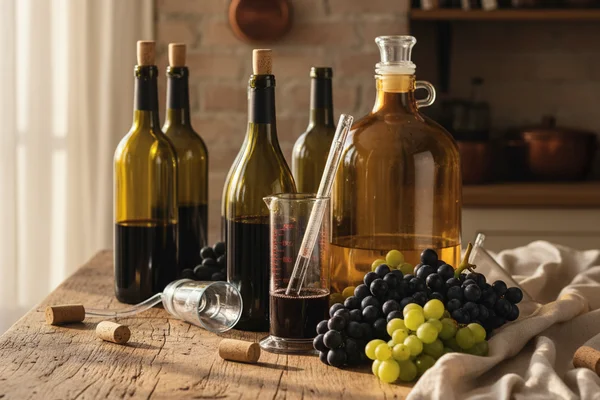
- Cover the fermenter and stir daily; check the specific gravity with a hydrometer and rack to a sanitized 1-gallon glass jug (carboy) when it drops to 1.020 or below.
- Fit an airlock and let the wine ferment for 30 days, then rack again, top up with water to minimize headspace, and refit the airlock.
- Rack every 60 days for the next 6 months, then stabilize with potassium sorbate and potassium metabisulfite and sweeten to taste if desired.
- Wait 10 days after stabilizing, then bottle; age at least 6 months before opening, though the wine will keep improving for up to 2 years.
Why this works
Rosemary’s flavor compounds — mainly borneol, camphor, and rosmarinic acid — are fat-soluble aromatics, which means hot water pulls them out faster than cold water does. That is why you pour boiling sugar syrup over the leaves rather than doing a cold steep. The Welch’s concentrate is not just a shortcut — it adds fermentable sugars, tartaric acid, and grape-derived tannin precursors that give the finished wine structure it would otherwise lack. Without some grape character anchoring it, rosemary wine can finish thin and sharp. The extra sugar in the dried-rosemary version compensates for the concentrate’s lower ratio in that recipe, keeping the starting gravity in the right range for a wine rather than a thin herbal beer.
Notes
Acid blend (a mix of tartaric, malic, and citric acids) is available at any homebrew shop or online — in a pinch, 2 tsp of lemon juice per teaspoon of acid blend is a rough substitute, though results will vary. If you can’t find powdered grape tannin, a very strong cup of plain black tea (brewed and cooled) added to the must provides a similar tannic backbone. Dried rosemary from the grocery store spice aisle works perfectly for Version 2 — no specialty store needed.