SALAL BERRY WINE (1)
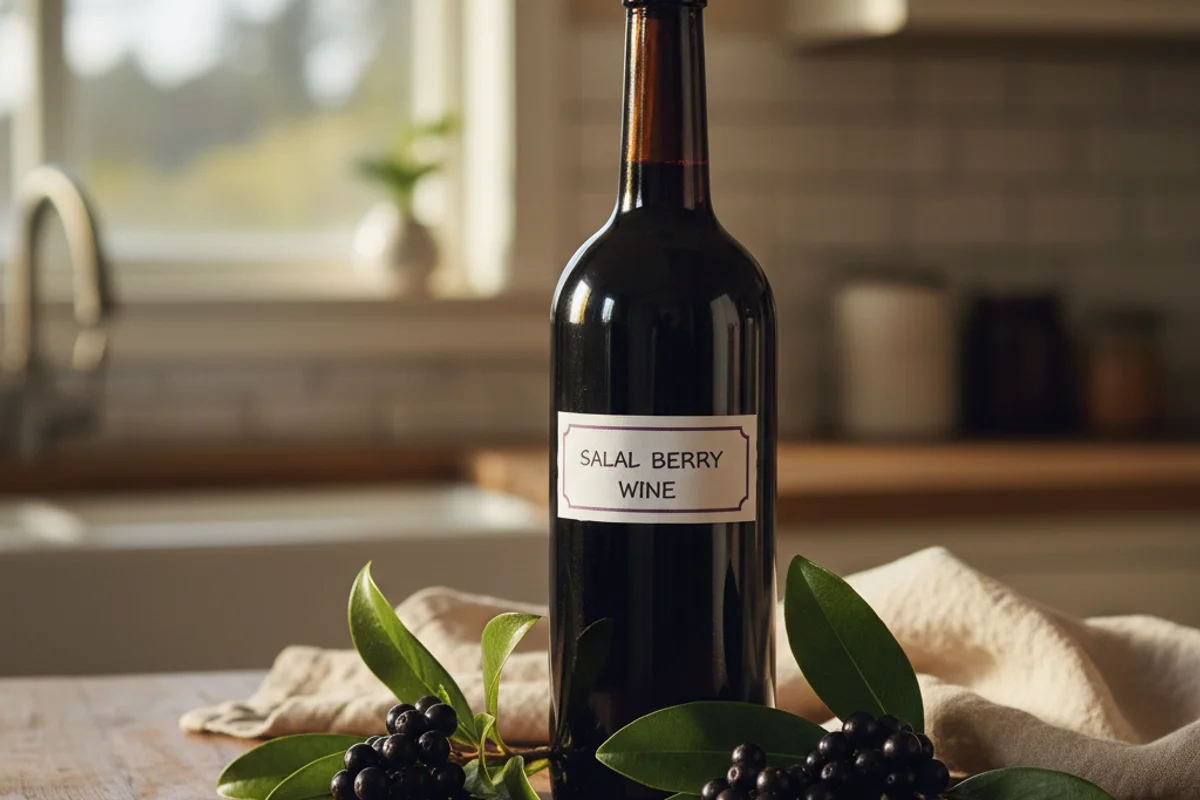
Salal berries grow wild along the Pacific Northwest coast, tucked under towering conifers where most fruit would never survive. They look like blueberries but taste like something in between — earthy, mildly sweet, with a subtle spiced undertone that makes for a wine unlike anything you’ll find on a store shelf. This is a slow, patient wine that rewards careful handling. Give it time and it turns into something genuinely interesting: medium-bodied, softly fruity, with a woodsy depth that pairs well with roasted meats or sharp cheese.
The beginner trap: Skipping the full 24-hour Campden and pectic enzyme wait time before pitching yeast will leave you with a hazy wine that never clears properly.
Ingredients
- 4 lbs salal berries, fresh or frozen
- 1¾ lbs granulated sugar
- 6½ pts (about 3¼ quarts) water
- ¼ tsp acid blend (or 1 tsp lemon juice as a backup)
- 1 tsp pectic enzyme
- 1 Campden tablet, crushed (or ¼ tsp potassium metabisulfite powder)
- 1 tsp yeast nutrient
- 1 packet wine yeast (Lalvin 71B or EC-1118 work well)
Method
- Bring half the water to a boil and stir in the sugar until fully dissolved, then remove from heat.
- Wash the berries and discard any that are unripe, mushy, or damaged.
- Place the berries in a nylon straining bag, tie it closed, and set it in your primary fermenter; mash the berries through the bag.
- Pour the hot sugar water over the berries, then add the remaining cold water to bring the temperature down faster.
- Cover the fermenter with a cloth and let it cool to room temperature.
- Stir in the acid blend, yeast nutrient, and crushed Campden tablet; re-cover and wait 12 hours.
- Stir in the pectic enzyme, re-cover, and wait another 12 hours.
- Activate your yeast according to the packet directions, then add it to the must and re-cover the fermenter.
- Stir the must twice daily until active fermentation slows noticeably, usually around 5–7 days.
- Lift out the straining bag, squeeze it firmly to extract as much juice as possible, then discard the pulp.
- Let the liquid settle overnight, then rack it into a clean secondary fermenter, top up with water if needed, and fit an airlock.
- Rack again at 60 days, top up, and refit the airlock; rack once more when the wine clears completely.
- Move the wine to a cool, dark spot for 4 months, checking the airlock occasionally to make sure it hasn’t dried out.
- Stabilize the wine (potassium sorbate plus a fresh Campden tablet), sweeten to taste if desired, and wait 14 days.
- Rack into clean bottles and enjoy.
Why this works
Salal berries are packed with pectin — the same stuff that makes jam gel. That’s great for jam, but terrible for wine clarity. Pectic enzyme breaks those pectin chains apart, letting the haze drop out so the wine can clear on its own. The two-stage waiting period matters: Campden goes in first to knock out wild yeast and bacteria, and then pectic enzyme goes in 12 hours later because sulfites can deactivate the enzyme if they contact it while still at full strength. Waiting for both stages to finish before pitching your wine yeast gives your chosen strain a clean, competitive environment to take hold and do its job without interference.
Notes
Frozen salal berries work just as well as fresh — freezing actually helps break down the cell walls and releases more juice during mashing. If you can’t source salal berries locally, check Pacific Northwest foraging suppliers or online specialty fruit vendors. Acid blend is available at any homebrew shop; if you only have lemon juice on hand, use 1 teaspoon as a rough substitute, though the results will be less precise.