SALAL BERRY WINE (2)
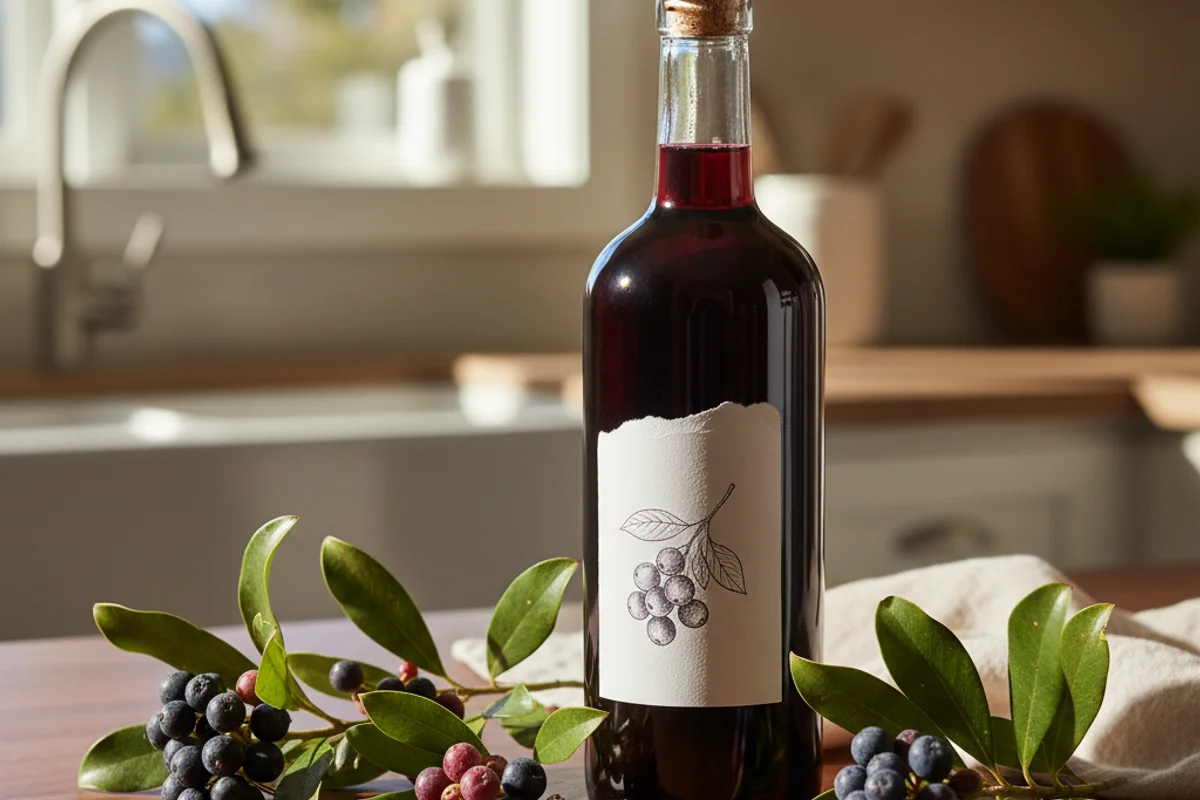
Salal berries grow wild along the Pacific Northwest coast, tucked under forest canopies where they’re easy to walk right past. Don’t. These small, dark blue-purple berries carry a flavor that’s earthy, mildly sweet, and just a little exotic — somewhere between a blueberry and a huckleberry with a hint of something woodsy underneath. That flavor translates beautifully into wine: deep-colored, medium-bodied, and complex enough to keep you thinking about what’s in the glass. This recipe pulls maximum juice and color from the fruit using a simple nylon bag ferment before moving everything into a long, quiet secondary aging phase.
The beginner trap: Skipping the full 24-hour Campden-then-pectic-enzyme waiting period — those two steps need to happen in sequence and on schedule, or you’ll fight haze problems and poor juice extraction later.
Ingredients
- 6 lbs salal berries, fresh or frozen
- 1½ lbs granulated sugar
- 6 pts (12 cups) water
- ½ tsp acid blend (find this at homebrew shops, or substitute 1 tsp lemon juice as a rough stand-in)
- 1 tsp pectic enzyme
- 1 Campden tablet, crushed (or ¼ tsp potassium metabisulfite powder)
- 1 tsp yeast nutrient
- 1 pkg wine yeast (Lalvin EC-1118 or Red Star Premier Blanc work well)
Method
- Wash the berries and discard any that look soft, moldy, or damaged. Load them into a nylon straining bag, tie it shut, and place it in your primary fermenter.
- Mash the berries through the bag with your hands or a potato masher to break the skins open.
- Pour the sugar over the mashed berries, then add the water and stir until the sugar fully dissolves.
- Stir in the acid blend, yeast nutrient, and crushed Campden tablet. Cover the fermenter and wait 12 hours.
- After 12 hours, stir in the pectic enzyme, recover the fermenter, and leave it alone for another 12 hours.
- Activate your yeast according to the packet instructions, then add it to the fermenter and recover.
- Stir the must twice daily for about 7 days, until visible fermentation activity starts to slow down.
- Lift out the straining bag and squeeze it firmly to extract as much juice as possible, then discard the pulp.
- Let the fermenter sit overnight so sediment can settle, then rack the wine into a clean secondary vessel (carboy or jug).
- Top up the secondary to minimize headspace if needed, then fit an airlock.
- After 60 days, rack again into a clean vessel, top up, and refit the airlock. Repeat once more when the wine runs clear.
- Move the wine to a cool, dark spot for 4 months, checking occasionally that the airlock hasn’t dried out.
- Stabilize the wine (add ½ tsp potassium sorbate plus a fresh crushed Campden tablet), sweeten to taste if you’d like, and wait 14 days.
- Rack into bottles and enjoy.
Why this works
Pectic enzyme is the unsung hero here. Salal berries — like most dark berries — contain pectin, a naturally occurring carbohydrate that holds cell walls together. When pectin survives into your finished wine, it causes a stubborn, protein-linked cloudiness that no amount of waiting will fully fix. Pectic enzyme breaks those long pectin chains apart before fermentation really gets going, freeing more juice and color from the fruit and leaving you with a wine that clears cleanly on its own. The reason you add it after the Campden tablet — and wait 12 hours in between — is that sulfite levels are high right after you add Campden, and high sulfites can knock pectic enzyme out of action before it does its job.
Notes
Frozen salal berries actually work great here — freezing ruptures cell walls and speeds juice release during the mash step. If you can’t find salal berries locally, check Pacific Northwest specialty retailers or online foraging co-ops. Blueberries are the closest everyday grocery-store substitute in terms of sugar content and body, though the flavor profile will shift noticeably.