Sand Burrs
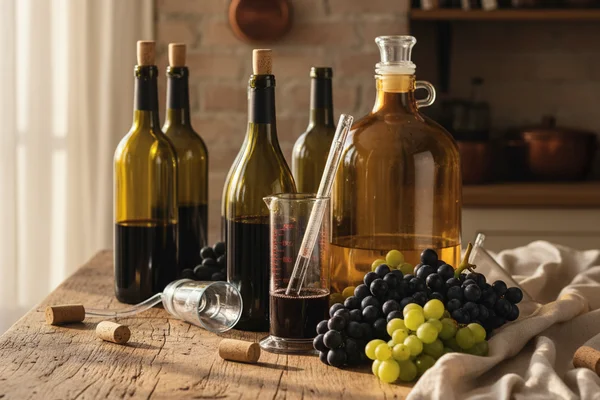
If you’ve ever pulled a sand burr out of your sock with a string of mild profanity, you already know this plant means business. Cenchrus echinatus — the sand burr — is a weedy grass that colonizes lawns, fields, and bare soil across the southern U.S. with ruthless efficiency. Its spiked seed clusters hitch rides on anything that moves. The finished wine, though, is a quiet surprise: light straw in color, clean on the palate, and genuinely good after a year in the bottle. Revenge, it turns out, is best served dry.
The beginner trap: Skipping the full boil time on the burrs — you need the full 15–20 minutes to extract color and what little tannin these seeds carry, so don’t rush it.
Ingredients
- 1 qt (about 4 cups) fresh green sand burr spikelets, stripped from stems
- 1 qt + 6½ pts water (total ~4 qts), divided
- 1¼ lbs (about 2¾ cups) finely granulated white sugar
- 1 can (11 oz) Welch’s 100% White Grape Juice Frozen Concentrate
- 1¼ tsp acid blend (found at homebrew shops; or substitute 1 tsp lemon juice per tsp as a rough stand-in)
- ⅛ tsp grape tannin (or substitute 1 oz strongly brewed unsweetened black tea)
- 1 tsp yeast nutrient
- 1 packet Pasteur Champagne yeast (or any dry champagne/white wine yeast)
- ½ tsp potassium sorbate
- 1 Campden tablet, crushed
Method
- Collect sand burr spikelets while still green and strip them from their stems using a fork. Rinse briefly and place in a saucepan with 1 qt of water.
- Bring to a boil, cover, and cook for 15–20 minutes. Strain out and discard the burrs, keeping the dark green liquid.
- While the liquid is still hot, stir in the sugar, acid blend, grape tannin, and yeast nutrient until fully dissolved.
- Add the frozen grape concentrate and the remaining water. Stir well, cover, and let the must cool to room temperature.
- Activate your yeast according to packet directions, then stir it into the cooled must. Cover the primary fermenter loosely.
- Stir the must once daily for 7–10 days, until the most vigorous bubbling slows down.
- Transfer to a sealed secondary fermenter (glass carboy or food-grade jug), top up to minimize headspace, and fit an airlock.
- Let ferment to complete dryness, roughly 30–45 days. Rack into a clean secondary, top up, and refit the airlock.
- Rack again after 60 days, then once more 30 days after that. The wine should be clearing nicely by now.
- Stabilize by stirring in the potassium sorbate and crushed Campden tablet. Sweeten to taste if desired.
- Wait 30 days, then rack into bottles. Drink after 2 months; cellar for a year if you can stand it.
Why this works
Boiling the burr spikelets does two things at once. It extracts pigment and trace tannins from the plant tissue — giving the wine its pale straw base — and it sanitizes the raw material so wild microbes don’t compete with your chosen yeast. Because the burrs themselves contribute almost no sugar and very little acid, the recipe leans on frozen grape concentrate to build body and a neutral grape backbone, while acid blend and supplemental tannin bring the chemistry into a range where yeast can thrive and the finished wine will actually taste balanced. Potassium sorbate at the end stops yeast from re-fermenting any sugar you add for back-sweetening.
Notes
Sand burrs must be harvested green — once they dry and brown out, the spikelets are far sharper to handle and likely past their prime for extraction. Wear gloves. If acid blend isn’t available locally, most homebrew supply websites stock it for a few dollars; lemon juice is a passable emergency substitute but will shift the flavor slightly. This wine genuinely rewards patience — a full year of bottle aging transforms it from pleasant to remarkable.