Saskatoon Serviceberry Wine
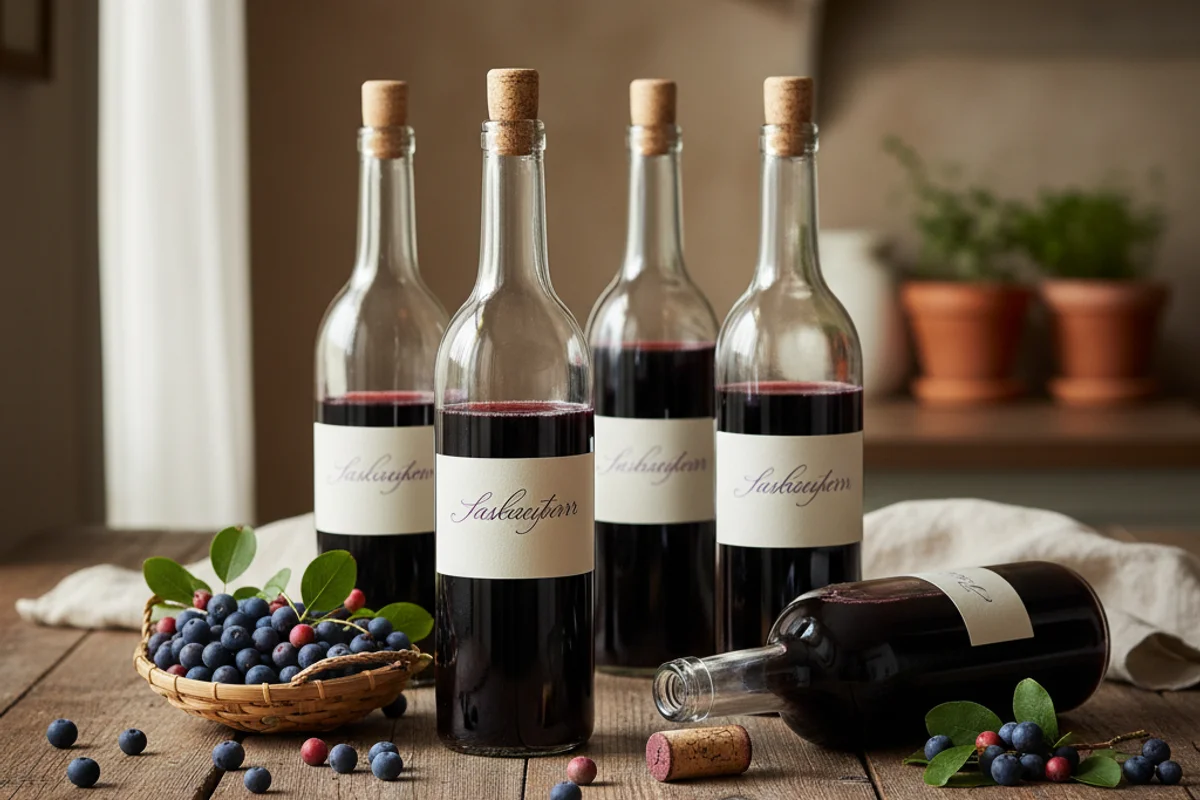
If you’ve never tasted a Saskatoon berry, think blueberry crossed with almond — sweet, slightly nutty, and loaded with deep purple pigment. Amelanchier alnifolia goes dark almost black when fully ripe, and that color tells you everything: anthocyanins, tannins, and enough natural character to build a genuinely interesting dry wine. These three recipes take the same fruit and pull increasingly more from it — fresh-crushed for the first, simmered for a deeper ruby color in the second, and simmered plus raisins for a full-bodied powerhouse in the third. Start with Recipe 1 if you want simple. Go straight to Recipe 3 if you want the best bottle on the shelf.
The beginner trap: Using underripe berries — if they’re still red instead of dark purple or near-black, leave them on the bush another week or the wine will taste thin and sharp.
Recipe 1 — Fresh-Crushed Saskatoon Wine
Ingredients
- 3–4 lbs Saskatoon serviceberries, fresh or frozen, fully ripe
- 2 lbs granulated white sugar
- Juice of 2 lemons (about ½ cup)
- 1 tsp pectic enzyme
- 5 pints (10 cups) water
- 1 Campden tablet, crushed (potassium or sodium metabisulfite)
- 1 tsp yeast nutrient
- 1 packet wine yeast (Champagne yeast pushes alcohol to 16–18%; any wine yeast reaches ~14%)
Method
- Wash, destem, and crush the berries by hand or with a potato masher.
- Combine crushed berries, sugar, lemon juice, water, and crushed Campden tablet in your primary fermenter; stir well until sugar dissolves.
- Cover with a clean cloth and leave in a warm spot (70–75°F); after 12 hours, stir in the pectic enzyme.
- Wait another 12 hours, then pitch the yeast and yeast nutrient; stir to combine.
- Stir twice daily for 5 days, keeping the fermenter covered between stirs.
- Strain the must through a medium-mesh nylon straining bag or fine sieve, pressing gently to release juice; return the liquid to the primary fermenter.
- Re-cover and wait 24 hours; rack (siphon) off the sediment into a clean secondary fermenter and fit an airlock, leaving about 3 inches of headspace for foam.
- Move the secondary to a cooler spot (60–65°F); when vigorous bubbling slows after 10–14 days, top up to within an inch of the airlock with water or reserved juice.
- Ferment 2 more weeks, then rack into a clean secondary; refit the airlock.
- Rack again after 30 days, then once more after another 30 days; bottle when clear.
Recipe 2 — Simmered Saskatoon Wine (Deeper Color)
Ingredients
- 2–3 lbs Saskatoon serviceberries, fresh or frozen, fully ripe
- 2½ lbs granulated white sugar
- Juice of 2 lemons (about ½ cup)
- 1 tsp pectic enzyme
- 5–7 pints (10–14 cups) water
- 1 tsp yeast nutrient
- 1 packet wine yeast
Method
- Wash, destem, and crush the berries; place in a pot and bring just to a low boil, then reduce to a simmer.
- Cover and simmer for 10 minutes; fold the top layer of berries under, re-cover, and simmer another 10 minutes.
- Pour berries into a nylon straining bag (a fine-mesh jelly bag works perfectly) suspended over your primary fermenter; let it drip until the pulp cools completely — do not squeeze yet.
- Dissolve sugar in 3 cups of boiling water; let the syrup cool to room temperature.
- Add the cooled syrup, lemon juice, pectic enzyme, and yeast nutrient to the primary fermenter with the dripped juice; submerge the jelly bag back in.
- Cover well and leave in a warm spot (70–75°F) for at least 10 hours before pitching yeast; stir twice daily.
- When the specific gravity drops to 1.040 (roughly 5 days), gently press the jelly bag to extract the clear juice; discard seeds and spent pulp.
- Rack the liquid into a clean secondary fermenter, top up to about 1 inch below the airlock, and fit the airlock; move to a cooler location (60–65°F).
- Rack after 30 days and again 30 days later; bottle when the wine runs clear.
- Store in a dark place to preserve the deep ruby color; the wine is drinkable at 6 months but improves with age.
Recipe 3 — Simmered Saskatoon Wine with Raisins (Full-Bodied, Best of Three)
Ingredients
- 2–3 lbs Saskatoon serviceberries, fresh or frozen, fully ripe
- 1 lb raisins (plain, no oil coating — check the bag), chopped or minced
- 2½ lbs granulated white sugar
- Juice of 2 lemons (about ½ cup)
- 1 tsp pectic enzyme
- 5–7 pints (10–14 cups) water
- 1 tsp yeast nutrient
- 1 packet wine yeast (Champagne yeast recommended)
Method
- Wash, destem, and crush the berries; simmer as in Recipe 2 (two 10-minute covered simmers), then drip through a nylon straining bag into your primary fermenter.
- Dissolve sugar in 3 cups boiling water and let it cool; set aside ⅔ cup of this syrup for later.
- Chop or mince the raisins and place them in a second nylon straining bag; tie it closed.
- Add the dripped berry juice, the berry jelly bag, the raisin bag, all but the reserved ⅔ cup of sugar-water, lemon juice, pectic enzyme, and yeast nutrient to the primary fermenter.
- Cover and let sit in a warm spot (70–75°F) for at least 10 hours; then pitch the yeast and stir twice daily from that point forward.
- After 5 days, gently press the berry jelly bag to extract clear juice; discard the berry pulp and seeds; re-cover and continue fermenting.
- Ferment 5 more days; then gently squeeze the raisin bag to extract its juice and discard the spent raisin pulp.
- Rack the liquid into a clean secondary fermenter; stir in the reserved ⅔ cup of sugar-water; top up and fit the airlock; move to a cooler location (60–65°F).
- Rack three times at 30-day intervals; bottle when completely clear.
- Store in a dark place; this wine needs at least 9 months before opening, and it gets noticeably better with a year or two of aging.
Why this works
Simmering the berries before fermentation does two things at once. Heat ruptures cell walls more thoroughly than crushing alone, releasing more of those deep anthocyanin pigments — the same compounds responsible for the wine’s dark ruby color and some of its antioxidant character. It also drives off dissolved oxygen, which slows oxidation early in the process. The raisin addition in Recipe 3 isn’t just about body: raisins contribute fermentable sugars, yes, but more importantly they add glycerol precursors and a range of amino acids that give yeast more to work with. The result is a rounder mouthfeel and a more complex finish — essentially a natural body-building trick that winemakers have used for centuries before anyone had a word for it.
Notes
If you can’t find fresh Saskatoon berries locally, frozen ones work beautifully — freezing actually helps break down cell walls, so you may get even better color and juice yield. Saskatoons are also sold as “juneberries” or “serviceberries” at some farmers markets and specialty grocers; blueberries are a reasonable flavor substitute in a pinch, though the almond note will be missing. If you don’t have a nylon jelly bag, a clean pillowcase or several layers of cheesecloth secured with a rubber band work just as well.